
Blue Springs vs Ginnie Springs sounds like a fair fight until you look at a calendar.
For about four and a half months a year, one of them won’t let you in the water at all.
If you’re fitting one into a Florida road trip, the month you go matters more than any ranking.
Here’s the short version.
From mid-November through March, Blue Spring State Park is a manatee refuge first: you watch them from the boardwalk, and nobody swims.
Ginnie Springs keeps its seven springs open to swimmers all year, at off-season prices from November to February.
From April to mid-November both are swimming holes, and honestly, the choice comes down to rules and crowds.
You have plenty of other options, too.
Florida has more large (first- and second-magnitude) springs than any other state, according to the state’s Department of Environmental Protection.
Our natural springs finder lists the ones closest to your town, and there’s a separate guide to Florida’s natural springs in the Panhandle.
A spring day makes a good break from the theme parks, or from the beaches once you’ve sorted out what you can take home from Florida’s shore.
Just don’t expect solitude at either of these two.
And no, neither one is a hidden gem.
Almost every “hidden gem” listicle is describing a place with a two-hour queue, and Blue Spring’s own page warns that visitors may face long lines to enter when it’s busy.
One thing up front: every rule and price below comes from the parks’ own pages, as of early November 2026 (for the state parks and the Forest Service, the newest archived copies, dated November 2025 to October 2026).
I’d still check the park’s page the week you go.
Which Spring Reigns Supreme? Check the Calendar First

Short answer?
Neither one wins all year.
I’d call it a split decision.
In winter, Blue Spring wins for watching and Ginnie wins for swimming.
In summer it’s much closer, and kind of a coin toss.
Ginnie’s seven springs are 72 degrees year-round, and the park is open year-round too, so a January swim there is normal.
It’s cheaper then as well.
Adult day admission is $20 in the off-season (November to February) and $25 from March to October.
Blue Spring runs the other way.
Its manatee season is November 15 to March 31, and during it swimming and every other water activity in the spring run is prohibited.
Reopening can slip if a lot of manatees are still in the spring when winter weather lingers.
The reason is the water.
The spring holds at 72 degrees, and manatees can’t tolerate water colder than 68 degrees for long.
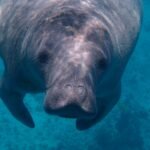
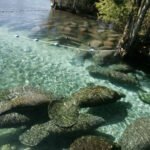
Blue Spring is one of the largest winter gathering sites for manatees in Florida (here’s where else in Florida they live), and the park’s page puts its 2023 count at a record 729.
So in winter you watch from the boardwalk, which runs about a third of a mile from the St. Johns River to the headspring.
Swimming or diving with the manatees isn’t permitted in any season.
From April 1 to November 14, Blue Spring is a swimming hole again, with the same 72-degree water as Ginnie.
That’s when it turns into a fight over rules and crowds.
One note for anglers.
The park says fish abound in the spring run, but fishing there isn’t permitted; you fish from the accessible dock on the St. Johns River instead.
If a really big fish is the point of your trip, that’s more of a Lake Erie question than a spring one.
Which Is Better, Blue Springs or Ginnie Springs? It Depends on Your Day

First, which Blue Springs?
The name covers two parks.
The one most people mean, and the one this post means, is Blue Spring State Park in Orange City, on the St. Johns River (its official name is singular).
The other is Ruth B. Kirby Gilchrist Blue Springs State Park, about five miles west of High Springs off County Road 340, the same road you take to Ginnie.
Gilchrist Blue is the one people pair with Ginnie, since they’re neighbors.
But its page has said since October 29, 2025, that no water activities are available while construction renovations go on.
Check it before you plan a two-spring day.
Getting in turns out to be the biggest practical difference.
Since July 15, 2026, every visitor to Blue Spring needs a day-use reservation, annual passholders included, and people on foot or on bikes too.
You can book up to 60 days ahead, same-day spots last until the limit is hit, and the $6 vehicle fee (two to eight people) is paid online when you reserve.
Ginnie is a private park, open to the public since 1976, and it doesn’t gate entry the same way.
Day passes can be bought online ahead of time, which the park encourages but doesn’t require, and every guest has to complete a waiver.
Day passes stop selling after 3 p.m.
Neither one is quiet on a hot weekend.
Blue Spring says it frequently reaches capacity and may temporarily close, sometimes for several hours.
Ginnie sends day-pass guests to overflow lots on summer weekends.
That’s the line you’re really choosing between.
For a lazy float, Ginnie wins outright.
Frankly, it isn’t close.
Most guests put in at Beaver’s Landing on the Santa Fe River with a tube or raft, float for an hour or so to the Tube Exit at Twin Spring, then walk back on the Tube Trail in about 15 minutes.
Tubes rent at the general store, and there’s a free air fill station if you bring your own.
If swimming is the whole plan, our list of Florida’s top swimming springs has more.
Blue Spring’s swim area is a crystal-clear spring run, and its list of what can’t go on the water is long.
That means coolers (cooler backpacks too), disposable items like plastic water bottles and grocery bags, radios and speakers, tobacco and vapes, and inflatables bigger than 72 inches in both width and length.
Divers have options at both.
Blue Spring allows scuba in designated areas only, for up to 32 divers at a time; open-water divers can’t carry lights or go below 60 feet, and every dive ends an hour before sunset.
Ginnie is known for its caves, like the Devil’s Spring System, where certified cave and cavern divers go, and for the Ginnie Ballroom, a bowl over 100 feet across and 15 feet deep.
A certified diver pays $36 a day there, or $28 with full cave certification.
Comparing clear water around the state?
We’ve also looked at whether the water is clear on Captiva Island.
Leave the dog at home for both.
Ginnie doesn’t allow pets at all, and Blue Spring keeps pets, service animals included, off the water (our dog-friendly springs guide covers where a leashed dog can go).
Ginnie’s other rules: open containers of alcohol only in campsites, no glass in common areas or the river, no lifeguards, adult supervision for kids 15 and under, and no jumping or diving off the decks and banks (or out of trees).
Location might settle it.
Ginnie is in High Springs.
The park says the airport in Orlando is within a two-hour drive, and so are Jacksonville’s and Tallahassee’s, while Gainesville’s is 40 minutes away.
Blue Spring is at 2100 W. French Ave. in Orange City, so put both addresses into your map app before you pick.
My pick, for what it’s worth: I’d book Blue Spring for a winter manatee morning, and I’d drive to Ginnie for anything with a tube or a dive tank, plus any January swim.
That’s it.
Not a close call once you know the month.
What Are Other Natural Springs in Florida Worth Comparing?
If neither one fits, these are the springs that come up next, starting with the one most often compared to Ginnie.
Same rule as above: every detail comes from each park’s own page.
Ichetucknee Springs State Park

Ichetucknee is the state park answer to Ginnie’s tubing.
Eight major springs join to form the 6-mile Ichetucknee River, and Blue Hole, one of them, stays at 72 degrees year-round.
The catch is that you can’t swim anywhere on the river, so you stay on your tube.
You swim or snorkel at the headspring or Blue Hole instead, and the park says Blue Hole is for experienced swimmers only, because of its depth and strong current.
For now, tubers launch from Dampier’s Landing at the South Entrance until 5 p.m., and tube rentals end at 4:30 p.m., because another launch point is closed for repairs.
It fills up, too.
Since May 20, 2026, the park temporarily closes to all visitors when it reaches capacity, even people with rental reservations or digital day passes.
For what lives along the river, see our Ichetucknee wildlife guide.
Gilchrist Blue Springs State Park
This is the other Blue from the section above.
Its main spring is a second-magnitude spring that puts out an average of 44 million gallons of water a day, and it sits along the Santa Fe River, like Ginnie.
While the water is closed, the large pavilion and picnic area are open, and so are the volleyball courts.
That’s a picnic stop, not a swim, until the renovations are done.
Madison Blue Spring State Park
Madison Blue is a first-magnitude spring, about 82 feet wide and 25 feet deep, that bubbles up into a limestone basin on the west bank of the Withlacoochee River.
The park’s own page says USA Today voted it the No. 1 swimming hole in the country.
That popularity has a cost.
The park says it closes frequently between 10 a.m. and 3 p.m. on weekends and holidays when it hits capacity, though it may reopen later that day.
It’s a cave-diving spring as well, so expect to share it with divers.
Rainbow Springs State Park

Rainbow’s flow is the fourth highest of all the springs in Florida, and like Blue Spring it now takes visitors by reservation only.
Parking is limited while renovations run through February 4, 2027.
The swim area runs 10 to 18 feet deep at about 72 degrees year-round, and no inflatables (tubes and rafts included) are allowed in it.
Tubing isn’t allowed at the headsprings at all; it runs from a separate entrance on S.W. 180th Avenue Road, seven days a week from Memorial Day to Labor Day.
The walkways pass three human-made waterfalls, left over from the days when the land was a mining operation and then a privately owned tourist attraction.
If old Florida attractions interest you, Homosassa Springs has a story of its own.
Juniper Springs Recreation Area

Juniper Springs is a Forest Service site in the Ocala National Forest, between Ocala and Ormond Beach on SR 40, built by the Civilian Conservation Corps in the 1930s. The spring is a clear pool, shallow at one end and deep enough to jump into at the other.
Paddlers come for Juniper Run, a narrow, winding waterway under old-growth forest with a take-out near SR 19.
The rules are pretty strict: no wading or fishing in the spring or runs, and no pets or alcohol in the day-use area.
The campground has 79 sites, and the boardwalk area is closed for renovations.
Edward Ball Wakulla Springs State Park
Wakulla is the one to pick near Tallahassee.
Swimming is allowed only in the designated area near the spring, where you can jump from a 22-foot dive and observation tower into 69-degree water.
Scuba isn’t allowed in the spring itself.
The river boat tour is the other reason to go: 45 to 55 minutes on a 2-mile loop downstream and back, $8 for adults and $5 for kids 3 to 12.
Manatees are most common in the river and spring from October through January, but the park says you can’t count on seeing one.
So, pick by month first and park second.
I mean it.
Whatever you pick, read its page the week you go, because Blue Spring’s reservation rule only began in July 2026, and rules like that keep changing.