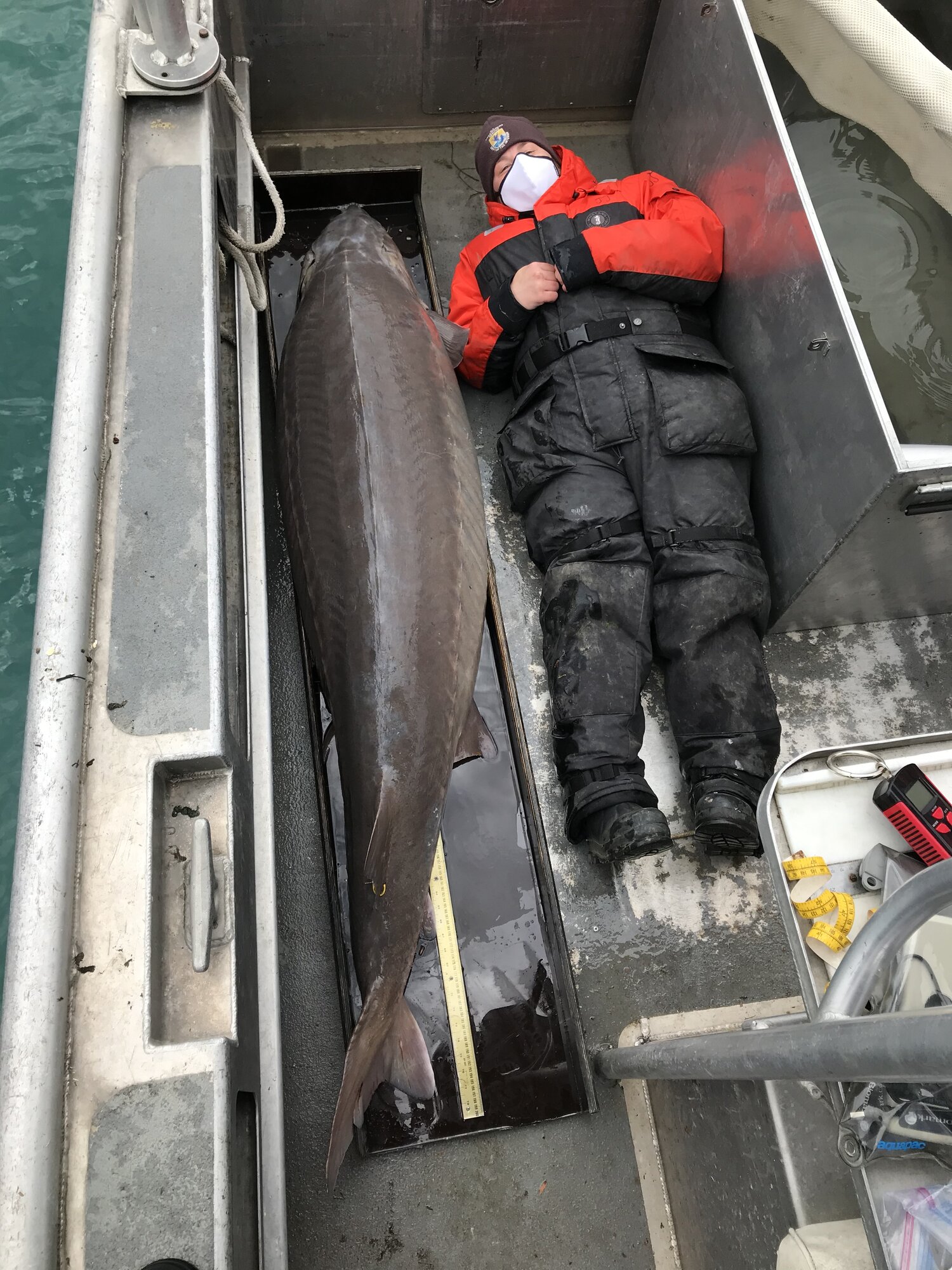

The largest fish in Lake Erie is the lake sturgeon.
One usually runs 4 to 6 feet long (sometimes up to 8) and 50 to 100 pounds, and the species can top 300 pounds.
Ohio’s heaviest on record came out of Lake Erie in 1929 and weighed 216 pounds.
Now the part the fish fry crowd won’t like: you can’t keep one.
In Ohio the lake sturgeon is a state endangered species, and if you hook one, it goes straight back into the water it came from.
So the big fish you’ll actually see on a cooler lid is something else.
Of the eight Lake Erie fish in Ohio’s 2023 Fish Ohio tally, the longest catch was a 38-inch channel catfish, and walleye had the most entries.
If you’re new to the lake itself, start with whether Lake Erie is man-made or natural, or how its waves compare with the ocean’s.
Rules change every season, so I’d check Ohio’s current fishing regulations before you go.
The Largest Fish in Lake Erie Is the Lake Sturgeon

A U.S. Fish and Wildlife Service crew pulled a 240-pound, 6-foot-10 female out of the Detroit River in the spring of 2021, put her age at more than 100 years, and let her go.
The Detroit River runs into Lake Erie’s west end, and the St. Clair and Detroit rivers hold one of the lake’s two remaining wild spawning stocks.
Lake sturgeon are slow at everything: females mature at 20 to 25 years and spawn only once every four to seven years.
The species can live to 150, though most live 40 to 50 years, and no other Lake Erie fish lives longer.
Don’t expect it to look like a sport fish, either.
No scales.
Bony plates run down the back and sides, and a tube of a mouth sits under the snout with four barbels in front of it.
They eat mostly mussels and snails off the bottom.
My favorite detail: “sturgeon” means “the stirrer,” for the way they stir up mud looking for food.
Keeping a Lake Erie Sturgeon Is Illegal in Ohio

Ohio’s 2026–27 fishing regulations put the lake sturgeon on the state endangered list.
If one bites, it must go straight back into the water it came from, and it’s unlawful to take or possess sturgeon from Lake Erie or any of its tributaries.
If you fish another state’s or Canada’s side of the lake, check its rules; in New York’s waters the lake sturgeon is listed as threatened.
Lake Erie once held an estimated 294,000 to 1.1 million adult sturgeon.
Commercial fishermen first killed them as a nuisance that tangled nets, then sold them.
Unregulated harvest in Lake Erie peaked at 2.3 million kilograms (about 5 million pounds) in 1885, fell 80% within a decade, and by 1920 was under 2,300 kilograms a year.
Dams that blocked their spawning rivers made it worse, and so did silt and pollution.
Today the lake has two self-sustaining spawning stocks left, in the upper Niagara River and the St. Clair and Detroit rivers, down from 19.
Ohio’s own waters show no sign of one.
So Ohio is stocking them.
The Maumee River has gotten 3,000 young sturgeon a year since 2018, planned through at least 2038.
Stocking in the Cuyahoga started in 2025 at 1,500 a year through 2045, and the Sandusky started at 750 a year the same year.
Stocked fish in the Maumee usually reach Lake Erie within a few weeks.
If you see a sturgeon in Ohio, the state’s lake sturgeon page links a reporting tool for it.
The Biggest Lake Erie Fish You Can Actually Keep

For fish that end up in your cooler, Ohio’s Fish Ohio program is a good yardstick.
Anglers enter catches over a set length for each species, and Ohio’s wildlife division published the longest catch reported in 2023 for eight Lake Erie species:
| Fish (Lake Erie entries, 2023) | Longest reported catch |
|---|---|
| Channel catfish (687) | 38 inches |
| Freshwater drum (810) | 36 inches |
| Steelhead (115) | 35 inches |
| Walleye (1,073) | 34 inches |
| Largemouth bass (78) | 24½ inches |
| Smallmouth bass (152) | 23¾ inches |
| White bass (247) | 19 inches |
| Yellow perch (324) | 15½ inches |
On that list, a channel catfish took 2023 by length.
Walleye took it by numbers, with more entries than any other fish there.
Ohio’s state records go by weight and cover the whole state, not Lake Erie alone.
Walleye stands at 16.19 pounds (1999), channel catfish at 37.65 (1992) and yellow perch at 2.86 (2016).
Walleye and yellow perch are the lake’s two economically important fish, fished hard by sport anglers and Canadian commercial fishermen alike.
If your Lake Erie trip is booked around the islands, our Put-in-Bay and Kelleys Island ferry planner shows you every boat, the fares and the last one back.

🗼 I Wrote a Book About My Japan Travel Catastrophes!
Before I landed in Tokyo, I thought I was the “Final Boss” of international travel. Spoiler alert: I WASN’T. 😅
🚅 I boarded the wrong Shinkansen and ended up in THE WRONG CITY. I confused locals with my “expert” bowing that was more awkward than accurate. I accidentally stumbled into a high-stakes Kendo practice thinking it was a tourist show. Sound like something you’d do?
“Things I Wish I Knew Before Going to Japan” is your shortcut to avoiding ALL my cringe-worthy mistakes. ✨ Inside, you’ll find practical, LIFE-SAVING tips on etiquette, transport, money, and hidden gems that will save you time, money, and a whole lot of confusion.
Which Fish Live in Lake Erie

Plenty.
New York Sea Grant counts over 120 species, from minnows and shiners up to big predators like lake trout and muskellunge, and calls Erie the most productive of the Great Lakes.
It’s also the smallest by volume, the shallowest and the warmest.
Ohio’s steelhead are stocked rainbow trout, native to the western U.S., that move between the lake and its rivers.
The state stocks 450,000 a year as 7- to 9-inch yearlings in April and May, into seven tributaries, the Vermilion River and Conneaut Creek among them.
You catch them in the lake May through September and in the rivers fall through spring.
Lake Erie has a past of its own (why it got called a dead lake), and it isn’t Ohio’s only big water: see the five largest lakes in Ohio, or try the Little Miami River for fishing and kayaking on a river instead.
Farther from Ohio, the site also covers whether Florida’s St. Johns River is fresh or salt water, the deepest freshwater lake in Florida and the longest free-flowing river in the US.
Sharks in Lake Erie: None on Record

No sharks.
In 2022 a video claimed bull sharks had been documented in the Great Lakes, and PolitiFact rated that False: there’s no documented case of a bull shark in the Great Lakes.
Getting here wouldn’t be easy, either.
Bull sharks have swum up the Mississippi as far as St. Louis, but locks and dams, plus an electric barrier on the Illinois River, would make the rest of the trip next to impossible, even for a bull shark.
For the boat version of that trip, here’s whether you can drive a boat from Lake Erie to the ocean.
Want sharks?
You want salt water; here’s when Florida has the most of them, or farther south, whether great whites swim in the Caribbean.
Jellyfish in Lake Erie: Tiny and Harmless

Craspedacusta sowerbii, the freshwater jellyfish, turns up in still and slow water across North America, from ponds to big rivers and lakes.
It’s typically about the size of a penny; its bell runs 5 to 25 millimeters, a fifth of an inch to an inch.
It isn’t native.
It comes from China’s Yangtze River.
It has been recorded in 44 states, and in watersheds that drain to Lake Erie in both Ohio and New York.
I wouldn’t plan a trip around seeing one.
The jellyfish stage turns up only sporadically, a spot can go several years between blooms, and blooms seem to need water of at least 25°C (77°F), so they’re most common in summer and fall.
Our Great Lakes water temperature tool shows you how warm Erie runs by month.
And no, it won’t sting you.
Freshwater jellies pose no danger to humans and are too small to sting larger animals, and their stingers likely can’t even get through human skin.
How Often You Can Eat Lake Erie Fish

Lake Erie fish is safe to eat, in moderation.
Ohio’s Department of Health puts yellow perch at two meals a week, and walleye and most other fish at one meal a week, in its sport fish advisory.
A few Lake Erie fish carry tighter limits because of PCBs.
You’re at one meal a month for channel catfish, freshwater drum, lake trout, smallmouth bass, steelhead, white bass, whitefish 21 inches and up, and carp from 19 to 27 inches.
Carp 27 inches and longer drop to one meal every two months.
Brown bullhead is one a month, for mercury.
Children under 15, pregnant women and women planning a pregnancy can have one serving a week unless the advisory’s table says otherwise.
It’s updated every year, so check the current advisory before your fish fry.
If I were cooking a Lake Erie catch, I’d start with perch, since two meals a week is the loosest limit on the list.
So the biggest fish in the lake is the one you have to let go, and the one you take home is a walleye or a perch.
Fair trade.
Related read: The Caribbean Travel Guide — Instant PDF + Kindle download. Secure checkout by Stripe