
Worry?
No. Pay attention?
Yes.
Here’s the part you can’t wish away.
Florida has about 1.3 million alligators, in all 67 counties and in practically all fresh and brackish water bodies, and occasionally in salt water.
And here’s the part that should calm you down.
Over the last 10 years, Florida averaged 8 unprovoked bites a year serious enough to need professional medical treatment.
A Florida resident’s odds of being seriously hurt that way are roughly one in 3.1 million.
From 1948 to 2022 there were 453 unprovoked bites, 26 of them fatal.
Rare, then.
Not zero.
Should I Worry About Alligators in Florida?

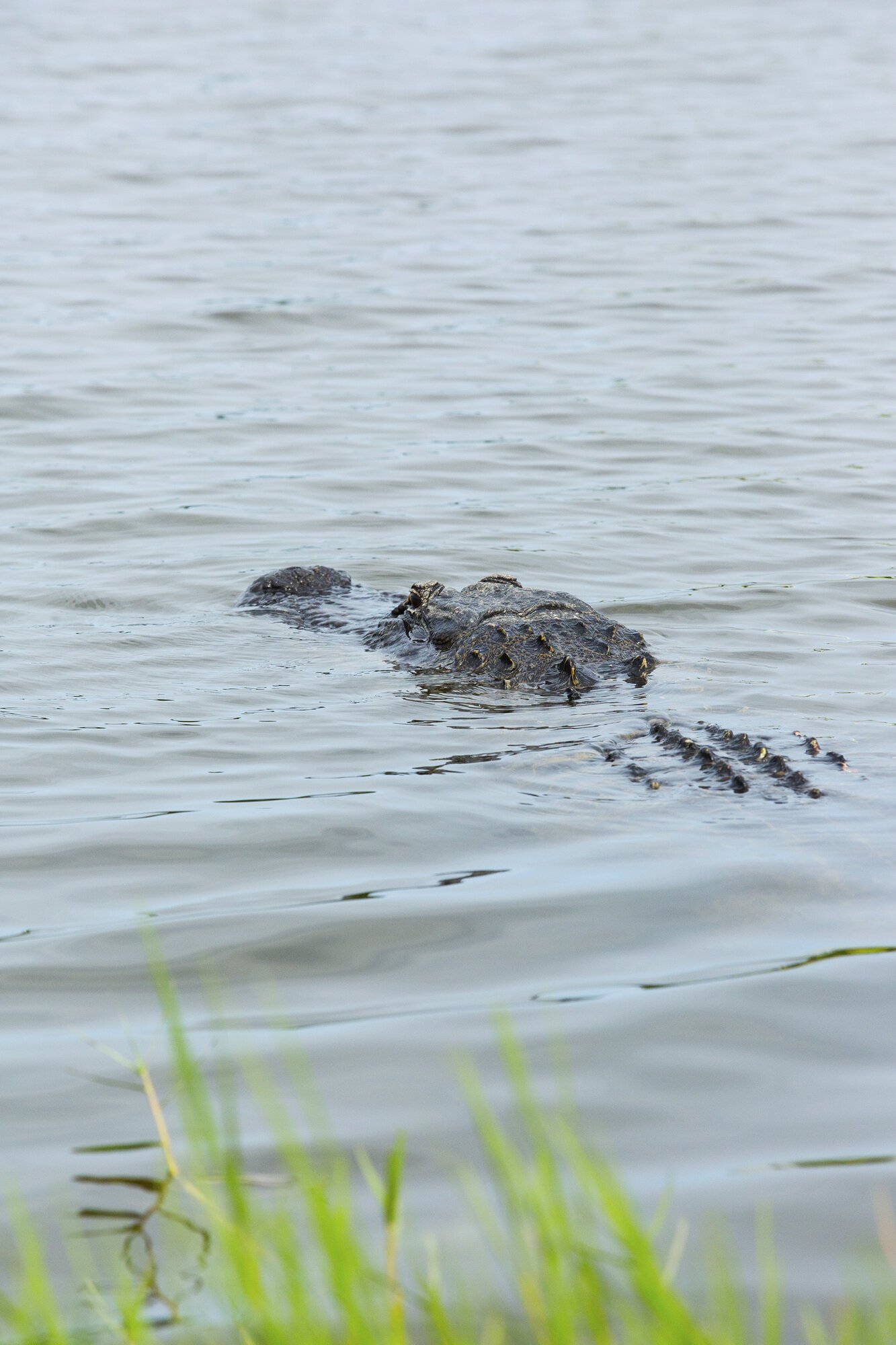
Start with this rule: because alligators can be found in nearly any waterbody in Florida, it’s safest to always assume they’re present.
Lake, pond, canal.
Assume.
Then think about the clock.
Alligators are most active between dusk and dawn, so swim only in designated swimming areas during daylight hours.
On a trip, that one’s easy.
Then the edge of the water.
They can lunge at prey within a few feet of the shoreline.
In the Everglades, stay at least 15 feet back, and if an animal is hissing, you’re too close, even if it’s more than 15 feet.
The water’s edge is where I draw the line.
And never feed one.
Most alligators are naturally afraid of people, but they may lose that fear once people feed them.
Illegal feeding gets most of the blame when alligators attack people.
In Florida, feeding them is illegal.
Full stop.
It comes up more now because more of us live near the water.
Population growth and waterfront homes can mean more frequent run-ins with alligators.
Here’s one town on the coast: are there alligators in Fort Pierce, Florida.
If one really does look like trouble, call the Nuisance Alligator Hotline at 866-FWC-GATOR (866-392-4286).
Generally, an alligator counts as a nuisance if it’s at least 4 feet long and you believe it’s a threat to people, pets or property.
Which Part of Florida Is Famous for Its Alligators?

Depends what you mean by “famous.”
If you mean record holders, there are two.
The heaviest, a 1,043-pound male that was 13 feet 10½ inches long, came from Orange Lake in Alachua County.
The longest, a 14-foot 3½-inch male, came from Lake Washington in Brevard County.
Alachua County is also home to Paynes Prairie, south of Gainesville, and these are its gator spots.
If you meant “most,” not “famous,” here’s what part of Florida has the most alligators.
The University of Florida in Gainesville
UF has its own gator lake on campus, Lake Alice.
The bigger draw is Paynes Prairie Preserve State Park, south of town, the state’s first preserve, set aside in 1970.
It covers nearly 23,000 acres, with over 30 miles of trails.
Alligators are commonly seen there, and so are sandhill cranes and bald eagles.
If you care about the cranes as much as the gators, see what time of year is best to bird Florida.
La Chua Trail, Gainesville, Florida
You’ll find abundant wildlife here, including alligators and migratory sandhill cranes.
It runs from the prairie’s north rim to the cove, with views over wet prairie that includes the Alachua Sink.
You’ll find the main access at 4270 SE 15th Street.
It opens at 8 a.m. every day and closes one hour before sunset for safety and wildlife disturbance reasons.
Foot traffic only.
No pets.
Got small kids with you?
Keep them on the boardwalk the whole time, and off the open, grassy trail.
Two small catches.
It’s a little over half a mile by the park’s count, though some call it a 1-mile round trip.
Also, in a drought, plants can limit wildlife viewing until a wetter rain cycle brings the water and the gators back.
From November through March, there are ranger-led hikes on most Saturdays, many of them on La Chua.
If it’s your first time, I’d do it that way.
Lake Alice, Gainesville, Florida
It’s a small lake on the UF campus that takes in most of the main campus’s stormwater.
It’s one of the few areas in incorporated Gainesville where you can see live alligators, and it has Florida softshell turtles too.
On the north side, a boardwalk leads you through the woods and swamp to a viewing platform.
Stay for the evening if you can.
UF’s two bat houses sit at its Field and Fork Farm and Gardens, on the north side of Museum Road across from the lake.
The colony runs to an estimated 450,000 to 500,000 bats, and you’re welcome to watch them come out in the evenings, seven days a week.
Lake Wauburg, Gainesville, Florida
Lake Wauburg is a 300-acre lake inside Paynes Prairie.
You can fish it (bass and bream are regular catches, and so is speckled perch) or canoe it, from a public boat ramp on the east side.
UF RecSports also runs a lake recreation area there, 8 miles from campus, with boating and swimming.
Day passes and guest entry are available.
Assume gators are present here like anywhere else, and swim only where it’s marked for swimming, in daylight.
Sweetwater Wetlands Park, Gainesville, Florida
Sweetwater is more than 125 acres of wetlands and ponds, built to improve the water quality of Paynes Prairie’s wetlands and the Floridan Aquifer.
You get more than 3.5 miles of crushed gravel trails and boardwalks.
Over 260 bird species call it home, and so do alligators.
It’s open 7 a.m. to sunset daily.
Parking is $5 per car, or $2 a head if you come on foot or by bike, in exact change or through the Passport Parking app.
Bikes stay at the rack.
Pets aren’t allowed, because of potential conflicts with wildlife, and drones aren’t either.
Where to See Wild Alligators in South and Southwest Florida

Anhinga Trail, Everglades National Park, Homestead, Florida
The Anhinga Trail is famous, and for once that’s not hype.
It’s a self-guiding pavement and boardwalk trail through sawgrass marsh and freshwater slough, 0.8 miles round trip and wheelchair accessible.
You may see alligators and turtles there, plus anhingas and many other birds, especially during the winter, when lower dry-season water crowds the wildlife into the slough.
So if you’ve booked a winter trip south, this is the easy one.
Leave the dog at home for it, though: pets aren’t allowed on any trail in the park, boardwalk, paved or unpaved.
Where pets are allowed, your leash can’t be longer than 6 feet.
The 15-foot rule applies here, and so does the hissing rule.
Feeding or harassing an animal, including throwing things at it, is a criminal offense that carries a fine.
In Southwest Florida, J.N. “Ding” Darling National Wildlife Refuge, on the barrier island of Sanibel off the southwest coast, is a place to see crocodiles, not alligators.
Not sure what counts as South Florida in the first place?
Here’s where South Florida starts.

🗼 I Wrote a Book About My Japan Travel Catastrophes!
Before I landed in Tokyo, I thought I was the “Final Boss” of international travel. Spoiler alert: I WASN’T. 😅
🚅 I boarded the wrong Shinkansen and ended up in THE WRONG CITY. I confused locals with my “expert” bowing that was more awkward than accurate. I accidentally stumbled into a high-stakes Kendo practice thinking it was a tourist show. Sound like something you’d do?
“Things I Wish I Knew Before Going to Japan” is your shortcut to avoiding ALL my cringe-worthy mistakes. ✨ Inside, you’ll find practical, LIFE-SAVING tips on etiquette, transport, money, and hidden gems that will save you time, money, and a whole lot of confusion.
Alligator Reproduction Through the Year

Spring first.
Courtship begins in early April, and mating happens in May or June.
As the weather warms and mating season approaches, alligators can become more active and visible.
That’s when you’ll likely notice them more.
Then the nest.
A female builds a mound of soil, vegetation or debris, about 3.5 feet high and twice as wide when it’s finished.
She picks a spot above the water level, because flooding kills most eggs within 12 hours of going under.
Eggs go in late June or early July: an average of 32 to 46, with 38 as the average clutch.
Incubation takes roughly 58 to 68 days, and hatching runs from mid-August through early September, and the female stays near the nest while the eggs incubate.
Temperature decides the sex.
Eggs at 90 to 93°F hatch as males, eggs at 82 to 86°F hatch as females, and in between you get a mix.
Then she carries 8 to 10 hatchlings at a time in her mouth down to the water.
Her young stay in pods near her, usually for up to a year and sometimes two or three.
Their odds are brutal.
About a third of nests are lost to predators, mainly raccoons, or to flooding.
A nest that survives gives an estimated 24 hatchlings, and only 10 live to their first birthday.
For adults, the biggest killers are probably cannibalism, fighting each other and hunting by humans.
What it means for you: in late summer, a gator sitting near a mound may well be a mother on guard.
When danger threatens, she’ll rapidly return to the nest to protect her eggs.
Give nests and baby gators plenty of room.
Frequently Asked Questions

A few things people ask once they’ve decided to go anyway.
Do Alligators Eat Dogs in Florida?

They can, and your dog is at more risk than you are, because dogs resemble the natural prey of alligators.
Even the sound of dogs barking and playing may draw an alligator over.
Near the water, keep pets on a leash and away from the edge, and never let them swim in fresh or brackish water.
Even a short dip to cool off or play can result in your pet’s death.
In the Everglades, alligators may see small dogs as prey, and all trails are closed to pets, boardwalk, paved and unpaved.
La Chua and Sweetwater don’t allow pets at all.
Where dogs are welcome, keep yours close.
Paynes Prairie allows well-behaved dogs on a six-foot hand-held leash on the paved Gainesville-Hawthorne State Trail, not on La Chua.
Where Are the Most Crocodiles in Florida?

Down at the bottom of the state.
Two crocodilians are native to the US, the American alligator and the American crocodile, and south Florida is the only place where both live side by side.
American crocodiles live in coastal areas throughout the Caribbean, and south Florida and the Keys are the northern end of their range.
(Whether Florida itself counts as part of the Caribbean is its own question.)
Look in brackish and salt water, in the ponds and creeks of mangrove swamps.
You won’t find many.
Listed as endangered in 1975, they’ve come back from a few hundred to as many as 2,000 adults, and they’re now classified as threatened.
They’re a shy and reclusive species.
One that splashes away loudly is frightened, not charging.
Want to see one?
Try Everglades National Park and Biscayne National Park, plus Ding Darling.
Ding Darling is on Sanibel Island, so here’s how to spend a day on Sanibel.
Do Alligators Get Hit by Cars in Florida?

Yes, it happens.
In March 2022, a 59-year-old Hillsborough County man died after his car struck an 11-foot alligator lying in the road.
It happened around 12:30 a.m. on C.R. 672 in Lithia, and the car overturned into a ditch.
The gator died too.
Vehicle strikes are among the threats to crocodiles, too.
Spring is when I’d watch the road.
In April 2020, Manatee County deputies took a 9-foot, 2-inch male off a county road after it was spotted being aggressive with traffic, and moved it to an alligator farm.
It was gator mating season, when they can be more mobile and aggressive than usual.
Paynes Prairie shows how big the road problem can get, though not for gators alone.
So many animals were killed on the highway across the prairie that the Florida Department of Transportation built a barrier wall with culverts.
In the year after it went in, 158 dead animals turned up, not counting treefrogs, in the same stretch where 2,411 road kills were recorded in the 12 months before.
Alligators were recorded using five of the culverts.
If one’s on the road in front of you, give it room and let it cross.
Don’t try to move it yourself.
Only properly trained and permitted people should handle wildlife, and the hotline is 866-FWC-GATOR.
Sources
- Florida Fish and Wildlife Conservation Commission
- National Park Service
- Florida State Parks
- City of Gainesville
- Visit Gainesville
- University of Florida
- Gainesville Clean Water Partnership
- US Geological Survey
- Conservation Evidence
- Orlando Weekly
- Fox 13
Sources checked early November 2026.
Related read: The Caribbean Travel Guide — Instant PDF + Kindle download. Secure checkout by Stripe