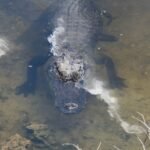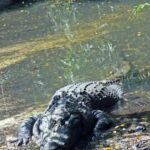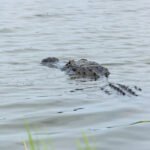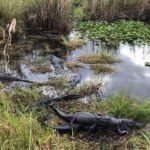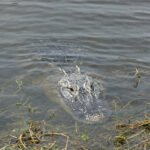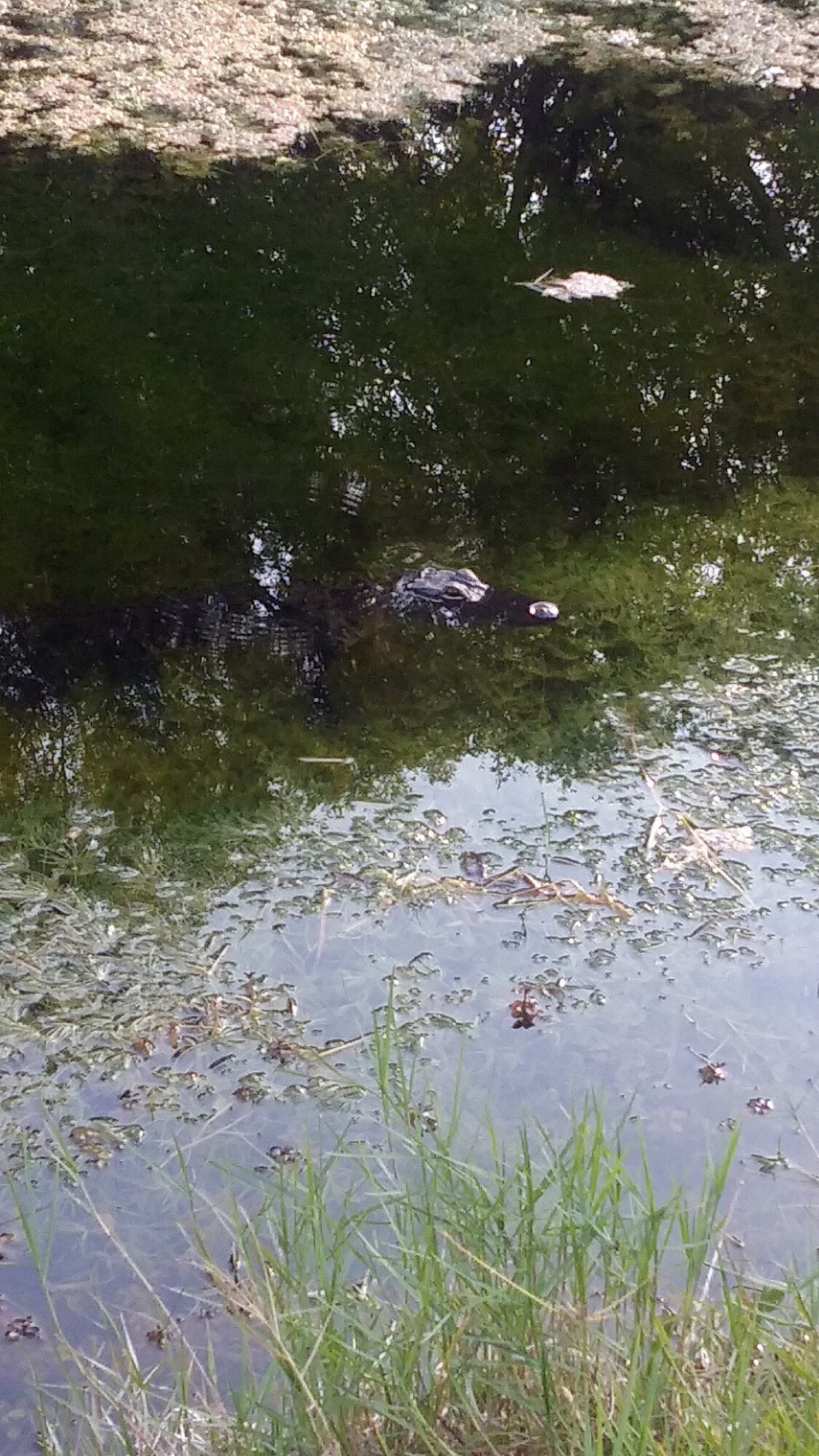

Yes.
Fort Pierce has alligators, same as the rest of Florida.
They’re found in all 67 counties, about 1.3 million of them statewide.

Where they live matters more than how many there are.
Alligators turn up in practically all fresh and brackish water, and only occasionally in salt water.
So think ponds and canals.
Marshes too.
The ocean side of town is mostly a rip-current question, not a gator question.
Bites are rare.
Florida averaged eight unprovoked bites a year from 2012 to 2022 that were serious enough to need professional medical treatment.
Rare isn’t never, though.
In February 2023 an 85-year-old woman was killed by an alligator at a retention pond in a community near Fort Pierce.
More on that further down.

Alligator Alley isn’t a region at all.
It’s a road, the I-75 toll road with a Collier County fire station at mile marker 63.
Are There Alligators in Fort Pierce, Florida?

Yes.
For a look at their kind of water, your best start is Savannas Preserve State Park, at a Port St. Lucie address.
It protects a piece of the basin marsh that once stretched throughout South Florida, before rapid suburban growth.
Even there, the park’s volunteer kayak tour is mostly wading birds and turtles, frogs too, and only on the rare occasion alligators.
Turns out seeing one is luck, not a schedule.
Closer to home is where it gets more real.
In 2018 Fort Pierce Police trapped a 9-foot alligator in someone’s backyard, and the department had recently answered five calls about nuisance alligators.
In 2023 the fatal attack happened at a retention pond in a 55-plus community near Fort Pierce.
That shouldn’t surprise anyone.
Bites on people have happened in all kinds of water, much of it small and not regularly used by alligators.
The neighborhood pond counts.
If you want the statewide version of this answer, here’s whether you should worry about alligators in Florida at all.
Where to Spot Alligators Around Fort Pierce

Look at fresh water, and look at the edges.
Alligators prefer fresh water, though you’ll find them in brackish water too.
They also have to bask on land to warm their bodies in the morning.
So scan the banks, not just the water.
Temperature matters too.
Alligators are most active between 82 and 92 degrees Fahrenheit, stop feeding below about 70, and go dormant below 55.
They’re also most active between dusk and dawn, which is exactly when you shouldn’t be wandering along a dark pond.
If you want an organized try, the Savannas kayak tour runs every Friday and Saturday at 8 a.m., plus Sundays in season.
It isn’t a walk-up thing.
You book it by calling the education center at 772-398-2779, and park admission applies.
Same number for the park’s guided hikes.
Whatever you do, watch and photograph them only from a safe distance.
So bring a zoom lens.
That’s pretty much the whole trick.
Alligator or Crocodile? Spotting the Difference

On this coast it’s worth knowing.
American crocodiles mostly live in south Florida, in brackish and salt water, but they’ve recently moved northward within their range and even inland into freshwater areas of southeast Florida.
Here’s the quick way to tell them apart:
- Color: crocodiles are grayish green; alligators are black.
- Teeth: on a crocodile, the fourth tooth on the lower jaw shows when its mouth is closed; on an alligator, only the upper teeth show.
- Snout: a crocodile’s is narrow and tapered; an alligator’s is broad and rounded.
- Young: baby crocodiles are light with dark stripes; baby alligators are dark with yellow stripes.
On habitat, crocodiles stick to brackish and salt water, and occasionally fresh water inland along the southeast coast’s canals.
And crocodiles are the rarer animal.
By one state count, their numbers have gone from less than 300 in 1975 to more than 2,000 adults, and they’re now classified as threatened.
They’re shy and reclusive, too.
If one splashes into the water when you show up, it’s frightened.
If one sits with its mouth open, that’s called gaping.
It’s about regulating body temperature and doesn’t mean the crocodile is acting aggressively.
For the far south end of their range, here’s more on the crocodiles in the Keys.

🗼 I Wrote a Book About My Japan Travel Catastrophes!
Before I landed in Tokyo, I thought I was the “Final Boss” of international travel. Spoiler alert: I WASN’T. 😅
🚅 I boarded the wrong Shinkansen and ended up in THE WRONG CITY. I confused locals with my “expert” bowing that was more awkward than accurate. I accidentally stumbled into a high-stakes Kendo practice thinking it was a tourist show. Sound like something you’d do?
“Things I Wish I Knew Before Going to Japan” is your shortcut to avoiding ALL my cringe-worthy mistakes. ✨ Inside, you’ll find practical, LIFE-SAVING tips on etiquette, transport, money, and hidden gems that will save you time, money, and a whole lot of confusion.
Safety Tips for Alligator Encounters

The state doesn’t give a number for how far to stay back, just a safe distance.
The rest of the rules, trimmed to what matters on a trip:
- Never feed an alligator. It’s dangerous and illegal, and fed gators learn to link people with food.
- Swim only in posted swimming areas, and only in daylight.
- Keep your pets on a leash and away from the water’s edge. Don’t let them swim, exercise or drink in or near water that may hold alligators.
- Put your fish scraps in the trash cans at boat ramps and fish camps, not in the water.
- Leave them alone. State law prohibits killing, harassing or possessing alligators except under permit.
If an alligator looks like a threat to people, pets or property, call the Nuisance Alligator Hotline, 866-FWC-GATOR (866-392-4286).
The state sends a contracted trapper.
A gator generally counts as a nuisance if it’s at least 4 feet long and believed to pose a threat.
And the one nobody wants to need.
If an alligator bites you, fight back with as much noise and resistance as you can.
Hitting or kicking it, or poking its eyes, may make it let go.
Then get medical attention right away, because alligator bites often cause serious infection.
Alligator Tales: What Really Happened Here

A few real stories from around Fort Pierce, oldest first.
2018, a backyard. Fort Pierce Police officers trapped a 9-foot alligator in a resident’s backyard and released it into Lake Okeechobee.
That’s not how the state’s nuisance program works.
Nuisance alligators don’t get relocated.
Once a trapper removes one, the alligator becomes the trapper’s property, and in most cases it’s processed for its hide and meat.
2019, a crocodile at Stuart. An American crocodile, about six to eight feet long, was spotted swimming near the Manatee Pocket Bridge in Stuart on June 2 at around 9 p.m. Crocodiles generally stay down south, as far north as Miami-Dade, and a mild winter was the likely reason for this one’s move north to Martin County.
2023, a retention pond. On February 20, 2023, Gloria Serge, 85, was walking her dog along a retention pond in the Spanish Lakes Fairways community near Fort Pierce.
A 10-foot alligator pulled her into the water after trying to nab her dog.
The dog survived.
A contracted nuisance trapper caught the alligator about two hours after the first 911 call and estimated it at 10 to 11 feet and 600 to 700 pounds.
It was killed.
By then the state’s records going back to 1948 showed 442 attacks in Florida, 26 of them fatal.
2023 and 2024, the crocodile that came back. Not Fort Pierce, but the same coast.
A crocodile was relocated from Brevard County on October 13, 2023.
By June 2024 it had been seen again on the Malibu Canal in Indialantic, after traveling over 100 miles in 8 months to get back.
It hadn’t done anything concerning, and wasn’t considered a threat.
The pattern’s boring and useful.
Small fresh water, a dog near the edge, a large gator.
That’s what every safety tip keeps coming back to.
Is Fort Pierce, Florida Safe?

Depends on which danger you mean.
For most visitors I’d rank them like this: the ocean, then the usual city stuff, then alligators.
One thing first: weather here can close things.
County offices and libraries (and other facilities) shut on November 3, 2026 because of heavy rain and flooding.
Check before you drive.
What the Crime Numbers Say
In January 2023, after a shooting at a Martin Luther King Jr. Day event killed a 29-year-old mother and injured seven others, Mayor Linda Hudson called the city safe.
Here are the numbers.
The 2019 FBI uniform crime statistics showed Fort Pierce’s crime rate falling.
But its violent-crime rate was 46% higher than the national and Florida average.
Overall crime was 36% higher than the Florida average and 38% higher than the U.S. average.
The catch is the date: those are 2019 numbers, the newest around in January 2023, because Florida’s law enforcement agencies, this city’s police included, didn’t send the FBI annual statistics.
People in town were split.
Downtown it’s busy and no one seems worried about their safety.
Half a mile from the park where the shooting happened, not everyone feels so sure.
My advice: do what you’d do in any small city with numbers like that.
Don’t leave bags in the car, and know where you’re going after dark.
Alligators in Neighborhood Ponds

Alligators only occasionally get into salt water.
In a town like Fort Pierce, that’s why I’d think less about the beach and more about the pond behind the rental, the canal by the golf course, the retention pond on the dog walk.
Dogs are the reason.
They’re more likely to be bitten than people because they resemble an alligator’s natural prey, and the sound of dogs barking and playing may draw one over.
So walk your dog away from the water’s edge, on a leash, and don’t let it drink from the pond.
It’s the first rule I’d follow.
Then there’s timing.
Alligators are most active between dusk and dawn, so the evening walk is the one to keep farther from the water.
And size.
Alligators under 4 feet aren’t big enough to be dangerous to people or pets unless handled.
Don’t handle one.
It’s illegal, and the bite can still get infected.
Found a small one in the pool or on the porch anyway?
Call the same hotline, 866-392-4286.
St. Lucie County Has Two Guarded Beaches
St. Lucie County has lifeguards at just two beaches, Pepper Park and Waveland.
Two in the whole county.
Not zero, and not many.
And one of them is in Fort Pierce: Pepper Park, at 3302 N. A-1-A.
Going into Memorial Day 2025, only 13 of the 39 public beaches overseen by Martin, St. Lucie and Indian River counties had lifeguards.
St. Lucie had its two, Martin County staffed four and Indian River County seven.
Pick a guarded beach if you can.
At an unguarded one, stay knee-deep or waist-deep at the deepest.
You don’t want to go over your head.
The guards are EMTs, CPR certified and American Red Cross lifeguard certified.
You can reach the towers directly: Pepper Park at 772-332-8298 and Waveland at 772-332-8221.
You can also call the line for beach conditions at 772-462-1421.
Waveland Beach, at 10350 South Ocean Drive in Jensen Beach, is the southernmost guarded beach in St. Lucie County.
It’s also where a 13.2-mile bike path starts, heading north along A1A.
For a quick read on the water before you go, our Florida beach conditions tool is a start.
Honestly, the lifeguard is better.
One more county detail that saves an argument: your dog’s welcome at Walton Rocks Beach.
Not at the state park beaches.
Rip Currents and the Jetty Rocks

Rip current advice is short: check the local beach forecast before you leave and talk to the lifeguard when you get there.
And only swim at a beach with lifeguards.
The chances of drowning at a beach with lifeguards are 1 in 18 million.
Here’s the part people don’t believe: rip currents often form on calm, sunny days.
A nice day isn’t a safe-water forecast.
The other local hazard is the rocks.
On Memorial Day 2023, the St. Lucie County Sheriff’s Marine Patrol rescued a half dozen swimmers stranded on the slippery North Jetty rocks at Fort Pierce Inlet State Park.
The sheriff’s marine unit and a SWAT medic responded, with help from the county fire district and a nearby lifeguard.
Nobody was hurt.
It happens far too often, when swimmers don’t take the slippery North Jetty rocks and the swift current into account.
The sheriff’s office strongly encourages all beachgoers to stay clear of those rocks.
Photograph the jetty.
Don’t climb it.
And if the only beach that fits your day has no guard, remember the rule from above: knee-deep, waist at the deepest.
Old Fort Park’s Mound
The mound at Old Fort Park contains human remains.
It was the centerpiece of an Ais culture dating back 500 to 1,000 years.
The Ais were once one of Florida’s largest indigenous groups, ranging along the coast from Cape Canaveral south to Jupiter.
They were all but wiped out by 1740.
So it’s a burial site, not a hill to climb for a photo.
Look from the path.
The marker stands near 901 South Indian River Drive.
What to Know Before Coming to Fort Pierce

The practical stuff:
- Parking: expect 2-hour limits in designated areas, no overnight parking at city parks and beaches, and no more than 24 hours in city-provided spaces. Tickets for the downtown 2-hour limit started July 13, 2026, enforced Monday to Friday, 8:30 a.m. to 5:30 p.m. The city’s Parking page has a public parking map. Code Enforcement is at 772-467-3720.
- State park fees: Fort Pierce Inlet State Park is $6 per vehicle (up to 8 people), $4 for a single-occupant vehicle or motorcycle, and $2 a head for pedestrians or bicyclists (extra passengers too). It’s open 8 a.m. until sundown, 365 days a year. Savannas Preserve is a cashless entry park.
- Fishing: saltwater fishing and freshwater fishing are licensed separately, so know which water you’re fishing before you buy. Our Florida fishing license tool walks through it.
- Metal detectors: metal detecting is prohibited on all state park lands except coastal parks. There it’s allowed only in beach areas between the toe of the dune and the high-water line, as the park manager designates, and never in submerged spots. Anything over 50 years old can’t be kept, even if you find it in an approved area. Call the park first. That rule is for state park land, not county and city beaches.
- Pets and drinks: in most coastal state parks with beaches, pets aren’t permitted on the sand or in the water (the one exception is a section of beach at Honeymoon Island State Park). Inside state parks, alcohol isn’t allowed in public locations such as the beaches.
- Alligator trouble: 866-FWC-GATOR (866-392-4286). Put it in your phone before you need it.
Is Fort Pierce Worth Visiting?
Yes, if you like some history with your beach.
Fort Pierce is on the Treasure Coast, and its best stops are a fort site, two museums, a 1923 theatre and a state park.
Here’s what’s there.
1. Downtown and the Sunrise Theatre

The Sunrise Theatre opened on August 1, 1923, and was once billed as the largest theatre on Florida’s East Coast between Jacksonville and Miami.
It closed in 1983 and reopened in 2006 after a full restoration.
It’s on the National Register of Historic Places.
Today it has a 1,200-seat Mainstage and a 210-seat Black Box Theatre.
VenuWorks has managed it for the city since June 2026.
Plus, mind the 2-hour downtown parking on weekdays.
2. Fort Pierce Inlet State Park
This one is a state park on the ocean, with a half-mile beach for swimming and snorkeling, plus surfing and scuba diving.
Before you swim, ask at the gate whether a lifeguard is on duty, and use the advice above.
Dynamite Point, in the park, was once the training site for World War II Navy Frogmen and is now a haven for bird-watchers.
Anglers fish the inlet along the park’s south end.
Jack Island Preserve, a mile north of the park, has trails for hiking and bicycling, and for nature study.
You’ll also find an observation tower at the west end of the Marsh Rabbit Run Trail, with a view of the Indian River.
If you’re comparing it with other beaches in Florida, the jetty rocks are the one local thing to respect.
3. Wildlife at Savannas Preserve State Park
You get over 17 miles of multi-use trails for hiking and biking, or horseback riding.
Canoeing and kayaking are popular in the wetlands, and so is fishing.
By 1895, the area was known as the Pineapple Capital of the World.
Check the alerts first.
In early November 2026, Canoe Launch Road had been closed to vehicles since September 19, until water levels recede and road conditions improve.
There’s also long-term construction at the Walton Road main entrance.
The Savannas Sun Trail was open to the public as of November 2.
4. The National Navy UDT-SEAL Museum

It bills itself as the only museum dedicated solely to preserving the history of the US Navy SEALs and their predecessors.
It sits on the training grounds of the original Naval Combat Demolition Units and Underwater Demolition Teams, the Frogmen.
It opened on Veterans Day in 1985 and claimed national stature in 2007.
5. The A.E. Backus Museum

A.E. Backus (1906-1990) is known as the Dean of Florida Landscape Painting, and African American landscape artists trace their beginnings to Fort Pierce in the 1950s.
Its 2026-27 season opened October 4 with the 45th “Best of the Best” juried exhibition.
6. Heathcote Botanical Gardens

Open Tuesday to Saturday, 10 a.m. to 4 p.m. Sundays are noon to 4, from November to Mother’s Day only.
So skip Sundays from May to October, when it’s closed.
Garden of Lights returns in December 2026, running on set dates from December 4 to 27.
7. About Those “Hidden Gems”
Fort Pierce doesn’t need the label.
A guarded beach, a fort site, a theatre and a marsh are enough.
For more around the state, there’s our list of adult escapes in Florida beyond the theme parks.
FAQs

Are There Alligators in the Ocean in Florida?
Occasionally, not usually.
Their home turf is fresh water, from ponds up to Florida’s big freshwater lakes.
The ocean’s only ever a short visit.
Alligators don’t have well-developed glands for getting rid of salt, so they can’t tolerate seawater very long and have to get back to fresh water.
Is Fort Pierce a Good Place to Live?
If you’re weighing a move, the crime numbers above, and how old they are, are the place to start.
For a lighter read on the people, there’s our piece on Florida’s Southern accent and who’s to blame for its dilution.
Is Fort Pierce Worth Visiting?
For a day or a weekend, yes.
The inlet park, the SEAL museum and the Sunrise Theatre are the three I’d plan around.
What Is Fort Pierce Known For?
Frogmen, for one.
The Navy UDT-SEAL Museum sits on the training grounds of the original Naval Combat Demolition Units and Underwater Demolition Teams, and the inlet park’s Dynamite Point was a World War II training site.
Painting, for another.
African American landscape artists trace their beginnings to Fort Pierce in the 1950s.
How Did Fort Pierce Get Its Name?
From a fort.
Fort Pierce (1838-1842) was a Second Seminole War post, built from palmetto logs on a high bluff on the Indian River’s western shore.
It was named for Brevet Lt. Col. Benjamin K. Pierce.
The fort never saw a battle.
It was deactivated in February 1842 and destroyed by fire in December 1843.
The site is now Old Fort Park, on the National Register of Historic Places.
Can Alligators Climb Trees?
Seems so.
A 2014 study watched crocodilians on three continents (Australia, Africa, North America) and found four species climbing trees, usually above water.
Smaller ones climbed higher and farther than larger ones.
Some species were seen as far as four meters up a tree and five meters down a branch.
Are Alligators Aggressive Towards Humans?
Not usually.
Most alligators are naturally afraid of people but may lose that fear when people feed them.
They seldom bite people for reasons other than food.
Female alligators may protect their nests by hissing and opening their mouths, but they rarely bite.
What Should I Do if I Encounter an Alligator?
Keep your distance and leave it alone.
If it’s a threat to people, pets or property, call 866-FWC-GATOR (866-392-4286).
How Fast Can an Alligator Run?
They can move quickly on land but aren’t well adapted to catching prey out of the water.
They can lunge at prey within a few feet of the shoreline, though, which is the part to remember.
Do Alligators Make Good Pets?
Not without a license, and it’s a bit of a process.
Keeping an alligator for personal use takes a Class II Personal Pet License.
You must be 18 and show 1 year and 1,000 hours of substantial practical experience, and caging requirements apply.
And live alligators can’t be taken from the wild without a valid Alligator Trapping License.
🗼 I Wrote a Book About My Japan Travel Catastrophes!
Before I landed in Tokyo, I thought I was the “Final Boss” of international travel. Spoiler alert: I WASN’T. 😅
🚅 I boarded the wrong Shinkansen and ended up in THE WRONG CITY. I confused locals with my “expert” bowing that was more awkward than accurate. I accidentally stumbled into a high-stakes Kendo practice thinking it was a tourist show. Sound like something you’d do?
“Things I Wish I Knew Before Going to Japan” is your shortcut to avoiding ALL my cringe-worthy mistakes. ✨ Inside, you’ll find practical, LIFE-SAVING tips on etiquette, transport, money, and hidden gems that will save you time, money, and a whole lot of confusion.
One Last Glimpse into the Alligator Kingdom

So, alligators in Fort Pierce: yes.
In fresh water mostly, ponds included, and more active from dusk to dawn.
But the risk is small and specific.
Keep your dogs and kids back from the water’s edge, never feed one, and swim where swimming is posted.
The bigger risk on your Fort Pierce trip is the ocean.
Swim near Pepper Park’s or Waveland’s lifeguards if you can, and stay off the jetty rocks.
And if you do see a gator, from a safe distance, at the Savannas on a kayak tour you booked ahead?
Take the picture.
That’s the good version of this story.
Sources
- Florida Fish and Wildlife Conservation Commission
- Florida State Parks
- Saint Lucie County
- City of Fort Pierce
- National Weather Service
- US Lifesaving Association
- state’s marker for the old fort
- WPTV
- WFLX
- CBS12
- WQCS
- FOX 35
- Florida Senate
- University of Florida Extension
- ScienceDaily
- each museum’s
- garden’s own site
Sources checked early November 2026.