
Central Florida, if you mean a region.
Lake Okeechobee, if you mean one body of water.
In the 2024 estimates, Okeechobee tops the list at about 33,542 alligators.
But the crowded part of the map is the St. Johns River and its lakes, from Brevard County’s marshes north to Lake George, plus Lake Kissimmee and its neighbors in Osceola and Polk counties.
Add up the eight St. Johns entries in the top 20 and you get about 59,700 alligators, close to 1.8 times Okeechobee.
The four Kissimmee entries come to about 30,000.
(Came for the opposite question?
Here’s what part of Florida has no alligators.)
Lake George is a 46,000-acre natural impoundment of the St. Johns itself, in Putnam and Volusia counties, one of the lakes of the river’s middle basin, which counts as central Florida.
Its 2024 estimate was about 5,412, 13th on the list.
And Lake Kissimmee came second on the list, at about 16,184.
What Part of Florida Has The Most Alligators?

Nobody counts every alligator in Florida.
The state surveys sample waters and estimates from those: researchers drive a boat along the shore at night, and the spotlight makes the gators’ eyes shine red.
Each number comes with a standard error, so read them as estimates, not head counts.
In 2023 there was recent data for 55 waterways, with an estimate of 210,485 alligators in just those.
The whole state has about 1.3 million, so those waters hold about 16% of Florida’s gators, roughly one in six.
The rest are spread around, since alligators live in all 67 counties.
The top five come out in the same order in 2023 and 2024: Okeechobee, Kissimmee, Jesup, Orange Lake, then Poinsett.
The St. Johns River, from Brevard’s marshes to Lake George
Florida’s longest river runs 310 miles, and it flows north.
It starts as a marsh in Indian River County, and those sawgrass headwaters are teeming with alligators.
In Brevard County the marsh turns into a navigable river.
Farther north it widens into a chain of lakes that includes Lake Harney, Lake Jesup and Lake George.
Eight of the 20 biggest estimates in 2024 are on this river: Lake Jesup (about 14,518), Lake Poinsett (10,951), Puzzle Lake (7,585), Lake Harney (7,110), Tosohatchee (6,198), Lake George (5,412), the upper basin canals (4,063) and Lake Hellen Blazes (3,890).
Lake Jesup, in Seminole County, gets the stories, including one that it used to be a dumping site for alligators.
As of 2021, Lake Poinsett, Lake Kissimmee and Lake Jesup had the largest populations locally of “bull” gators, the ones longer than 9 ft.
Lake George is big water, 46,000 acres, with the river coming in at its south end.
If you want the lakes ranked one by one, here’s which Florida lake is the most alligator-infested.
Weirdly, the river barely goes downhill.
It’s one of the laziest rivers in the world, dropping less than 30 feet from source to mouth, about 1 inch per mile.
Here’s why the St. Johns River runs north, if that’s bugging you now.
Lake Kissimmee and its neighbors
Lake Kissimmee was second in 2024, at about 16,184.
It’s in Osceola and Polk counties, 34,948 acres, 40 miles south of Orlando.
Lake Tohopekaliga (5,716), the Kissimmee River (4,570) and Lake Hatchineha (3,524) made the top 20 too, all three in Osceola or Polk, with the river reaching into Highlands and Okeechobee counties as well.
Want to see the lake from land?
Lake Kissimmee State Park sits off State Road 60, 15 miles east of Lake Wales, with an observation tower over the lake.
Its campgrounds have been closed for renovation since Feb. 17, 2026, so check before you plan a night there.
Lake Okeechobee
It shouldn’t surprise anyone that Florida’s largest lake also has the most gators.
Okeechobee spans roughly 730 square miles.
Its 2023 figure was 24,678, and the 2024 estimate was about 33,542.
Five counties share the lake, from Hendry and Glades to Martin and Palm Beach, plus Okeechobee County itself.
Lake Istokpoga didn’t make the 2024 top 20, but it still has gators.
Here’s more on alligators in Lake Istokpoga.
Orange Lake and the Gainesville area
Orange Lake, on the Marion-Alachua county line, was fourth at about 12,032.
Lochloosa Lake, in Alachua County, made 20th with 3,218.
Together that’s about 15,250.
Orange Lake also holds Florida’s weight record, a male that weighed 1,043 pounds.
For a look on foot, the Gainesville area has Paynes Prairie Preserve State Park, south of the city, with an impressive population of American alligators.
Not sure about the town?
Here’s whether Gainesville is worth visiting at all.
The Everglades
Turns out the Everglades isn’t where the biggest counts are.
The Everglades Wildlife Management Area, state lands in Broward, Palm Beach and Dade counties, was sixth in 2024, at about 8,301.
Everglades National Park isn’t in the top 20 at all, but the ranking only covers the state’s survey units, so don’t read that as “no gators.”
The alligator is a keystone species of the park.
The park’s alligators live at the southern extreme of their range, and both sexes tend to be smaller in South Florida (adult males occasionally reach 13 to 15 ft, females about 10).
So there are plenty of gators down there, just not the biggest numbers on paper.
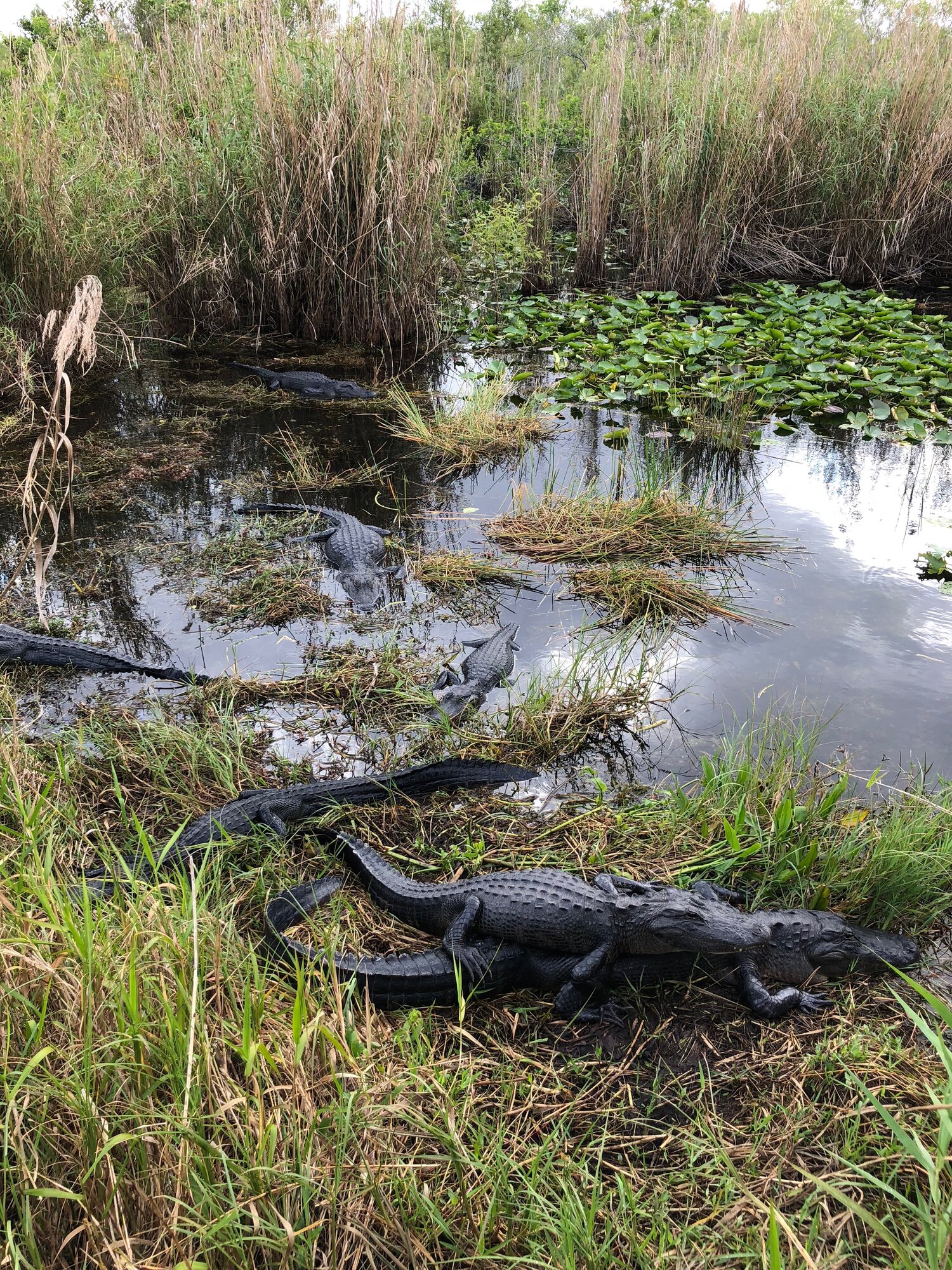
It’s 1.5 million acres, a national park since 1947, and it has crocodiles too, so you may see an alligator or a crocodile basking beside a trail or road.
For more, see does Florida have crocodiles, alligators or both.
North Florida and the Panhandle
Up north, the numbers come with arguments.
The state doesn’t estimate alligators county by county, so nobody can tell you how many live around Panacea.
Its statewide number has been stable for many years, and at St. Marks National Wildlife Refuge the numbers seemed to be holding steady.
Wakulla County had 52 alligators harvested in 2022, and some people think the real number was higher.
To see one up there, Wakulla Springs State Park in Wakulla County runs river boat tours.
If you came north for the sand instead, here are the best beaches in northwest Florida.
Where do most alligators live in Florida?

Anywhere with fresh water, pretty much.
Alligators live in all the wild areas of Florida that can support them, and you’ll find them anywhere there’s water, man-made canals included.
They like freshwater lakes and slow-moving rivers with their wetlands best, but they turn up in brackish water too.
In the Everglades, they mostly live in freshwater swamps and marshes.
And in the winter dry season they dig out “alligator holes” that hold water and shelter other animals.
As of 2021, most documented nuisance sightings were at public parks or in residential areas near wetlands, so that’s where to keep an eye out.
If you’d rather go looking on purpose, try these.
Anhinga Trail, Everglades National Park
Start here if it’s your first time.
It’s 0.8 miles round trip, wheelchair accessible, starting from the Royal Palm Visitor Center four miles from the main park entrance.
You may see alligators and turtles along with a lot of birds, especially during the winter, and it’s one of the most popular trails in the park.
Keep 15 to 20 ft from wildlife.
A basking gator may not move for hours.
It isn’t fake.
It’s warming up.
Shark Valley
Shark Valley, at 36000 SW 8th Street in Miami, is the park’s other easy one.
A paved loop of 15 miles runs out to an observation tower at the halfway point, and you may see alligators along it.
You walk it, rent a bike, or take the narrated tram, which takes 2 hours; private cars stop at the lot.
The park’s entrances don’t connect inside the park, so this and the Anhinga Trail are separate drives.
Shark Valley is nobody’s hidden gem.
It’s one of the park’s most popular and accessible areas, so expect long wait times between 10 a.m. and 3 p.m. Parking fills and may run one car in, one car out, so arrive 1.5 to 2 hours early for a scheduled tram.
So yes, there’s a line.
The entrance gate is open 8:30 a.m. to 6 p.m.
Don’t count on the bus, either.
There’s no public transportation to Shark Valley, and visitors who came by Uber, Lyft or taxi have been unable to get a ride back.
Drive, or sort out the return before your driver leaves.
Airboats on the Tamiami Trail
The airboats aren’t at Shark Valley itself.
There are three concessions 15 to 20 minutes east of it on US 41: Coopertown Airboats, Everglades Safari Park and Gator Park.
Wakulla Springs
Edward Ball Wakulla Springs State Park is built around one of the world’s largest and deepest freshwater springs.
Its river boat cruise promises spectacular views of birds and alligators of all sizes.
The tour leaves about every hour from near the lodge, and reservations are currently required.
So get it booked before you drive out.
Two of the boats are ADA-friendly, and you ask for one when you book.
Park entry is $6 per vehicle, and the park is open 8 a.m. to sunset.
Myakka River State Park
Myakka River State Park covers over 37,000 acres, and 14 miles of the Myakka River run through it.
Alligators and turtles sun lazily on logs and riverbanks, and the Birdwalk is a phenomenal place to view wildlife.
Its Canopy Walkway hangs 25 ft up, with a tower 74 ft tall over the treetops and wetlands.
Drinking water has been unavailable since Oct. 28, 2025, so bring your own (the ranger station hands out bottled water free).
South of State Road 72, boaters need a wilderness preserve permit, and only 30 people a day are allowed, registered at the ranger station that day.
If you’re basing yourself nearby, see the Sarasota, Florida guide.
Canoeing and kayaking are popular on the river, so you’ll be paddling in gator water.
Want a river with no wild gators at all?
Their native range runs from Oklahoma to North Carolina and south, which leaves Michigan out, so here’s kayaking the Ausable River.
Paynes Prairie and the La Chua Trail
The La Chua Trail is a little over half a mile round trip from the prairie’s north rim, with views of wet prairie including the Alachua Sink.
Main access is at 4270 SE 15th Street.
It opens at 8 a.m. and closes an hour before sunset.
Pets aren’t allowed on it, since you could run into alligators, snakes or bison.
In a drought, vegetation can limit the view until the water comes back.
The preserve is nearly 23,000 acres and became Florida’s first state preserve in 1970.
There’s also a 50 ft observation tower at the end of the quarter-mile Wacahoota Trail from the visitor center, if La Chua is dry.
Corkscrew Swamp Sanctuary
Audubon’s Corkscrew Swamp Sanctuary sits about 30 minutes northeast of Naples (Florida’s Naples, not the Italian one you’d visit for things to do in Pozzuoli).
It has a 2.25-mile boardwalk through cypress trees nearly 600 years old.
Come for the birds, a Painted Bunting among the winter visitors, and treat any alligator as a bonus.
Gatorland, if you want a sure thing
Captive, but honest about it.
Gatorland is home to more than 2,000 alligators and was Central Florida’s first major tourist attraction.
Its gators are used to people, which makes them a little more dangerous than alligators in the wild.
If Orlando’s the plan anyway, here’s what to do in Orlando besides Disney.
FAQs


🗼 I Wrote a Book About My Japan Travel Catastrophes!
Before I landed in Tokyo, I thought I was the “Final Boss” of international travel. Spoiler alert: I WASN’T. 😅
🚅 I boarded the wrong Shinkansen and ended up in THE WRONG CITY. I confused locals with my “expert” bowing that was more awkward than accurate. I accidentally stumbled into a high-stakes Kendo practice thinking it was a tourist show. Sound like something you’d do?
“Things I Wish I Knew Before Going to Japan” is your shortcut to avoiding ALL my cringe-worthy mistakes. ✨ Inside, you’ll find practical, LIFE-SAVING tips on etiquette, transport, money, and hidden gems that will save you time, money, and a whole lot of confusion.
What county in Florida has the most alligators?

Nobody can say for sure, because the state doesn’t estimate alligators county by county.
Brevard County keeps coming up.
Five of the 2024 top-20 waters touch it: Lake Poinsett, Puzzle Lake, the T.M. Goodwin Broadmoor Unit, the upper basin canals and Lake Hellen Blazes.
Their estimates add up to about 34,000, though Poinsett and Puzzle Lake straddle county lines, so not all of those gators are in Brevard.
Brevard also had the most calls about troublesome gators in the state for 2020, and Orange County came fourth.
And the state’s length record is from there: a male 14 feet 3.5 inches long, from Lake Washington in Brevard County, part of the Lake Poinsett stretch.
Nuisance numbers measure people as much as gators, though.
In 2016 Orlando had the most complaints, more than 230, and one trapper’s explanation was simple: the more people you have, the more gator sightings you’re going to have.
In 2017 Palm Beach County logged 1,036 complaints and 582 removals, and St. Lucie County had 281 complaints.
Here’s more on alligators in Fort Pierce.
Brevard has the strongest case, with the upper St. Johns marsh, a pile of top-20 waters, the most calls in 2020 and the record gator.
Osceola and Polk have a fair claim through the Kissimmee lakes, and Seminole has Lake Jesup.
If you’re choosing a coast rather than a county, here’s Cocoa Beach vs. Sarasota.
Is swimming safe in Florida lakes?

In a designated swimming area, in daylight, it’s a reasonable bet.
Swim only in designated swimming areas during daylight hours, because alligators are most active between dusk and dawn.
The local rule is a good one: if you see a body of water, assume there is a gator in it.
The odds are on your side.
Florida averaged eight unprovoked bites a year from 2012 to 2022 serious enough to need professional medical treatment.
A Florida resident’s chance of a serious injury from an unprovoked incident is roughly one in 3.1 million.
There were 453 unprovoked bites from 1948 to 2022, 26 of them fatal.
Inside Everglades National Park, though, the answer is just no. No swimming, snorkeling or diving anywhere in the park’s canals, ponds, freshwater lakes, marked channels or boat basins.
Wakulla Springs shows how a park handles it.
Swimming is allowed only within the designated area near the spring, where a dive tower 22 ft high stands over water of about 70°.
The same park sells a river cruise to see alligators of all sizes.
Both are true at once, which is the whole point of a designated area.
A sign at Wildcat Lake in Ocala National Forest says it straight: no lifeguard on duty, swim at your own risk.
For the big lake specifically, here’s whether it’s safe to swim in Lake Okeechobee.
In the ocean the worry is a different animal, so here’s which Florida beach has the most shark attacks.
Is it safe to swim in a lake with alligators?

Not outside a marked swim area, and not at dusk, dawn or after dark.
At Paynes Prairie, in duckweed, a gator can be just a head and a strip of back.
You’d walk right past it.
Keep small children and pets away from shorelines and basking alligators.
Pets often resemble an alligator’s natural prey, so keep them on a leash, at least 10 ft from the water’s edge.
Never feed one.
It’s dangerous and illegal, and most alligator attacks on people are put down to illegal feeding, which makes them bolder.
Once you hand feed a wild alligator, you’ve basically signed his death certificate.
If you see someone feeding one, the number for reporting violations is 888-404-3922.
A gator that’s just there isn’t automatically a problem.
One generally counts as a nuisance if it’s at least 4 ft long and believed to threaten people, pets or property; the hotline is 866-FWC-GATOR (866-392-4286).
Nuisance gators don’t get relocated, since relocated ones often try to return to where they were caught.
A gator sitting around with its mouth open isn’t a nuisance by itself.
If one bites, fight back with as much noise and resistance as you can; hitting, kicking or poking its eyes may make it let go.
Then get medical help, because the bites often lead to serious infection.
For the bigger picture on risk, see should you worry about alligators in Florida, and snakes are their own question in are there copperheads in Florida.
Sources
- Florida Fish and Wildlife Conservation Commission
- USA TODAY Network
- News 6 in Orlando
- WTXL
- WLRN
- WPTV
- National Park Service
- Florida State Parks
- St. Johns River Water Management District
- The Lodge at Wakulla Springs
- Audubon’s Corkscrew Swamp Sanctuary
Sources checked early November 2026.