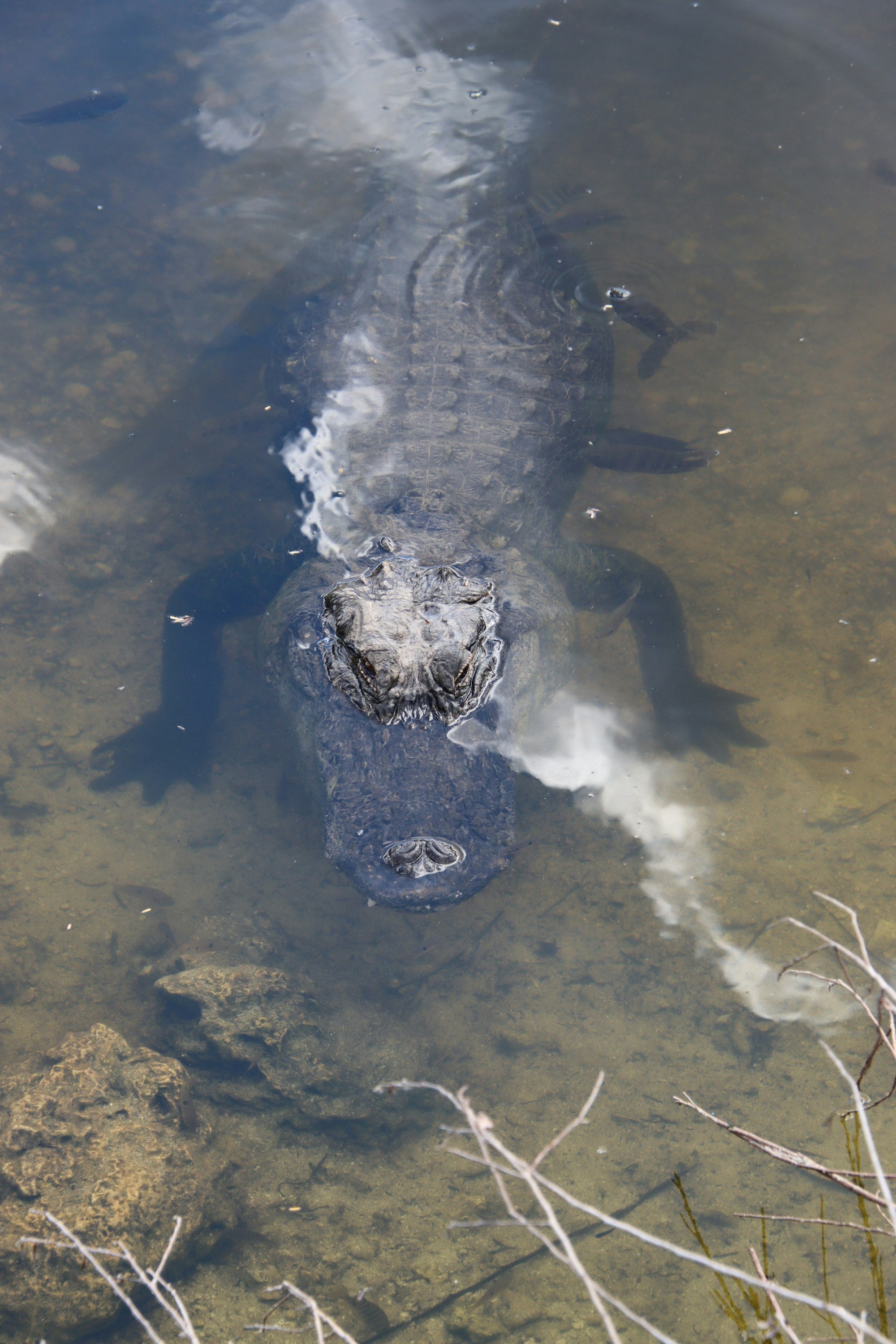

Short answer: Lake Okeechobee.
Going by the state’s own estimates, no Florida lake has more alligators, with about 33,542 on the 2024 numbers.
That’s just counting heads, though.
If you mean crowded when you say “infested,” the answer is Lake Jesup in Seminole County.
It’s third on those same estimates with about 14,518 gators, in a lake that’s a sliver of Okeechobee’s size.
Work it out per square mile and Jesup wins by a mile.
And Lake George?
Thirteenth.
About 5,412.
Which Lake in Florida Has the Most Alligators?

Okeechobee, and on raw numbers nothing else is close.
The name means “big water” in the Seminole language, and it’s earned.
It covers 730 square miles, the biggest lake in the southeastern United States, and you can’t see the far shore from the water’s edge.
Turns out it’s shallow, too: only 9 feet deep on average.
There’s an extensive marsh system too, and a berm runs around the lake.
Lots of room, lots of marsh.
Here’s how the top lakes line up in the two sets of state numbers you’re likely to run into.
The first column is the estimated population for 2024.
The second is the state’s May-to-August 2023 survey.
| Lake | FWC estimate, 2024 data | FWC 2023 survey |
|---|---|---|
| Lake Okeechobee | about 33,542 | 24,678 |
| Lake Kissimmee | about 16,184 | 15,404 |
| Lake Jesup | about 14,518 | 11,881 |
| Orange Lake | about 12,032 | 11,544 |
| Lake Poinsett (St. Johns River) | about 10,951 | 5th, no number given |
| Lake George | about 5,412 (13th) | not in the top 5 |
Places 6 through 12 on the 2024 list go to the Everglades WMA, Puzzle Lake on the St. Johns, the T.M. Goodwin Broadmoor Unit, Lake Griffin, Lake Harney, the Tosohatchee stretch of the St. Johns and Lake Tohopekaliga.
Not everything on that list is even a lake.
Why Lake Jesup Gets Called the Most Infested

Because there’s so little lake for all those gators.
Lake Jesup’s size swings with the water: about 9,150 acres at low water and 13,034 at high, and by some figures anywhere from 8,000 to 16,000.
Either way it’s shallow, six feet deep or less.
And it’s close to where a lot of you will land, about 12 miles from Orlando Sanford International Airport.
Now look at how crowded each lake gets per square mile, with Jesup at both low and high water.
| Lake | Gators per square mile |
|---|---|
| Lake Jesup | about 713 to 1,015 |
| Orange Lake | about 614 |
| Lake Kissimmee | about 296 |
| Lake George | about 75 |
| Lake Okeechobee | about 46 |
These lakes grow and shrink with the rain, and the gator counts are estimates, but Jesup still comes out at something like 15 to 22 times as many gators per square mile as Okeechobee.
One airboat captain on the lake will tell you no lake in Florida has more alligators per acre.
Among these five, at least, the numbers agree.
As for why, ask around and you’ll get a story.
Back in the ’60s and ’70s, with alligators on the endangered species list, relocated gators supposedly got brought to Jesup, and the lake is said to have been a dumping site for them.
Could be a myth, and the state doesn’t confirm or deny it.
The big ones are there too.
Going by state data from 2021, Lake Poinsett, Lake Kissimmee and Lake Jesup were the local waters with the largest populations of “bull” alligators, meaning longer than nine feet.
Lake Kissimmee and Orange Lake

Second and fourth on the estimates, and you could easily miss both if all you know is Okeechobee.
Lake Kissimmee is 34,948 acres, about 40 miles south of Orlando and 18 miles east of Lake Wales.
The 2024 estimate gives it about 16,184 alligators.
Orange Lake sits about 20 miles southeast of Gainesville.
It covers 12,550 acres, averages 5.5 feet deep and is 12 feet at its deepest.
It holds about 12,032 gators by the 2024 estimate, which makes it the second most crowded lake here.
It also holds the heavyweight.
FWC keeps a table of the 10 longest males and 10 longest females its biologists have officially measured since 1977.
The heaviest gator on it is a 1,043-pound male from Orange Lake, 13 feet 10½ inches long, taken April 17, 1989.
Another Orange Lake male, 13 feet 8 inches, comes in ninth.

🗼 I Wrote a Book About My Japan Travel Catastrophes!
Before I landed in Tokyo, I thought I was the “Final Boss” of international travel. Spoiler alert: I WASN’T. 😅
🚅 I boarded the wrong Shinkansen and ended up in THE WRONG CITY. I confused locals with my “expert” bowing that was more awkward than accurate. I accidentally stumbled into a high-stakes Kendo practice thinking it was a tourist show. Sound like something you’d do?
“Things I Wish I Knew Before Going to Japan” is your shortcut to avoiding ALL my cringe-worthy mistakes. ✨ Inside, you’ll find practical, LIFE-SAVING tips on etiquette, transport, money, and hidden gems that will save you time, money, and a whole lot of confusion.
What About Lake George?

It’s a real gator lake.
It just isn’t the answer.
Lake George is a 46,000-acre natural impoundment of the St. Johns River, mostly less than 10 feet deep.
On the 2024 estimates it ranks 13th, with about 5,412 alligators.
Spread over that much water, that’s roughly 75 per square mile.
You’ll still see it near the top of plenty of lists, likely because of raw counts.
People spot more gators at Lake George, 2,660 against 2,414 at Lake Jesup, but spotted isn’t the same as living there.
Jesup’s estimated population runs as high as 13,000.
Where Lake George does come first is big females.
Of the 10 longest females on FWC’s measured table, five came from Lake George.
That includes the longest, 10 feet 6⅝ inches and 375 pounds, taken October 10, 2019.
How FWC Counts the Alligators in a Lake

At night, from a boat.
FWC has surveyed its alligator management units since the statewide harvest started in 1988, to follow population trends and set harvest quotas.
They’re called night-light surveys: a boat runs along the shoreline after dark, and the spotlight makes the gators’ eyes shine red.
The count isn’t the population.
The estimates also use that year’s size data, environmental variables like water levels, and detection probability, and they come with a standard error that varies by water body.
Put simply, not every gator is at the surface when the boat goes by, and the estimate tries to account for the ones that aren’t.
That’s why the numbers you find online disagree so badly.
Okeechobee can show up as 9,308 counted or about 30,000 estimated, and smaller lakes go the same way (Lake Istokpoga had 1,321 spotted).
So before you trust any “most gators” number, ask one thing: was it counted, or estimated?
One more wrinkle.
This census used to run on up to 100 water bodies, but the last one was in 2023.
The 55 waterways with recent data added up to an estimated 210,485 gators.
Statewide, the population is about 1.3 million.
Where to See Crowds of Gators Without Getting in the Water

If you’re near Orlando, Lake Jesup is the easy one.
Flying into Sanford?
At about 12 miles out, you could fit it into arrival day with your carry-on still in the trunk.
The Lake Jesup Conservation Area covers almost 6,000 acres in three tracts.
On the East Lake Jesup tract, a 1.4-mile loop trail runs through the hammock to an observation tower over the marsh, and it’s open daily, sunrise to sunset.
Or go out with somebody who’s on the lake every day.
Black Hammock Airboat Tours runs 30-minute airboat rides on Jesup.
Figure on about $38 plus tax for adults and $32 for kids, going by 2024 prices, and check before you book.
Come in winter if you can, when you’ll believe there’s 12,000 alligators out there.
In summer most of them are lying on the bottom of the lake or back in the marsh.
So for gator spotting, summer’s pretty much the off-season out there.
If you want sheer crowding, there’s Deep Hole in Myakka River State Park, near Sarasota.
It’s a sinkhole about 200 feet wide and 130 to 140 feet deep.
Park waters dry up from December to May, and the gators crowd around the sinkhole; in especially dry years, more than 100 of them.
It’s a five-mile round-trip hike.
Permits for the wilderness area that includes Deep Hole were capped at 30 a day back in 2017, so call the park before you plan a day around it.
Wherever you go, FWC’s rules are short, and you’ve probably heard most of them.
Keep your distance.
Keep pets on a leash and away from the water’s edge.
Swim only in designated areas during daylight hours, since alligators are most active between dusk and dawn.
Never feed one; it’s illegal.
From 2012 to 2022, Florida averaged eight unprovoked bites a year serious enough to need professional medical treatment.
If a gator worries you, the Nuisance Alligator Hotline is 866-FWC-GATOR (866-392-4286).
There’s more in should I worry about alligators in Florida.
Questions People Ask About Florida’s Gator Lakes

Can you swim in Lake Jesup or Lake Okeechobee?
Only in designated swimming areas during daylight hours, and that goes for any Florida lake.
For Okeechobee in particular, here’s whether it’s safe to swim in Lake Okeechobee.
Is there a lake in Florida with no alligators?
Don’t count on it.
You’ll find alligators in all 67 counties, and they were living in Florida’s lakes and rivers long before people were.
There’s more on that in is there a lake in Florida without alligators and what part of Florida has no alligators.
Are there crocodiles in these lakes?
Not usually.
American crocodiles live in brackish or salt water in South Florida and the Keys, in the ponds and creeks of mangrove swamps.
They do turn up occasionally in fresh water inland along the southeast Florida coast, because of the extensive canal system.
More in are there saltwater crocodiles in the Keys.
Do alligators live anywhere besides the U.S.?
Just one other species.
The critically endangered Chinese alligator, from the lower Yangtze River, is the only one of the alligator family’s eight species that lives outside the Americas.
The American alligator ranges from North Carolina to Texas.
How big do the gators in these lakes get?
The longest on FWC’s measured table is a 14-foot 3½-inch male from Lake Washington, taken November 1, 2010.
The heaviest is that 1,043-pound Orange Lake male.
And for what it’s worth, serious injuries from alligators are rare in Florida.
More Florida water from us: Blue Spring vs. Ginnie Springs, the wildlife of Ichetucknee Springs and are there sharks in Naples, Florida.
Sources
- Florida Fish and Wildlife Conservation Commission
- USA TODAY Network
- News 6
- South Florida Water Management District
- Florida Senate
- Central Florida Public Media
- Saint Johns River Water Management District
- A-Z Animals
- News 13
- Fox 13
- Sarasota Magazine
- Florida Birding Trail
- Smithsonian’s National Zoo
Sources checked early November 2026.