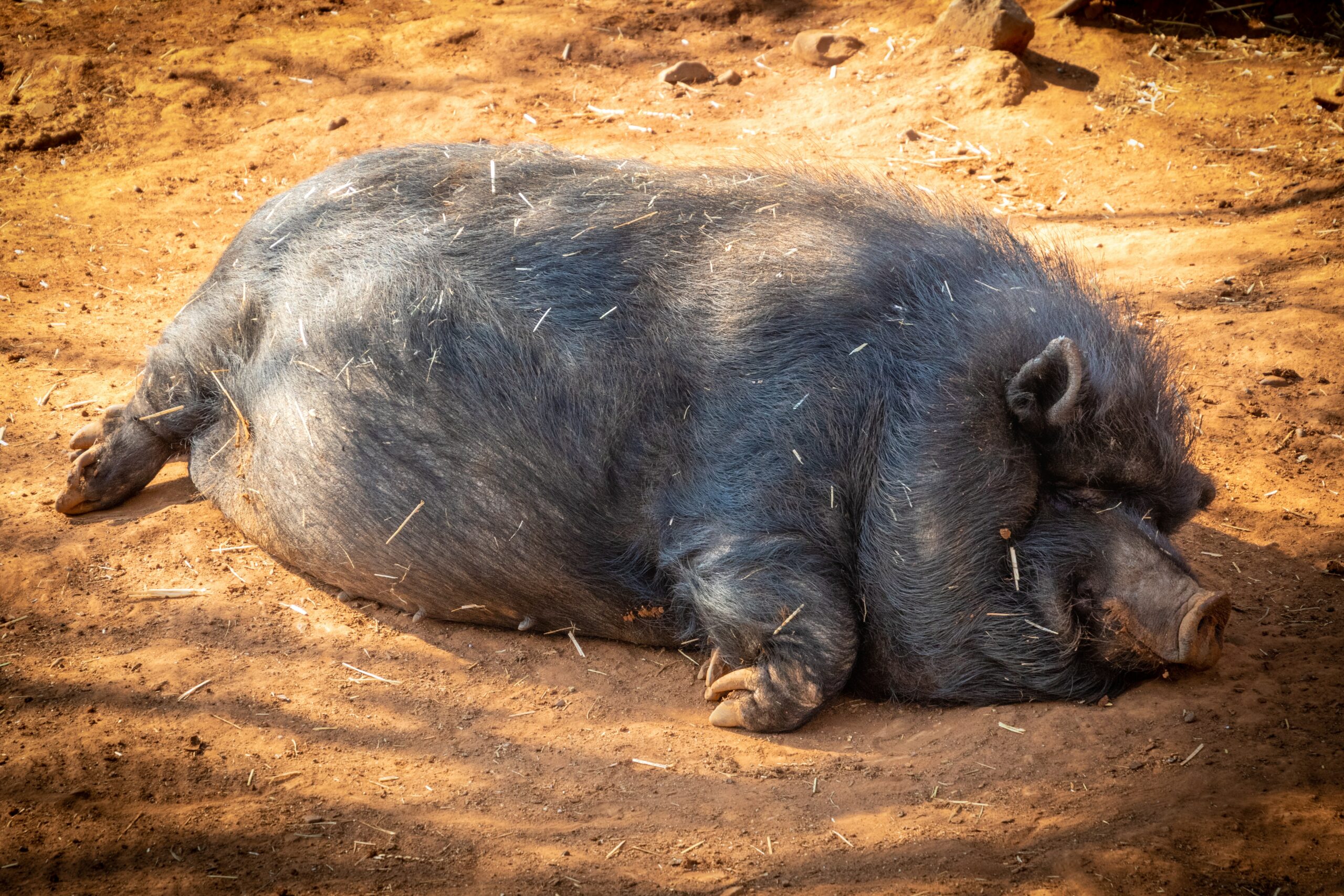

Short answer: usually not.
A wild hog in Florida would rather run from you than fight you.
But a hog that’s hurt, cornered or with its young can turn aggressive, move fast and cause serious injury, mostly with its hooves and tusks.
That’s the part worth knowing before you go.
First, the names.
It’s a wild hog, also called a feral hog, feral swine, feral pig, wild boar, wild pig or piney woods rooter.
Same animal, six spare names.
And a Florida “boar” isn’t a pure European wild boar.
As of 2010, none were believed to roam free in Florida, only feral hogs and hybrids.
They aren’t native, either, but wild hogs live in all 67 of Florida’s counties.
Where do they like to be?
Oak and cabbage palm hammocks, freshwater marshes and sloughs, pine flatwoods and more open farm country.
Notice what’s missing: the beach.
If your trip is mostly hunting sea glass on Florida’s beaches, I wouldn’t lose sleep over hogs.
If you’ve booked a cabin out by the pine flatwoods or the farm fields, though, you’re in their kind of country.
You may still never see one.
Feral swine are usually active at night, so they’re seen less often by day, especially in hot, humid climates.
What you’re more likely to spot is the mess.
They can leave the ground looking like it’s been plowed.
They usually travel in small family groups or alone.
Sizing up Florida’s other hazards while you’re at it?
Here’s whether tornadoes are serious in Florida too.
And if Florida is still just one of the trips you’re pricing, here’s which is cheaper, the Bahamas or Hawaii.
How Did Wild Boars Come to Florida?
Blame the Spanish, probably.
Hogs may have been brought in by the explorer Hernando de Soto as early as 1539.

De Soto brought swine to supply a settlement he set up at Charlotte Harbor, in Lee County.
And Ponce de León may have brought hogs to the same site in 1521, on a brief visit.
Explorers and settlers kept bringing pigs for the next four centuries.
People often raised them half-wild, let them roam and rounded them up only when needed.
That lasted until open range ended in the mid-1900s.
Eurasian wild boar arrived centuries later, for hunting, first released in the US in New Hampshire in 1886, then in New York (1900), North Carolina and Tennessee (1912) and Texas (1919), as a new big game animal.
Today’s feral swine are a mix of escaped domestic pigs, Eurasian wild boars and hybrids of the two.
They breed fast: year-round, with up to two litters and as many as 26 young a year.
Size is all over the place.
Wild hogs can weigh more than 150 pounds and be 5 to 6 feet long.
Average adult males may weigh 200-plus pounds and stand 3 feet at the shoulder, and males more than twice that size have been recorded.
They look a lot like farm pigs, but they’re generally thinner, with thicker hides of coarse, bristly hair and longer tusks.
Colors vary (white, black, brown, red), and piglets are often striped or spotted.
How many are there?
More than 500,000 in Florida as of 2010, second only to Texas.
What Harm Do Wild Boars Do in Florida?
Plenty.
Just not mostly to buildings.
The minimum cost of feral swine damage runs to $3.4 billion a year across the US, and damage and control in farming alone comes to an estimated $2.5 billion a year nationwide.
The damage does include property, like golf courses and public parks.
Rooting is the part you can see.
Just a few hogs can turn over large areas of soil in a single night.
For scale, here’s whether it’s illegal to dig a hole on a Florida beach.
A hog doesn’t ask.
On private land, they damage lawns and landscaping, plus crops, livestock feed, tree seeds and saplings.
Wildlife takes a hit too.
Hogs compete with deer and squirrels for food (turkeys too).
They eat the nests and young of turtles and ground-nesting birds.
Mammals too, and young livestock.
The water and the land suffer as well.
Rooting and wallowing speed up erosion along waterways and in wetlands.
In dry seasons, hogs can hog the scarce water and foul it (sorry, I had to).
And they spread invasive plant seeds on their fur and in their droppings.
Then there’s disease.
Feral swine carry at least 30 viral and bacterial diseases and nearly 40 parasites that can pass to people and pets, and to livestock and wildlife, pseudorabies and swine brucellosis among them.
The damage even includes crashes, with vehicles and with aircraft.
So, Are Florida Boars Aggressive?
Mostly no.
The best attack data comes from a 2013 study that gathered 412 wild pig attacks on people, from 1825 to 2012, across 47 countries and 21 US states.
Every hiker should know this part: wild pigs normally show little to no aggression toward people and typically try to flee.
The US had the biggest share of the attacks, 24%.
Within the US, Texas had 24%, Florida 12% and South Carolina 10%.
Texas and Florida also have the largest estimated hog populations.
Most attacks were in rural places (73%) and in daylight (91%).
Most didn’t happen during a hunt (76%).
Across every country in the study, winter had the most attacks (33%) and summer the fewest (17%).
The pigs that attacked were mostly alone (82%), male (81%) and large (87%).
Outside of hunting, the most common cause was no provocation at all (49%).
During hunts, it was a wounded animal (48%).
Deaths are rare, but they happen.
Fatalities came in 15% of the attacks where the pig made physical contact.
As of 2013, only four fatal wild pig attacks had ever been reported in the US.
Three were wounded animals during hunts, and the most recent was in Texas in 1996.
How rare is rare?
At the Savannah River Site in South Carolina, one hunter was hurt in over 1.5 million hunter hours, and three remote workers were attacked in over 3.9 million work hours.
The odds of an attack there work out to less than one in a million.
Food can make a hog bolder.
Feral swine have been aggressive toward, and even attacked, farmers and golfers.
Hikers and picnickers too.
Aggression can go up when they link people with food, from handouts and from trash left out.

🗼 I Wrote a Book About My Japan Travel Catastrophes!
Before I landed in Tokyo, I thought I was the “Final Boss” of international travel. Spoiler alert: I WASN’T. 😅
🚅 I boarded the wrong Shinkansen and ended up in THE WRONG CITY. I confused locals with my “expert” bowing that was more awkward than accurate. I accidentally stumbled into a high-stakes Kendo practice thinking it was a tourist show. Sound like something you’d do?
“Things I Wish I Knew Before Going to Japan” is your shortcut to avoiding ALL my cringe-worthy mistakes. ✨ Inside, you’ll find practical, LIFE-SAVING tips on etiquette, transport, money, and hidden gems that will save you time, money, and a whole lot of confusion.
What to Do If You See a Wild Boar in Florida
Mostly, nothing dramatic.
Give the hogs a wide berth, or if you’re too close, back away slowly without sudden or threatening moves.
Don’t chase one, and don’t stand in the path of one that’s trying to get away.
Don’t walk up to a hurt one.
And don’t feed or touch one, especially in a suburb or a town.
Walking alone, on foot, through undeveloped areas with thick brush raises your risk too.
These hiking safety rules apply here too.
A dog changes the math.
Walking a dog through undeveloped areas, leashed or not, adds risk.
Pigs may see dogs as predators, and in a few cases they went after dogs on a leash.
Some owners stepped in to save their dog and were attacked themselves.
There’s a disease angle too.
Pseudorabies isn’t a threat to people but is always fatal in dogs.
Keep dogs on a leash and away from feral hogs, and never feed them raw hog meat.
If you’re hiking with your dog in Florida, that’s the rule I’d remember.
If a hog charges from close up, climb something, at least 6 feet off the ground.
Hogs can’t climb, but big ones can “walk” their front legs up a trunk and reach things 4 to 5 feet up.
I wouldn’t trust a tree that isn’t high.
Outrunning one is a long shot.
You can try if it starts coming from far off, but pigs run faster than people, so it may not work if it keeps chasing.
If you can’t get away, face it and fight back with whatever you’ve got.
People have used things like a camera tripod, a shovel, a cane or a dog leash.
Try to stay on your feet.
Knocked down?
Get on your back with your feet toward the hog and kick fast at its snout.
Most attacks last under a minute.
When it leaves, let it, and don’t block its way out.
Playing dead has worked once, but there’s no real evidence behind it as a strategy.
Then get any wound seen by a doctor right away, because serious infections can follow.
Staying somewhere with a yard?
The right fencing should keep hogs out of small yards and gardens, and motion-activated lights or alarms usually don’t work, or only for a while.
Here to hunt one instead?
There’s no off-season on private land.
With the landowner’s permission, hogs may be trapped, shot or hunted year-round with no fees, licenses or permits required, and poisoning them is prohibited.
Moving or holding a live hog is a different story: the Florida Department of Agriculture and Consumer Services regulates that.
Here’s where you can hunt hogs for free in Florida.
And if you clean one, wear gloves.
Hunters and anyone handling raw hog meat are at risk for brucellosis, and the meat should be cooked thoroughly to 170 degrees.
Freezing or smoking the meat won’t kill the bacteria, and neither will drying or pickling it.
Most of the time, the hog wants out as much as you do.
Let it go.
Sources
- Florida Fish and Wildlife Conservation Commission
- US Department of Agriculture
- University of Florida
- CDC
- John J. Mayer’s 2013 study of wild pig attacks
Sources checked November 2026.
Related read: The Caribbean Travel Guide — Instant PDF + Kindle download. Secure checkout by Stripe