The other day, as I lounged in my favorite spot, savoring the refreshing tang of my ice-cold lemonade, a friend unexpectedly dropped a seemingly simple yet thought-provoking question on me:
“Is Florida in the Northern Hemisphere?”
This seemingly innocuous inquiry, casually posed in the midst of a relaxed afternoon, sparked an intriguing journey into geography and a reflection on our understanding of the world’s complex spatial arrangements.
Florida is indeed located in the Northern Hemisphere.
But as I mulled over this query, it became apparent that beneath its straightforward surface lay a deeper exploration of our perceptions of place, the Earth’s divisions, and the interplay between geographical knowledge and our daily lives.

Florida, often dubbed the “Sunshine State,” is renowned for its idyllic beaches, lush swamplands, and vibrant cities.
But how many of us really stop to think about its precise global positioning?
We tend to envision it as a southern state within the United States, bathed in the warmth of the tropical sun.
However, this apparent simplicity conceals a nuanced understanding of its geographical location and the broader context of the Northern Hemisphere.
Moreover, Florida’s geographical location plays a pivotal role in its climate and ecology.
Situated between the Gulf of Mexico and the Atlantic Ocean, the state’s warm waters foster the development of hurricanes, which are more common during the Atlantic hurricane season in the summer and fall.
The lush Everglades in the southern part of the state, with their unique ecosystem of marshes and wetlands, are another consequence of Florida’s geographical location.
Florida’s connection to the Northern Hemisphere extends beyond climate and ecology.
It also influences aspects of culture, economy, and daily life.
Many of us flock to Florida from northern states during the winter months to escape the cold, boosting the state’s economy.
What Region is Florida In?
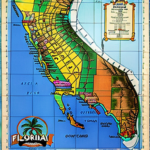
Florida is in the southeastern region of the United States.
It’s situated on the southeastern tip of the North American continent.
To give you a more precise idea, Florida is bordered by the states of Alabama and Georgia to the northwest and is separated from the rest of the continental United States by the Gulf of Mexico.
The Atlantic Ocean lies to its east.

The southernmost point of Florida is Key West, which is a mere 90 miles from the coast of Cuba.
Being in the southeastern region has several consequences.
Florida enjoys a tropical and subtropical climate due to its proximity to the Caribbean, making it a popular destination for beachgoers and water sports enthusiasts.
You’ll find cities like Miami, Orlando, and Tampa thriving in this sunny state, with attractions like Walt Disney World, Universal Studios, and the Everglades National Park drawing visitors from all over the world.
Additionally, Florida’s location can sometimes put it in the path of hurricanes during hurricane season, which typically runs from June 1st to November 30th.
Florida’s Geographical Coordinates
Florida’s location on the Earth’s surface is characterized by specific geographical coordinates that unequivocally place it within the Northern Hemisphere.
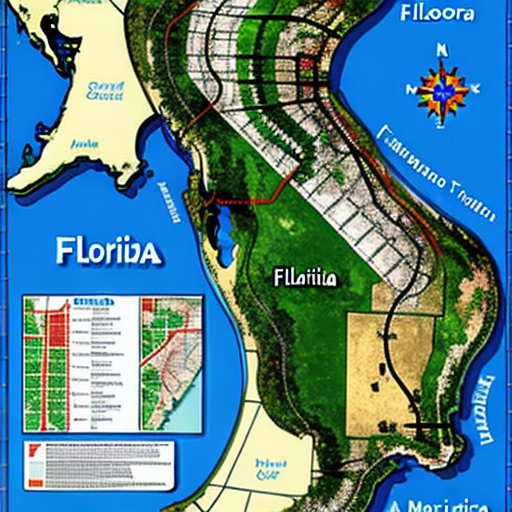
Florida stretches from approximately 24°N to 31°N latitude.
To put this in perspective, this latitude range aligns with regions like Egypt, Saudi Arabia, and northern India.

In fact, some of Florida’s southernmost islands nearly touch the Tropic of Cancer, positioned at 23.5°N.
When you think about Florida’s climate, which features abundant sunshine, warm temperatures, and occasional hurricanes, it’s important to recognize that these characteristics are consistent with a subtropical climate typical of the Northern Hemisphere.
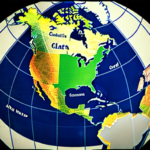
The Northern Hemisphere comprises the majority of the Earth’s landmass and population, encompassing North America, Europe, Asia, and the northern part of Africa.
What Is Considered the Northern Hemisphere?
The Northern Hemisphere comprises all the Earth’s land and water areas that lie north of the equator, which is at 0 degrees latitude.
When you think of well-known northern hemisphere countries, examples that come to mind are the United States, Canada, Russia, China, and the United Kingdom.
To get specific, the northernmost point on Earth is the North Pole, which sits at approximately 90 degrees North latitude.
While people don’t live there, it’s a pivotal point in defining the northern hemisphere.

If you travel to cities like New York, Moscow, or Tokyo, you’re unmistakably in the northern hemisphere.
For instance, New York City, the Big Apple, is situated at around 40.7128° N latitude, well above the equator.
The northern hemisphere experiences distinct seasons: spring, summer, autumn, and winter.
These seasons occur at different times throughout the year, thanks to the tilt of Earth’s axis.
So, if you’ve ever wondered why you need a winter coat in New York during December but not in Sydney, Australia, it’s because New York is in the northern hemisphere, while Sydney is in the southern hemisphere.
To give you a clearer picture, here are a few more prominent countries and cities that reside in the northern hemisphere:
- United States: The contiguous United States stretches from approximately 24 degrees N latitude at the southern tip of Florida to around 49 degrees N latitude at the Canadian border.
Major cities like New York City, Chicago, and Los Angeles all fall within the northern hemisphere.
- Canada: The second-largest country in the world, Canada, is almost entirely situated in the northern hemisphere.
Cities such as Toronto, Vancouver, and Montreal are well above the equator.
- Russia: Russia, the largest country globally, dominates the northern hemisphere with a significant portion of its landmass.
Moscow, its capital, sits at approximately 55.7558° N latitude.
- China: China extends from around 20 degrees N latitude in the south to about 53 degrees N latitude in the north.
Beijing, China’s capital, is situated at approximately 39.9042° N latitude.
- United Kingdom: While not as far north as some other northern hemisphere countries, the United Kingdom, with cities like London, Edinburgh, and Belfast, falls comfortably in this hemisphere, at latitudes ranging from about 51 to 55 degrees N.
- Japan: The archipelago of Japan is located between 24 and 45 degrees N latitude, encompassing major cities like Tokyo, Kyoto, and Osaka.
- Sweden: This Scandinavian country spans from roughly 55 to 69 degrees N latitude, including cities such as Stockholm and Gothenburg.
The northern hemisphere experiences the full range of seasons, from the warmth of summer to the chill of winter, owing to Earth’s axial tilt.
Understanding the northern hemisphere’s geographical reach helps explain the diverse climates and weather patterns experienced across these countries and regions.

🗼 I Wrote a Book About My Japan Travel Catastrophes!
Before I landed in Tokyo, I thought I was the “Final Boss” of international travel. Spoiler alert: I WASN’T. 😅
🚅 I boarded the wrong Shinkansen and ended up in THE WRONG CITY. I confused locals with my “expert” bowing that was more awkward than accurate. I accidentally stumbled into a high-stakes Kendo practice thinking it was a tourist show. Sound like something you’d do?
“Things I Wish I Knew Before Going to Japan” is your shortcut to avoiding ALL my cringe-worthy mistakes. ✨ Inside, you’ll find practical, LIFE-SAVING tips on etiquette, transport, money, and hidden gems that will save you time, money, and a whole lot of confusion.
Is Florida North or South of the Equator?
Florida is north of the equator!
If you’re ever in Miami and decide to whip out your GPS, you’ll see it proudly displaying a latitude of approximately 25.7617° N.
That’s pretty clear evidence of Florida hanging out in the Northern Hemisphere.
But wait, there’s more!
Head a bit north, and you’ll find Orlando, another Florida gem, with a latitude of about 28.5383° N.
Yep, still north of that equatorial line.

Now, let’s explore Tallahassee, Florida’s capital.
It’s perched even farther north at around 30.4383° N.
So, whether you’re sipping Cuban coffee in Miami, enjoying roller coasters in Orlando, or discussing politics in Tallahassee, you’re firmly planted in the Northern Hemisphere!
Understanding the Equator’s Significance
The Equator, positioned at 0° latitude, serves as a fundamental reference point for understanding the division of Earth into the Northern and Southern Hemispheres.
This imaginary line not only separates the hemispheres but also influences the climate and weather patterns of regions nearby.
While the Equator traverses various countries like Ecuador, Colombia, and Indonesia, Florida is not among them.
Instead, it lies distinctly in the Northern Hemisphere.
Consider the Equator as the planet’s waistline.
Anything north of it falls into the Northern Hemisphere, and anything south becomes part of the Southern Hemisphere.
This division plays a pivotal role in climatology, navigation, and even cultural aspects of the regions it affects.
Climate Zones & Florida’s Position
Florida’s geography plays a significant role in shaping its climate.
Positioned in the Northern Hemisphere, Florida experiences a diverse range of climate zones, primarily influenced by its latitude, proximity to the Gulf of Mexico and the Atlantic Ocean, and the Gulf Stream.
These factors contribute to Florida’s subtropical climate, characterized by warm and humid conditions.

Further north in Florida, especially in cities like Tallahassee and Jacksonville, the state’s proximity to the North American continent allows for cooler temperatures in the winter, and on rare occasions, snowfall.
Meanwhile, the southernmost tip of Florida, including the Florida Keys, basks in a tropical climate with consistently warm temperatures year-round.
Florida’s Unique Geography and Biodiversity
Florida’s position within the Northern Hemisphere has profound effects on its biodiversity.
The state’s varied landscapes, from wetlands and forests to coastal plains and coral reefs, support a wide range of plant and animal species.
Its unique geography, including the Everglades, the largest tropical wilderness of any kind in the U.S., showcases the state’s ecological significance within the Northern Hemisphere.

Florida’s geographical diversity is home to iconic wildlife like the American alligator, manatees, and a variety of bird species, including the elusive Florida scrub jay.
These species thrive in the Northern Hemisphere’s subtropical and tropical ecosystems.
Florida’s Place in the Northern Hemisphere’s Economy
Florida’s strategic location within the Northern Hemisphere has contributed significantly to its economic prosperity.
The state serves as a gateway for international trade and tourism.
Ports like Miami and Tampa are vital hubs for importing and exporting goods, connecting Florida with countries across the Northern Hemisphere.
The tourism industry in Florida benefits from its Northern Hemisphere position, attracting visitors seeking warm weather year-round.
Theme parks, beaches, and cultural attractions draw tourists from the United States, Canada, Europe, and beyond.
What Hemisphere is Orlando, FL In?
Orlando, Florida is located in the northern hemisphere.
For instance, if you look at the coordinates of Orlando, it’s approximately at 28.5383° N latitude and 81.3792° W longitude.
Now, let’s break this down a bit: The “N” in the latitude stands for North, indicating that Orlando is north of the equator.

Conversely, the “W” in the longitude stands for West, showing that Orlando is west of the Prime Meridian, which runs through Greenwich, London.
So, Orlando’s geographical location places it firmly in the northern hemisphere, along with other North American cities like New York, Toronto, and Mexico City.
What Hemisphere is Miami, FL?
You’re in luck!
Miami, Florida is located in the northern hemisphere.
If you were to look at a map and find Miami’s coordinates, you’d see it’s situated at approximately 25.7617° N latitude and 80.1918° W longitude.
To put that into context, it means Miami is above the equator, in the half of the Earth that includes North America, Europe, and most of Asia.
So, when you’re basking in the Miami sun or enjoying the vibrant nightlife, you’re firmly in the northern hemisphere.
This positioning has some interesting consequences.
For instance, during the summer solstice, which falls around June 21st, the northern hemisphere experiences its longest day of the year.

In Miami, this means you’ll enjoy more daylight to explore the beautiful beaches, like South Beach, or visit attractions like the Art Deco Historic District.
On the flip side, during the winter solstice, around December 21st, the northern hemisphere experiences its shortest day of the year.
So, while Miamians might not be building snowmen, they can still relish the relatively mild winters compared to their southern hemisphere counterparts.
Is Tampa in the Southern Hemisphere?
No, Tampa is not in the southern hemisphere.
It’s actually situated in the northern hemisphere, just like Miami.
Tampa’s coordinates are approximately 27.9506° N latitude and 82.4572° W longitude.
So, when you’re in Tampa, you’re in the same half of the Earth that includes North America, Europe, and most of Asia.
This means you can enjoy the same phenomena as in Miami – longer days during the summer and milder winters during the winter solstice.
During the summer, which falls around June 21st, Tampa experiences its longest day of the year, just like any other location in the northern hemisphere.
This means more sunshine to enjoy attractions like Busch Gardens or the beautiful beaches along the Gulf Coast.

And during the winter, around December 21st, Tampa, like Miami, enjoys a relatively mild winter compared to places in the southern hemisphere.
While you won’t find snow-covered streets in Tampa, you can take advantage of the pleasant weather to explore places like the Tampa Riverwalk or visit the Lowry Park Zoo.
What States Are in the Northern Hemisphere?
The northern hemisphere is home to a diverse array of U.S.
states.
Here’s just a handful of the many U.S.
states located in the northern hemisphere.
Each offers its own unique attractions and experiences, all within the northern half of our planet:
- New York: Known for its iconic city, New York City, the state of New York sits in the northern hemisphere.
You can explore the bustling streets of Manhattan and enjoy the changing seasons in this vibrant state.
- California: The Golden State, famous for its sunny weather, is also in the northern hemisphere.
From the beaches of San Diego to the towering Redwood forests in the north, you’re definitely in the northern half of the world.
- Texas: The Lone Star State, known for its vast landscapes and diverse culture, is another northern hemisphere resident.
Whether you’re in the big cities like Houston or enjoying the Tex-Mex cuisine, you’re firmly in the northern part of the Earth.
- Illinois: Home to Chicago, the Windy City, Illinois is in the northern hemisphere as well.
You can experience the stunning architecture, deep-dish pizza, and the Great Lakes—all part of the northern half of the globe.
- Florida: We’ve already covered Miami, but the entire state of Florida resides in the northern hemisphere.
That means you can soak up the sun in Orlando, explore the Everglades, or enjoy the tropical vibes of Key West—all north of the equator.
- Washington: Known for its lush forests, tech hub Seattle, and the stunning Cascade Range, Washington state sits in the northern hemisphere.
It’s a place where you can hike in the Olympics, visit the Space Needle, or explore the Pacific coastline.
- Michigan: The Great Lakes State, Michigan, is entirely situated in the northern hemisphere.
You can enjoy the vast waters of Lake Superior, the vibrant city of Detroit, and the unique beauty of the Upper Peninsula.
- Massachusetts: This New England state, famous for its rich history, is in the northern hemisphere as well.
You can explore Boston’s historic Freedom Trail, relax on Cape Cod’s beaches, and take in the beautiful fall foliage.
- Minnesota: Known as the Land of 10,000 Lakes, Minnesota is firmly positioned in the northern hemisphere.
From the bustling Twin Cities of Minneapolis and St.
Paul to the serene wilderness of the Boundary Waters, there’s much to experience here.
- Alaska: The northernmost state in the U.S., Alaska, is predominantly located in the northern hemisphere.
You can witness the majestic beauty of Denali National Park, see the Northern Lights, and observe unique wildlife like grizzly bears and bald eagles.
- Montana: Known for its stunning landscapes, including Glacier National Park and the Rocky Mountains, Montana is another northern hemisphere gem.
Here, you can go hiking, fly fishing, and soak in the rugged beauty of Big Sky Country.
- Maine: The Pine Tree State, Maine, is firmly in the northern hemisphere.
Explore its rocky coastline, visit charming coastal towns like Bar Harbor, and savor fresh lobster by the Atlantic Ocean.
- New Hampshire: Nestled in New England, New Hampshire boasts the beautiful White Mountains and Mount Washington.
It’s yet another state in the northern hemisphere where you can enjoy outdoor adventures year-round.
Top Northern Hemisphere Tropical Paradises
If you’re captivated by tropical destinations and prefer to stay within the Northern Hemisphere, you have a plethora of remarkable options:
- Hawaii: Located in the central Pacific Ocean, Hawaii offers lush landscapes, volcanic wonders, and pristine beaches, making it a tropical haven.
- The Bahamas: Nestled in the Atlantic Ocean, the Bahamas feature stunning coral reefs, turquoise waters, and a consistent tropical climate throughout the year.
- Jamaica: Known for its reggae culture, Jamaica boasts beautiful beaches, vibrant traditions, and a tropical climate perfect for relaxation.
- The Dominican Republic: Sharing the island of Hispaniola with Haiti, this country presents visitors with white-sand beaches, diverse ecosystems, and a tropical climate that beckons exploration.
- The Turks and Caicos: Situated in the Atlantic Ocean, this British Overseas Territory offers unspoiled beaches and excellent snorkeling opportunities, all within the Northern Hemisphere.
🗼 I Wrote a Book About My Japan Travel Catastrophes!
Before I landed in Tokyo, I thought I was the “Final Boss” of international travel. Spoiler alert: I WASN’T. 😅
🚅 I boarded the wrong Shinkansen and ended up in THE WRONG CITY. I confused locals with my “expert” bowing that was more awkward than accurate. I accidentally stumbled into a high-stakes Kendo practice thinking it was a tourist show. Sound like something you’d do?
“Things I Wish I Knew Before Going to Japan” is your shortcut to avoiding ALL my cringe-worthy mistakes. ✨ Inside, you’ll find practical, LIFE-SAVING tips on etiquette, transport, money, and hidden gems that will save you time, money, and a whole lot of confusion.
What Hemisphere is the United States In?
The United States is primarily situated in the northern hemisphere.
When you look at the country on a map, you’ll find it spans from roughly 24° N latitude in the southernmost point of Key West, Florida, to approximately 49° N latitude in the northernmost point near the U.S.-Canada border in places like Northwest Angle, Minnesota.
So, whether you’re savoring a lobster roll in Maine or catching some rays in California, you’re in the northern half of the globe, along with countries like Canada, Russia, and most of Europe.
This northern hemisphere positioning also means the United States experiences the changing seasons that come with it.
For instance, if you’re planning a visit to New York City in the fall, you’ll be treated to the colorful foliage as the leaves change colors due to the autumnal equinox, which usually occurs around September 22nd.
Similarly, if you’re looking to hit the ski slopes in Colorado in the winter, you can expect the colder temperatures and snowy landscapes associated with the northern hemisphere’s winter season, which peaks around the December solstice.
FAQs
What continent is Florida part of?
Florida is unequivocally part of the North American continent and is recognized as the southernmost state within the continental United States.
Does Florida experience snowfall?
While snowfall is a rare occurrence in Florida, it can happen in the northern regions of the state during the occasional cold front.
Is Florida considered a tropical destination?
Florida’s climate is classified as humid subtropical.
While it may not be entirely tropical, it enjoys characteristics conducive to the cultivation of citrus fruits and pleasant winters.
Which countries are intersected by the Equator?
The Equator crosses a range of countries, including Ecuador, Colombia, Brazil, Sao Tome & Principe, Gabon, the Republic of the Congo, the Democratic Republic of the Congo, Uganda, Kenya, Somalia, the Maldives, Indonesia, and Kiribati.
Is the United States situated in the Northern or Southern Hemisphere?
The continental United States, encompassing Florida, is exclusively located within the Northern Hemisphere.
Is the United States in the Northern Hemisphere?
The United States is indeed in the northern hemisphere.
To pinpoint its location, let’s consider the coordinates of its geographic center, near Belle Fourche, South Dakota.
It sits at approximately 44.9680° N latitude and 103.7669° W longitude.
This means that the vast majority of the United States, including iconic cities like New York City, Los Angeles, Chicago, and Houston, is situated above the equator.
So, when you’re exploring the bustling streets of Manhattan, taking in the grandeur of the Grand Canyon, or basking on the sunny beaches of Miami (as mentioned in a previous response), you’re firmly within the northern hemisphere.