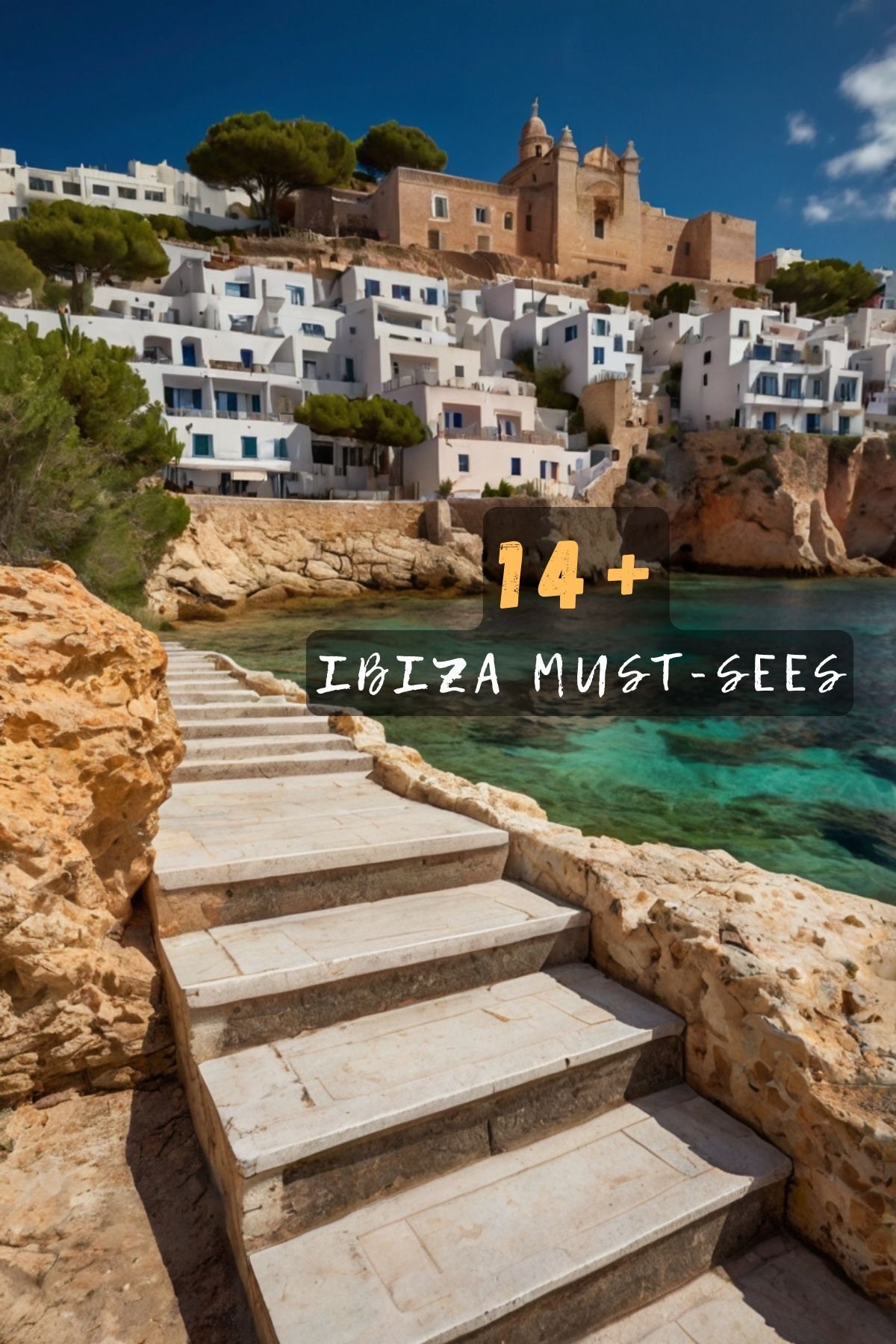

Ibiza isn’t just another party island on the Mediterranean—it’s a place where something shifts inside you, where the ordinary rules of life seem to suspend, and where thousands of travelers have experienced moments that redefined who they are.
Wondering how long you will be in the air?
See how long the flight to Spain is: from 19 US airports, both ways.
People fly in expecting clubs and cocktails, but they leave talking about magic rocks, sacred sunrises, and moments of clarity that therapy couldn’t give them in years.
Here are my favorite experiences:

Watching Sunrise at the Mystical Es Vedrà Rock

You’ll drag yourself out of bed at 4:30 AM, probably still buzzing from the night before, wondering why you agreed to this insane plan.
The drive through pitch-black Ibizan roads feels surreal, almost dreamlike, as you wind toward the western coast with nothing but headlights and anticipation.
Then you arrive at the viewpoint, and there it is—Es Vedrà, a massive limestone rock jutting 400 meters out of the sea, shrouded in darkness and legend.
People say this rock is the third most magnetic point on Earth, though scientists dispute this claim with the same energy that believers defend it.
You don’t care about the debate because something about standing there in the pre-dawn silence makes your chest feel different, lighter somehow.
As the sun creeps over the horizon behind you, Es Vedrà transforms from a dark silhouette into a golden monument, and the Mediterranean turns from black to sapphire to liquid amber.
Tourists who’ve done this describe feeling emotionally cracked open, like the sunrise physically pulled something heavy out of their bodies.
You might cry, and you won’t be the first or the last person to do so at this exact spot.
The experience isn’t about the rock itself—it’s about the pause, the silence, the rare moment where you’re not scrolling or talking or planning.
You’re just existing in front of something ancient and indifferent to your problems, which somehow makes your problems feel less crushing.
Local legends claim Es Vedrà is the tip of sunken Atlantis, a UFO hotspot, and the island that lured Odysseus off course.
Whether you believe any of that doesn’t matter because the feeling you get standing there transcends logic.
People say they’ve made life-changing decisions at this viewpoint—quit jobs, ended relationships, started new chapters.
There’s something about witnessing such raw natural beauty that makes you realize how much time you’ve wasted on things that don’t matter.
You’ll take a thousand photos, but none of them will capture what you actually feel.
That’s the point—this experience forces you to be present, to actually live a moment instead of just documenting it.
Joining the Full Moon Drumming Circle at Benirràs Beach

You’ll hear the drums before you see the beach, a rhythmic pulse echoing through the pine trees as you descend the rocky path.
Benirràs Beach transforms every Sunday evening, but during full moons, it becomes something else entirely—part ritual, part party, part spiritual experience that defies categorization.
Dozens of drummers gather on the rocks and sand, their rhythms creating a hypnotic soundtrack that seems to sync with your heartbeat.
You don’t need musical experience or special equipment; you just show up, and someone will hand you a djembe or a shaker or point you toward the dancing crowd.
The sun begins its descent, painting the sky in oranges and purples, while the almost-full or perfectly-full moon rises on the opposite horizon.
This dual celestial show—sunset and moonrise happening simultaneously—creates a lighting situation that feels orchestrated by something bigger than human effort.
Hippies and CEOs, backpackers and luxury travelers, locals and tourists all merge into one sweaty, rhythmic mass of humanity.
Nobody cares what you do for work or where you’re from; the drums equalize everything, stripping away the usual social hierarchies.
You’ll find yourself dancing with complete strangers, your body moving in ways it hasn’t moved since childhood, uninhibited and free.
The drumming builds and builds, creating waves of sound that crash over the crowd, and you can physically feel the vibrations in your chest.
People describe experiencing a trance-like state, where time becomes meaningless and self-consciousness evaporates completely.
You might lock eyes with someone across the circle and share a moment of pure recognition—two humans acknowledging the absurd beauty of being alive.
As darkness falls and the moon climbs higher, the beach takes on an otherworldly glow, silver light mixing with bonfire flames.
This experience breaks something open in people who spend their normal lives armored and controlled.
You’ll leave with sand in places sand shouldn’t be, your hands possibly sore from drumming, and a strange sense of having touched something ancient.
The full moon drumming isn’t a tourist attraction that someone manufactured for Instagram—it’s a genuine community ritual that visitors are welcomed into.
That authenticity is what makes it transformative; you’re not watching culture, you’re participating in it.
Experiencing Sunset at Café del Mar in San Antonio

You’ve probably heard the Café del Mar chillout compilations, those downtempo albums that defined an entire genre of music.
But listening to the music at home while doing emails doesn’t prepare you for the actual experience of being there as the sun melts into the sea.
Café del Mar sits on the western edge of San Antonio, a spot that generations of people have recognized as sacred sunset-watching territory.
You’ll arrive early because everyone knows the drill—this isn’t a secret, it’s a pilgrimage that hundreds make every single evening.
The venue itself feels like an extension of the rocks and sea, all white walls and comfortable seating that faces the endless Mediterranean horizon.
You’ll order something cold and expensive because that’s part of the deal, and you’ll try to find the perfect spot that isn’t already claimed.
As sunset approaches, a hush falls over the crowd—conversations lower, phones come out briefly then get put away, and everyone turns westward.
The DJ reads the moment perfectly, their music swelling and softening in sync with the changing light, creating a soundtrack that feels custom-designed for this exact sunset.
Colors you didn’t know existed start spreading across the sky—coral and lavender and gold all bleeding into each other.
The sun sits on the horizon like it’s hesitating, like it knows everyone’s watching and wants to make the moment last.
Then it begins its descent, and you understand why humans have been worshipping sunsets since we first developed consciousness.
The crowd erupts in applause as the sun finally disappears, a tradition that might seem cheesy but feels completely natural in the moment.
You’ll feel tears prick your eyes, and you won’t even be embarrassed because you’ll notice other people wiping their faces too.
This experience changes people because it’s a reminder that beauty still exists, that nature puts on free shows every single day if you just stop and watch.
In our overstimulated, screen-addicted world, the act of sitting still and watching the sun set becomes almost revolutionary.
You’re not checking notifications or planning tomorrow or replaying yesterday’s mistakes—you’re just here, now, watching light and color do their eternal dance.
People say they’ve healed heartbreaks at Café del Mar, found perspective on major life decisions, and reconnected with joy they thought they’d lost.
The sunset doesn’t actually solve your problems, but it reminds you that you’re part of something much bigger than your individual struggles.
🗼 I Wrote a Book About My Japan Travel Catastrophes!
Before I landed in Tokyo, I thought I was the “Final Boss” of international travel. Spoiler alert: I WASN’T. 😅
🚅 I boarded the wrong Shinkansen and ended up in THE WRONG CITY. I confused locals with my “expert” bowing that was more awkward than accurate. I accidentally stumbled into a high-stakes Kendo practice thinking it was a tourist show. Sound like something you’d do?
“Things I Wish I Knew Before Going to Japan” is your shortcut to avoiding ALL my cringe-worthy mistakes. ✨ Inside, you’ll find practical, LIFE-SAVING tips on etiquette, transport, money, and hidden gems that will save you time, money, and a whole lot of confusion.
Attending a Silent Disco on the Beach at Sunrise

The concept sounds ridiculous when someone first explains it—hundreds of people wearing headphones, dancing silently on a beach while the sun comes up.
You’ll feel skeptical, maybe even embarrassed, as you collect your wireless headphones and adjust them over your ears.
Then the music starts, and you’re transported into your own private concert while simultaneously being part of a massive collective experience.
You can switch between three different DJ channels, each offering a completely different vibe—house, techno, or ambient chill.
Looking around at the silent crowd is surreal; people are moving to completely different rhythms, creating a beautiful chaos that shouldn’t work but absolutely does.
Without the pressure of loud music dictating your moves, you dance differently—more authentically, less performatively, more connected to what your body actually wants to do.
You can take off your headphones at any moment and hear the waves, the gulls, the whisper of wind, and the shuffle of hundreds of dancing feet on sand.
This contrast—the silence of the real world versus the music in your head—creates a meditative quality that regular clubbing never achieves.
As dawn approaches, the sky begins its transformation, and the DJ seems to sense it, shifting the music to match the changing light.
You’re dancing in the surf now, warm Mediterranean water lapping at your ankles, your headphones somehow still working despite the splashing.
The sun breaks over the horizon, and whoever’s DJing has timed a massive drop perfectly, and everyone’s jumping and screaming silently together.
People describe this moment as transcendent, as one of those rare times when strangers share a genuinely profound collective experience.
You’ll make eye contact with other dancers and communicate entire conversations without words—just smiles and raised arms and mutual recognition of how special this is.
The silent disco demolishes the barrier between being alone and being together; you’re having a deeply personal experience while being part of a community.
Mental health professionals actually recommend this kind of thing—mindful movement, nature exposure, community connection, and joy all wrapped into one activity.
You finish dancing as the sun fully rises, your body exhausted but your mind somehow clearer than it’s been in months.
When you finally remove your headphones and the real world rushes back in, you feel different—lighter, more open, less burdened.
This experience changes people because it proves that joy doesn’t require substances or excess; sometimes it just requires showing up and letting yourself be vulnerable.
Exploring the Hippie Markets of Las Dalias

You’ll smell the market before you see it—a mixture of incense, grilled food, leather, and possibility wafting through the pine trees.
Las Dalias started in the 1960s when actual hippies fleeing conventional society set up shop under the trees and started selling handmade goods.
That countercultural DNA still runs through the market today, even as it’s expanded into a massive labyrinth of over 200 stalls.
Walking through the entrance feels like stepping through a portal into a dimension where capitalism became creative and commerce became art.
Every stall offers something unique—hand-embroidered kimonos, raw crystal jewelry, vintage band t-shirts, paintings, sculptures, photographs, handmade instruments.
You’ll pick up a necklace and the vendor will tell you its entire story—where the stones came from, what energy they hold, why this particular piece called out to be made.
This isn’t the impersonal shopping of malls and websites; every purchase becomes a conversation, a connection, a moment of actual human interaction.
Street musicians and performance artists work the crowd, creating spontaneous pockets of entertainment that feel magical rather than manufactured.
You’ll turn a corner and find a guy playing a handpan while a woman paints live portraits and someone else juggles fire even though it’s broad daylight.
The food section alone could occupy hours—paella cooked in massive pans, fresh fruit smoothies, vegan wraps, grilled octopus, churros, and endless variations of Mediterranean deliciousness.
You’ll sit at a communal table sharing space with people from six different countries, everyone eating and talking and laughing like old friends.
What changes people about Las Dalias isn’t any single purchase or experience—it’s the atmosphere of radical acceptance and creative expression.
You’ll see seventy-year-olds in full bohemian regalia dancing next to twenty-year-olds in designer clothes, nobody judging, everyone just existing.
Body types, ages, orientations, nationalities all blend together into a demonstration of what human community could look like without rigid social structures.
You might arrive planning to browse quickly and leave, but you’ll stay for hours, getting lost in conversations with artists and makers.
Someone will read your tarot cards, or your palm, or your aura, and even if you’re skeptical, they’ll say something that hits weirdly close to home.
People describe Las Dalias as the place where they finally felt permission to be exactly who they are without apology or explanation.
You’ll leave carrying bags of treasures you definitely didn’t need but absolutely had to have, each item now carrying the memory of its discovery.
Cliff Jumping at Atlantis (Sa Pedrera)

The hike to Atlantis alone weeds out the casual tourists—it’s steep, rocky, poorly marked, and takes about forty minutes of scrambling down a clifftop path.
You’ll question your choices several times, especially when the path seems to disappear and you’re just following spray-painted arrows on rocks.
Then you round a final corner and see it—a surreal abandoned quarry carved directly into the cliffs, where workers once extracted sandstone for building projects.
The quarry’s angular cuts and geometric shapes create a landscape that looks designed by aliens, all sharp edges and precise lines against the wild Mediterranean backdrop.
Turquoise water fills the quarry pools, so clear you can see every rock and fish beneath the surface, the color so vibrant it looks Photoshopped.
Hippies carved peace signs and symbols into the soft sandstone walls decades ago, adding to the otherworldly atmosphere of this hidden spot.
You’ll explore the carved spaces and platforms, each turn revealing new angles and perspectives, the whole place feeling like a natural cathedral.
Then comes the moment of truth—the jump.
Various platforms offer different heights, from a modest few meters to the absolute commitment of the highest ledge at about ten meters.
You’ll stand at the edge, your brain screaming every logical reason why jumping off a cliff is a terrible idea, your heart pounding against your ribs.
Other jumpers will encourage you, complete strangers shouting “You’ve got this!” and “Don’t think, just go!” with genuine enthusiasm.
The seconds before you jump feel eternal—your toes gripping the edge, your arms out for balance, your entire focus narrowed to this single decision.
Then you leap, and for a brief moment you’re suspended in pure air, completely free, all your problems and worries left behind on that ledge.
The water rushes up fast, you break the surface, cold Mediterranean surrounds you, and you come up screaming with adrenaline and triumph.
People describe this jump as the moment they proved to themselves that they’re braver than they thought, that they can override fear with action.
It’s not actually about the physical jump—it’s about the metaphor, about taking leaps in life when everything tells you to stay safe.
You’ll climb back up and do it again, and again, each jump becoming easier, your confidence building with every successful landing.
After cliff jumping at Atlantis, regular life challenges seem less intimidating; you’ve literally jumped off a cliff, so what’s so scary about that difficult conversation or risky career move?
This experience transforms people because it provides tangible proof of their own courage, a physical memory they can draw on whenever fear tries to stop them.
Discovering Traditional Villages in the Ibiza Countryside

You’ll Rent a Scooter or car and head inland, away from the beaches and clubs, into the Ibiza that most tourists never see.
The landscape changes quickly—party posters and beach clubs giving way to ancient olive groves, white-walled churches, and stone houses that have stood for centuries.
Santa Gertrudis appears first, a village so authentically charming that you’ll suspect it’s too perfect, like someone built a movie set of “quaint Mediterranean town.”
But the locals drinking coffee in the square and the old men playing cards outside the bar prove this is real life, still happening according to centuries-old rhythms.
You’ll stop at a gallery and realize the art is genuinely incredible, not tourist-trap garbage, because Ibiza’s countryside has always attracted serious artists.
The village restaurants serve traditional Ibizan food—bullit de peix, sofrit pagès, flaó—dishes that most beach clubs would never put on their menus.
Each bite connects you to this island’s history, to the farmers and fishermen who lived here long before DJs and beach clubs claimed the coastline.
Continuing inland, you’ll find San Carlos, another village where time seems to move differently, where siestas still matter and nobody rushes.
The Church of San Carlos stands bright white against blue sky, its simple architecture so perfect that it makes modern buildings seem tragically overthought.
You’ll stop at Anita’s Bar, a legendary spot where hippies have been gathering since the 1960s, and the bartender will serve you like you’re an old friend.
Further exploration reveals Sant Llorenç, perched on a hilltop, offering views that stretch across the entire island to the sea beyond.
These villages show you Ibiza’s soul, the authentic culture that exists beneath and beyond the party reputation.
You’ll meet locals who remember when the island had more farmers than tourists, who speak Catalan and maintain traditions that stretch back to Phoenician times.
Old women still wear traditional dress on special occasions—black skirts and white blouses, their jewelry passed down through generations.
You’ll stumble upon a small local festival—a saint’s day celebration or a harvest festival—where you’re welcomed despite being a complete outsider.
The generosity and warmth of rural Ibizans contrasts sharply with the transactional vibe of tourist areas, reminding you that kindness still exists.
People describe these village explorations as the experience that made them fall in love with Ibiza beyond the superficial, that revealed the island’s true character.
You’ll return to your hotel thinking about buying property here, about changing your entire life, about what really matters in a life well-lived.
The villages don’t assault you with excitement or adrenaline; they offer something quieter and ultimately more transformative—a glimpse of a different way to live.
Taking a Yoga Retreat in the North Island Hills

You’ll arrive at the retreat center exhausted from partying or traveling or just from life in general, your body tight and your mind racing.
The center sits nestled in the hills of the north island, surrounded by pine forests and almond groves, far enough from civilization that silence becomes a physical presence.
Your room is simple—white walls, comfortable bed, a window looking out at nothing but green trees and blue sky.
The absence of television, of city noise, of constant stimulation feels uncomfortable at first, like withdrawal from a drug you didn’t know you were addicted to.
Your first yoga class happens at dawn on an outdoor platform, the air still cool, the world still quiet except for birds announcing the day.
The instructor moves you through poses slowly, gently, constantly reminding you to breathe, to notice sensations without judging them.
You realize you’ve been holding your breath through life, tensing muscles unnecessarily, carrying stress in your shoulders that has no reason to live there.
As days progress, the retreat’s rhythm rewires your nervous system—morning yoga, meditation, healthy meals, afternoon sessions, walks through nature, early bedtimes.
Your phone stays in your room, forgotten, its buzzing demands suddenly seeming absurd and optional rather than mandatory.
You’ll cry during a hip-opening pose, emotions you’d been storing in your body suddenly releasing, and the instructor will nod knowingly, unsurprised.
Meals are vegetarian, organic, served family-style at long tables where conversations happen slowly, people actually listening instead of just waiting to talk.
You’ll make friends with strangers over chopped vegetables and herbal tea, sharing stories that you’d normally keep private, finding unexpected common ground.
The meditation sessions challenge everything you thought you knew about your capacity for stillness; your mind screams and protests and eventually, reluctantly, quiets.
In moments of silence, sitting on a cushion with eyes closed, you’ll have realizations about your life that therapy and self-help books couldn’t surface.
The clarity that comes isn’t dramatic or earth-shattering—it’s gentle, obvious, like finally seeing something that was always right in front of you.
You’ll understand what needs to change in your life, what relationships serve you and which ones drain you, what actually matters versus what you’ve been told should matter.
By the final day, your body feels different—longer, looser, more alive, like you’ve been living in a cramped space and finally stood up fully.
People describe yoga retreats in Ibiza as the experience that taught them they’re allowed to rest, that productivity isn’t virtue, that doing nothing is actually doing something crucial.
You’ll leave with tools—breathing techniques, meditation practices, yoga sequences—but more importantly, you’ll leave with permission to prioritize your peace.
Dancing Until Dawn at Underground Clubs

You’ll hear about the party through whispers and cryptic Instagram posts—location revealed last minute, vibes promised to be “authentic” and “underground.”
The venue isn’t a famous super-club with your VIP tables and bottle service; it’s a warehouse or a finca or a secret garden hidden behind unmarked doors.
You’ll arrive around 2 AM because showing up earlier marks you as amateur, and the crowd will be just getting started, energy building slowly.
The space feels raw and real—exposed beams, minimal decoration, sound system clearly invested in while aesthetics remained intentional DIY.
No celebrity DJs headline here; instead, local selectors and underground artists play extended sets that take you on actual journeys.
The music doesn’t pander or follow predictable patterns; it challenges you, surprises you, demands that you actually listen and feel.
You’ll dance next to people who clearly live for this—clubbing not as weekend recreation but as spiritual practice, as communion, as art form.
Their movements teach you something about surrender, about letting music move through you rather than you moving to music.
Hours dissolve into pure rhythm; you’ll look up and realize it’s somehow 5 AM, then 6 AM, then sunrise is breaking through the windows or over the outdoor dancefloor.
Your legs should hurt but they don’t; your body has accessed some reserve of energy that regular life never requires.
The crowd moves as one organism now, everyone synchronized not by choreography but by shared experience, by being broken open by the same beats.
You’ll lock eyes with strangers and recognize something—mutual acknowledgment that this moment matters, that this is why humans invented music and movement.
No phones are out because everyone understands that some experiences can’t be captured, that trying to photograph this would diminish rather than preserve it.
The DJ builds toward something, tension increasing, everyone anticipating the drop that’s coming, the entire room holding its collective breath.
When the beat finally breaks, the release is physical—hundreds of people screaming and jumping and embracing, pure joy expressed through pure movement.
You’re hugging strangers, dancing with people whose names you don’t know and won’t remember, connected by something deeper than personal identity.
As dawn fully breaks and the music finally winds down, you’ll stumble out into morning light feeling scoured clean, emptied of everything you were carrying.
People describe underground clubbing in Ibiza as therapy, as meditation, as church for the secular, as the thing that reminds them they’re alive and human.
You’ll fly home and regular nightlife will seem hollow and commercial, and you’ll start planning your return to the island before you’ve even finished unpacking.
🗼 I Wrote a Book About My Japan Travel Catastrophes!
Before I landed in Tokyo, I thought I was the “Final Boss” of international travel. Spoiler alert: I WASN’T. 😅
🚅 I boarded the wrong Shinkansen and ended up in THE WRONG CITY. I confused locals with my “expert” bowing that was more awkward than accurate. I accidentally stumbled into a high-stakes Kendo practice thinking it was a tourist show. Sound like something you’d do?
“Things I Wish I Knew Before Going to Japan” is your shortcut to avoiding ALL my cringe-worthy mistakes. ✨ Inside, you’ll find practical, LIFE-SAVING tips on etiquette, transport, money, and hidden gems that will save you time, money, and a whole lot of confusion.
Sailing to Formentera for the Day


You’ll board the ferry or private boat early, leaving Ibiza’s harbor while the island is still rubbing sleep from its eyes.
The crossing takes about thirty minutes, the boat cutting through Mediterranean blue so perfect that every language should have a special word for exactly this shade.
Formentera rises from the sea looking impossible—white sand beaches, turquoise shallows, green interior, the whole island like a mirage or a travel poster that can’t possibly be real.
But it is real, and as you step onto its shores, you’ll understand why people call this place magical, why locals from Ibiza come here to escape Ibiza.
The island is small enough to bike across, which is exactly what you’ll do, renting a bicycle and setting off on roads that wind through salt flats and wheat fields.
Cars exist here but feel intrusive, wrong; this island is meant for slower speeds, for actually seeing the landscape instead of just passing through it.
You’ll ride to Playa de Ses Illetes, consistently rated among the world’s best beaches, and you’ll immediately understand why no other description is needed.
The sand is powder-fine and blindingly white; the water transitions through seventeen shades of blue and green; the beach stretches forever in both directions.
You’ll wade into water so clear and shallow that you can walk fifty meters out and still only be waist-deep, warm waves lapping gently.
Lying on this beach feels like resting in heaven’s waiting room, so peaceful that your mind can’t maintain its usual anxiety patterns.
Hours pass without you noticing; time becomes meaningless when your surroundings are this beautiful, when there’s literally nothing to do except exist.
You’ll bike to a beachfront restaurant and eat grilled fish so fresh it was swimming this morning, served with local wine and crusty bread.
The simplicity of the meal—just perfect ingredients prepared simply—becomes a metaphor for how life could be if you stripped away everything unnecessary.
As afternoon deepens, you’ll explore more beaches—Cala Saona with its red cliffs, Playa de Migjorn with its endless stretch of sand, each one somehow more beautiful than the last.
You’ll meet other travelers and fall into easy conversation, everyone softened by Formentera’s effect, all guards lowered, all pretenses stripped away.
The island doesn’t have megaclubs or big hotels; it preserved itself against over-development, choosing to remain small and special instead of big and profitable.
This decision—to value quality over growth—teaches you something about what success actually means, about what’s worth protecting in life.
As your boat returns to Ibiza at sunset, you’ll watch Formentera recede into the distance, feeling like you’ve left a part of yourself on those shores.
People describe day trips to Formentera as perspective-shifting, as the experience that showed them what true peace feels like, what beauty actually does to the human soul.
You’ll spend the rest of your life trying to carry a piece of Formentera with you, trying to access that feeling whenever life gets too loud and complicated.
Ibiza delivers exactly what you bring to it—show up wanting only parties, and you’ll party until you forget your own name.
But arrive with an open heart and curious mind, and the island will crack you open, pour light into your shadows, and send you home transformed in ways you can’t quite explain to people who’ve never been.
These ten experiences aren’t about checking boxes on a travel itinerary; they’re about allowing yourself to be changed by place and moment and magic.
Book the ticket, make the leap, dance until dawn, watch the sunrise—your future self will thank you for every single moment.