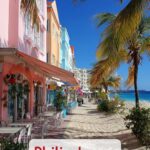
Short answer: walk Punda and Otrobanda, the two old quarters on either side of the harbor mouth.
Cross between them on the Queen Emma pontoon bridge, step inside the 1732 synagogue with its sand floor, and give the Kurá Hulanda Museum the 2 hours I’d give it.
Then get out of town for one day: the caves in the morning, a west-end beach like Grote Knip in the afternoon.
That’s Willemstad done properly.
Since 1997 the whole historic center has been a UNESCO World Heritage Site.
Most of what’s worth seeing is close enough to walk.
I rewrote this guide in October 2026 and dropped a few things from the old list that I couldn’t confirm are still running.
Here’s what’s left, in the order I’d do it.
In the city (all walkable)
1. Walk Punda’s waterfront
Start here.
Punda faces Otrobanda across Sint Anna Bay, and it’s one of the four quarters of the old centre, a UNESCO World Heritage Site since 1997.
Go early in the morning for photos, before the cruise crowds, and come back after dark when the bridge lights are on.
2. Cross the Queen Emma Bridge
Locals call it the “Swinging Old Lady,” and the nickname is literal.
It’s a pontoon bridge, built in 1888, that swings aside so ships can come into the harbor.
A small operator’s hut at one end runs two diesel engines that turn propellers and push the whole thing parallel to the shore.
It only takes a few minutes.
The lighting arches went up in 1955.
Worth timing your walk to see it swing.
3. Visit the Mikvé Israel-Emanuel Synagogue
Completed in 1732, it’s the oldest surviving synagogue in the Americas, and the congregation goes back to 1651.
Inside, the floor is covered in sand.
The sand is said to recall how the congregation’s ancestors on the Iberian peninsula covered the floors of their makeshift prayer houses, so their footsteps were muffled and no one would denounce them.
Honestly, it’s the single most memorable room in Willemstad.
It’s in Punda at Hanchi di Snoa 29.
4. Fort Amsterdam
The Dutch West India Company built it in 1634, the year it took the island from Spain.
It’s still the seat of Curaçao’s government and governor, so it’s a working government building.
5. Otrobanda
In Papiamentu the name means “the other side.”
It was founded in 1707 across the bay from Punda and became the city’s cultural center.
It feels less polished than Punda, which is part of the appeal.
6. The Kurá Hulanda Museum
If you do one museum, make it this one.
It sits in Otrobanda in restored buildings that were once part of a slave-trading post, and it deals with the transatlantic slave trade head-on.
It was founded in 1999 by Jacob Gelt Dekker.
There are five permanent exhibitions and more than 5,000 artifacts.
Guided tours run in four languages, English included, and I’d book one.
It’s heavy going.
But it’s the context the rest of the city needs.
You walk back out into Otrobanda a little differently, knowing this city grew into one of the major centers of the Atlantic slave trade.
I think that’s the point of putting the museum right here, on the quay where the slave ships came in, instead of somewhere tidier.
7. Look down from the Queen Juliana Bridge
At its top, the high bridge over the bay is 185 feet above the water.
Ships pass right under it.
It opened on April 30, 1974.
Part of it had collapsed during construction in 1967, killing 15 workers, and was rebuilt.
It’s a road bridge, so the view is from a car or a taxi, but it’s one of the highest viewpoints on the island.
Ask your driver to take it rather than the long way round.
8. Pietermaai and Scharloo
Pietermaai Smal and Scharloo face each other across the smaller Waaigat harbor, and both are among the four quarters of the protected historic center.
Pietermaai itself was laid out in 1675 just outside the old city walls.
Both sides are where I’d look for dinner.
One day out of town (rent a car)
9. Hato Caves
Limestone show caves north of Willemstad, about 790 ft long.
The Arawak and Caiquetio people who lived there around 1,500 years ago left petroglyphs, and runaway slaves later hid in them.
10. Christoffelpark
Curaçao’s big national park, at the island’s northwest end, built around Mount Christoffel.
At 1,239 feet, that’s Curaçao’s highest point.
The park takes in three old plantations and a mine site, and you can explore it by car, by bike, on horseback or on foot.
If you’re hiking to the top, go at first light.
It gets hot fast.
11. Grote Knip (Kenepa)
You’ve seen this one on every Curaçao poster.
It’s a small cove between high rocks on the west side, between Westpunt and Lagun.
It’s free and open to the public, and there’s a reef close by, so bring a snorkel.
Your Ultimate Caribbean Adventure Awaits!
Discover hidden coves, secret beaches, and the best rum punches in the islands. Your insider’s guide to Caribbean paradise.
Get Your Guide Now$15.99When to go
Honestly?
Any month works.
That’s rare for the Caribbean.
Curaçao is semi-arid.
It gets only about 18 inches of rain a year, mostly in a short wet season from October to December.
It also sits outside the main hurricane zone.
No hurricane has made landfall there since the US National Hurricane Center started tracking them, though passing storms have caused floods.
Average temperatures barely move, from about 80°F in January to 84°F in September, and trade winds take the edge off.
There’s no real off-season for weather, so pick your dates on price.
And check the cruise calendar if you can.
Punda feels very different on a day with two ships in port.
Practical bits
Dutch is the official language.
Papiamentu is what you’ll hear on the street, though, and English and Spanish are widely spoken too, so you’ll get by fine in English.
Willemstad is walkable.
The rest of the island is spread out, so rent a car for the day out.
And if you’re only in port on a cruise, booked for a few hours, stick to the first six on this list.
Weighing Curaçao against its neighbors?
Our ABC islands hub has everything else we’ve written about the ABC islands, and our things to do in Curaçao covers the rest of the island.
Related read: The Caribbean Travel Guide — Instant PDF + Kindle download. Secure checkout by Stripe