There’s this moment — right before you pull out of the driveway — where everything feels electric.
The tank is full.
The playlist is queued.
And for a second, you feel completely free.
I’ve chased that feeling more times than I can count.
But I’ve also sat on the side of a desert highway at 11pm, no signal, no snacks, and a phone at 3% — wondering what I was thinking.
That’s what built my essentials list.
Not some checklist I found online.
Real, hard-earned experience from hundreds of hours behind the wheel.
So let me save you some trouble.
My Go-To Car Organizer (Seriously, Don’t Skip This)

I used to laugh at people who had those back-seat car organizers.
Then I spent six hours digging through a pile of wrappers, chargers, and mystery receipts trying to find my sunglasses.
Now I’m a total convert.
A good organizer — one with deep pockets and a solid hanging system — changes everything about how your car feels on a long drive.
I use one that hooks over the passenger headrest and has separate slots for snacks, a water bottle, my notebook, and my phone.
It sounds small.
But when you’re three states deep and you just need a quick granola bar without pulling over, you’ll thank yourself.
If I’m being honest, the organizer alone cut my “frustrated stop” count in half.
Look for one that’s easy to wipe clean too.
Because things will spill.
They always do.
The Power Bank Situation (Mine Lives in the Cup Holder)

Your phone is your map, your music, your emergency contact, and your camera.
And it will die on you at the worst possible moment.
I learned this the hard way somewhere in Montana — no car charger, dying battery, and a turn I needed to make in about four minutes.
Now I carry two things without fail.
A high-capacity power bank — we’re talking something that can fully charge my phone at least three times — and a quality car charger with at least two USB-C ports.
The power bank lives in my cup holder.
Not the trunk.
Not the bag in the back.
The cup holder.
Accessible, charged, ready.
If you’re road-tripping with someone else, get one that charges two devices at once.
Nothing kills the vibe faster than fighting over the charger cord.
Snacks I Actually Pack (Not Just “Trail Mix”)

Okay, real talk.
I used to pack those little sad bags of trail mix and call it a day.
Then I’d stop at a gas station two hours in and spend fourteen dollars on chips and a lukewarm hot dog.
Now I pack intentionally.
A small soft cooler bag that fits between the front seats is my secret weapon.
Inside: cut fruit in a sealed container, string cheese, turkey roll-ups, a couple of boiled eggs, and yes — a few fun snacks, because road trips deserve a little indulgence.
Sparkling water cans.
Dark chocolate.
Corn nuts, because they’re criminally underrated on long drives.
I also pack a small ziplock of dry snacks in the center console — crackers, almonds, a couple of protein bars.
The goal is to feel fueled, not wrecked, when you finally arrive.
Your stomach will thank you.

🗼 I Wrote a Book About My Japan Travel Catastrophes!
Before I landed in Tokyo, I thought I was the “Final Boss” of international travel. Spoiler alert: I WASN’T. 😅
🚅 I boarded the wrong Shinkansen and ended up in THE WRONG CITY. I confused locals with my “expert” bowing that was more awkward than accurate. I accidentally stumbled into a high-stakes Kendo practice thinking it was a tourist show. Sound like something you’d do?
“Things I Wish I Knew Before Going to Japan” is your shortcut to avoiding ALL my cringe-worthy mistakes. ✨ Inside, you’ll find practical, LIFE-SAVING tips on etiquette, transport, money, and hidden gems that will save you time, money, and a whole lot of confusion.
My Emergency Kit Setup (Because You Just Never Know)

This is the part most people skip.
And it’s the part that matters most.
I keep a dedicated emergency bag in my trunk — always.
It’s not dramatic.
It’s just smart.
Inside mine: a basic first aid kit, a mini flashlight with extra batteries, jumper cables, a reflective triangle, a window breaker and seatbelt cutter combo tool, duct tape, a basic tool kit, and a small fire extinguisher.
I also keep a printed list of emergency numbers folded inside — just in case my phone really does die.
The one thing I’d say is non-negotiable?
The jumper cables.
I’ve used them for myself.
I’ve used them for strangers on the side of the road.
They’ve started some genuinely great conversations and saved some genuinely bad days.
What I Wear on Long Drives (Comfort Is Not Optional)

I used to think dressing for a road trip meant jeans and a t-shirt.
Then I did a 12-hour drive in stiff denim and arrived feeling like I’d been folded up inside a filing cabinet.
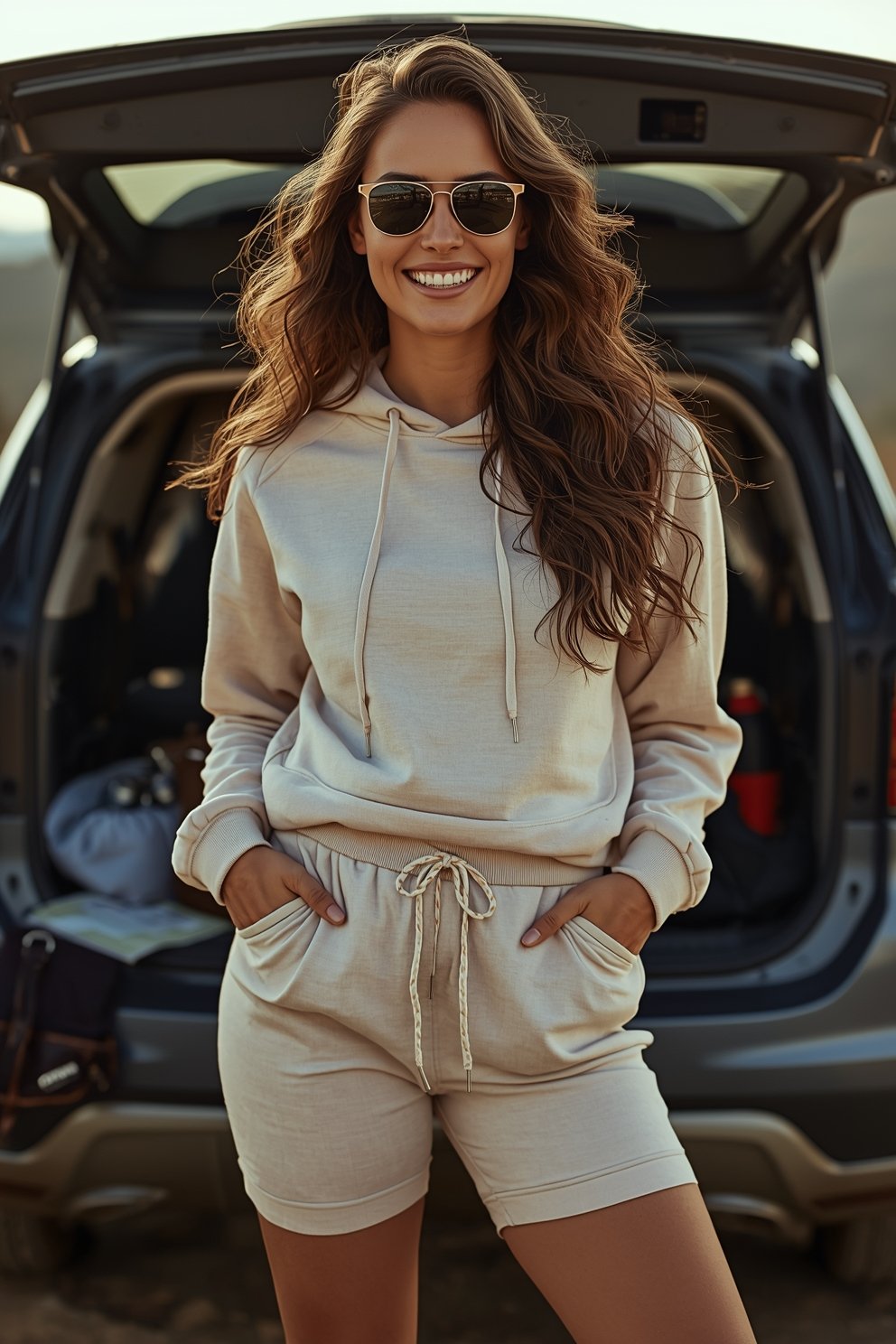
Now I wear soft joggers or athletic shorts, a breathable hoodie I can layer on and off, and my most broken-in sneakers.
Nothing restrictive.
Nothing that pinches after hour four.
I keep a small bag on the back seat with a fresh change of clothes for when I arrive — because showing up somewhere and being able to change into something clean feels like a reset button.
I also pack a baseball cap.
Not just for looks.
Sun glare on long afternoon drives is genuinely brutal, and a good brim saves your eyes when the visor isn’t enough.
Dress like you’re going to be sitting in a car for eight hours.
Because you will be.
The Cooler That Changed My Road Trips

I resisted buying a real cooler for years.
Soft bags, foam boxes — I tried them all.
Then a friend brought a hard-shell cooler on a group trip and I was kindda embarrassed by how much better his setup was.
A quality hard cooler keeps ice for days.
Not hours.
Days.
That means cold drinks all trip, fresh food that actually stays safe to eat, and zero stops at overpriced gas station coolers.
I keep mine loaded with a bag of cubed ice on the bottom, my drinks on one side, and food packed tightly on the other.
The trick I swear by: pre-chill everything before it goes in.
Room-temperature drinks eat through ice fast.
Cold drinks going in cold?
You’re set for the long haul.
If you road trip more than a few times a year, a solid cooler pays for itself fast.
My Comfort Essentials for the Passenger Seat

If you’re not driving, your job is to be comfortable.
And I take that seriously.
A good travel pillow — not the foam horseshoe kind, but one you can actually prop against the window — makes a long stretch genuinely restful.
I also keep a lightweight blanket tucked into the door pocket.
Not for sleeping necessarily, just for that weird in-between temperature you always hit somewhere around hour five when the AC is too cold and outside is too warm.
Noise-canceling earbuds are on my “never leave without them” list.
Whether you’re listening to a podcast, a playlist, or just blocking out the road noise to think — they’re worth every penny.
And if you’re the passenger with me?
You’re getting the aux and you’re expected to bring good energy.
That’s the deal.
The Navigation Setup I Actually Use

Google Maps on my phone is great.
But it’s not my only backup.
Before any big trip, I download the offline maps for every region I’m driving through.
Because signal drops.
Especially in mountains, deserts, and rural stretches where the drive is often the most beautiful part.
I also keep a small physical atlas in my door pocket.
Sort of old school, I know.
But there’s something I genuinely love about flipping it open at a rest stop and tracing the route with my finger.
Plus, it’s saved me twice when my phone was dead and I needed to navigate on the fly.
The other thing I do: I screenshot my key turns and save them to my camera roll before I leave.
Low-tech.
But it works every single time.
How I Handle Gas and Money on the Road

Cash is not dead on a road trip.
I always keep at least a little on hand — small bills, some quarters — for toll roads, parking meters, farm stands, and those amazing roadside diners that are cash only.
I also have a credit card I use specifically for travel, because the points add up fast when you’re filling a tank every few hundred miles.
Before I leave, I map out rough fuel stops along my route.
Not obsessively — just a general sense of where the stations are in case I hit a stretch with nothing.
Some parts of the American West will genuinely surprise you with how long you can go between options.
I once coasted into a tiny Nevada town with the fuel light blinking and about half a mile to spare.
Never again.
Fill up when you’re at a quarter tank.
Just do it.
🗼 I Wrote a Book About My Japan Travel Catastrophes!
Before I landed in Tokyo, I thought I was the “Final Boss” of international travel. Spoiler alert: I WASN’T. 😅
🚅 I boarded the wrong Shinkansen and ended up in THE WRONG CITY. I confused locals with my “expert” bowing that was more awkward than accurate. I accidentally stumbled into a high-stakes Kendo practice thinking it was a tourist show. Sound like something you’d do?
“Things I Wish I Knew Before Going to Japan” is your shortcut to avoiding ALL my cringe-worthy mistakes. ✨ Inside, you’ll find practical, LIFE-SAVING tips on etiquette, transport, money, and hidden gems that will save you time, money, and a whole lot of confusion.
Little Things That Make a Big Difference


This is my favorite section to share.
Because these aren’t glamorous — but they are genuinely game-changing.
A small spray bottle with water + a few drops of peppermint oil.
Spray it on your face and neck after a few hours.
Instant alert.
A microfiber towel for gas station spills, impromptu swim stops, or wiping down a dusty dashboard.
A reusable shopping bag stuffed under the seat for trash.
Because nothing kills the good road trip feeling like a car full of wrappers and empty cups.
Sunscreen in the center console.
Window glass does not fully block UV, and a left arm with more sun than the right is a very real thing.
A paper notebook and a pen.
Not for productivity.
Just for thoughts, random observations, and the occasional address of a place I want to remember.
Getting to your destination wired and exhausted is a real thing.
And I used to just crash — skip dinner, skip anything — and wake up stiff and groggy the next day.
Now I have a little ritual.
First: I move.
Even just a ten-minute walk around wherever I’ve stopped.
Legs, back, neck — everything needs to decompress.
Then: a real meal if it’s reasonable, or at least something warm if it’s late.
I keep instant oatmeal packets and a small camp-style electric kettle in my bag for exactly those moments when nothing is open and I just need something.
And then I write down one thing from the day.
One moment, one view, one conversation.
Something I want to hold onto.
Road trips go fast when you’re in them.
Writing it down slows it down just enough.