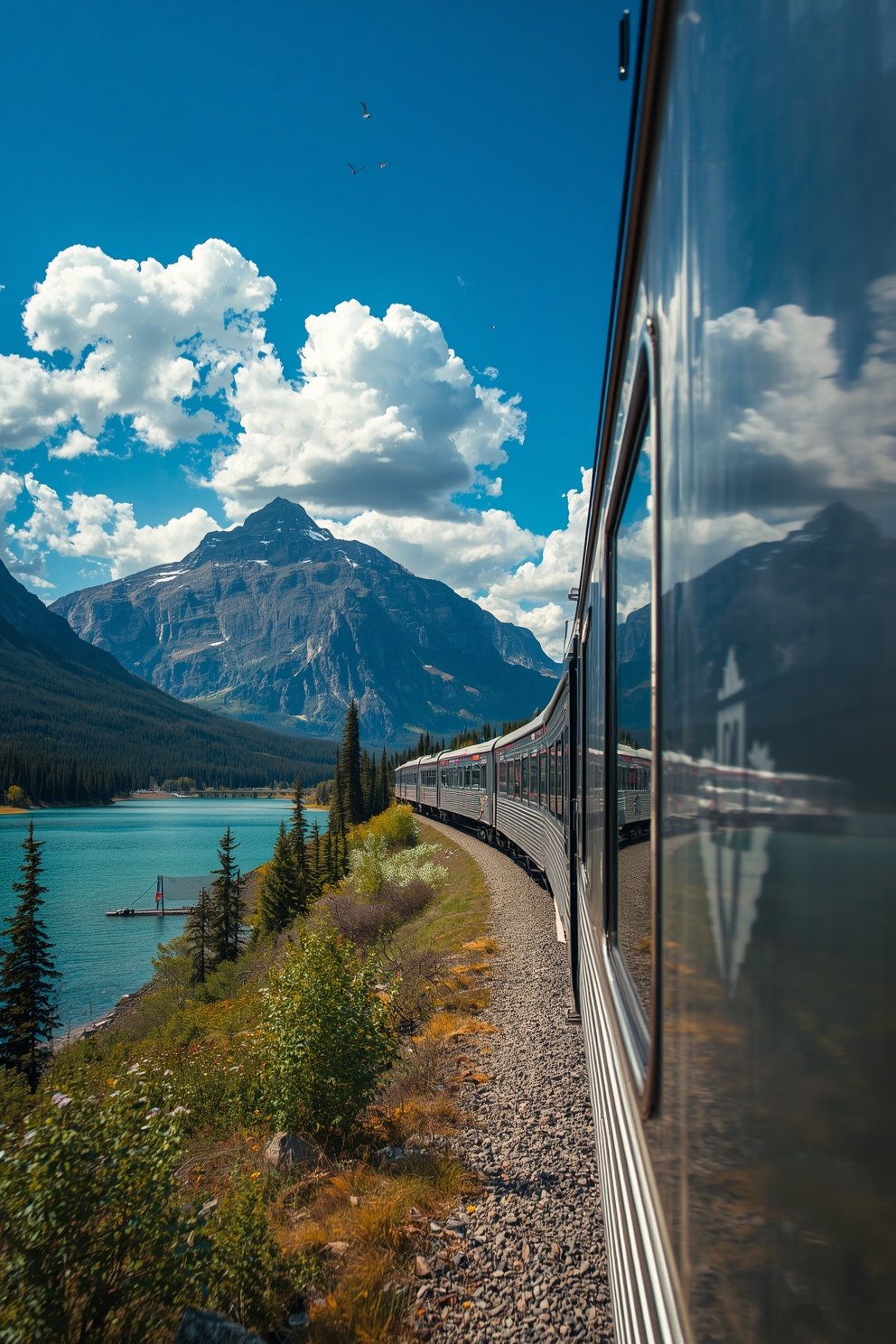
There’s this moment — and if you’ve done it, you already know exactly what I’m talking about — where the train rounds a bend and the valley just opens up below you.
No warning.
No announcement.
Just glass and light and something so wide and wild you actually forget to breathe for a second.
I had that moment somewhere in the Swiss Alps, coffee in hand, watching fog lift off the mountains like the whole world was slowly waking up.
That moment is why I’ll always choose the train.
Not the plane.
Not the highway.
The train.
And after years of chasing that feeling on rails across four continents, I’ve put together my personal list of the scenic rides that are genuinely worth every mile.
Why Train Travel Hits Different (And I Mean That Literally)

I used to be a fly-everywhere guy.
Fast, efficient, done.
But somewhere along the way I realized I was skipping the whole middle part of travel — the part where the place actually gets under your skin.
A plane takes you over a country.
A train takes you through it.
And those are two completely different experiences.
When you’re riding through the Scottish Highlands or cutting across the Canadian Rockies at ground level, you feel the scale of things in a way that no altitude can replicate.
The villages blur past.
The rivers follow you.
The mountains grow slowly, over hours, instead of appearing suddenly below a cloud.
It’s slower, sure.
But slow is kind of the point.
I think the reason scenic train travel feels so deeply satisfying is that it forces you to be present.
Your phone signal drops.
There’s nothing to do but look out the window.
And honestly?
That’s exactly what I needed every single time I got on one of these trains.
The Glacier Express, Switzerland — The One That Started Everything

This is the ride that converted me.
Full stop.
The Glacier Express runs between Zermatt and St.
Moritz, and calling it a train ride almost feels like an insult to what it actually is.
It’s eight hours of pure, unrelenting Swiss mountain scenery.
Viaducts curving over gorges.
Tiny red-roofed villages that look like they were placed there on purpose.
Snow-capped peaks that just don’t quit.
I took the panoramic car — the one with the enormous curved windows that go almost to the ceiling — and I genuinely did not look at my phone for six hours.
That never happens.
My tip: book the dining car lunch.
It’s not cheap, but sitting down to a proper meal while the Rhône Valley rolls past your table is an experience that I still think about constantly.
And if I could give you one piece of practical advice?
Go in early autumn.
The alpine light is golden, the crowds have thinned, and the whole thing just feels cinematic in a way that’s hard to describe.
The Rocky Mountaineer, Canada — Big Sky, Bigger Feelings

Canada does scale better than almost anywhere on earth.
And the Rocky Mountaineer proves that.
This private train runs through British Columbia and Alberta, and it only travels during the day — which is actually brilliant, because you don’t miss a single mountain, river canyon, or black bear standing in a meadow.
(Yes, I saw a bear.
From the train.
Safe and spectacular.)
The GoldLeaf Service is worth the upgrade if your budget allows — you get a glass-domed upper level that feels like riding inside a moving greenhouse.
The Fraser River Canyon section is especially wild.
You’re threading through walls of rock with the river churning somewhere below, and you just kind of sit there with your mouth open going “okay, this is insane.”
What I love about this route is how the landscape shifts.
You start in lush Pacific forest, and then slowly — over hours — the terrain opens up into high desert and then dramatic mountain peaks.
It’s like watching three different countries pass by.
My honest recommendation?
Do it as a two-day journey with an overnight stop in Kamloops.
Don’t rush it.
🗼 I Wrote a Book About My Japan Travel Catastrophes!
Before I landed in Tokyo, I thought I was the “Final Boss” of international travel. Spoiler alert: I WASN’T. 😅
🚅 I boarded the wrong Shinkansen and ended up in THE WRONG CITY. I confused locals with my “expert” bowing that was more awkward than accurate. I accidentally stumbled into a high-stakes Kendo practice thinking it was a tourist show. Sound like something you’d do?
“Things I Wish I Knew Before Going to Japan” is your shortcut to avoiding ALL my cringe-worthy mistakes. ✨ Inside, you’ll find practical, LIFE-SAVING tips on etiquette, transport, money, and hidden gems that will save you time, money, and a whole lot of confusion.
The Trans-Siberian Railway — For the Ones Who Need to Disappear for a While

Okay, this one isn’t for everyone.
But if it’s for you, you already know.
The Trans-Siberian is roughly 5,700 miles from Moscow to Vladivostok, and it takes about a week to complete the full route.
A week.
On a train.
I know.
But here’s the thing — it’s one of the most meditative, perspective-shifting experiences I’ve ever had in my life.
Somewhere around day three, the Lake Baikal stretch hits.
And it’s the deepest lake in the world, and it stretches on so long that you start to wonder if you’re dreaming.
The train shudders along its edge for hours.
Frozen or liquid, it doesn’t matter — Baikal is something else.
I’d recommend booking a two-person coupe for comfort.
Bring food.
Pack books.
Talk to the Russians in your car.
Use translation apps.
Accept tea from the provodnitsa (the car attendant) every time it’s offered.
And let go of needing to be somewhere.
That’s the whole lesson of the Trans-Siberian.
The Bernina Express, Switzerland/Italy — The One That Crosses a World Heritage Route

The Bernina Express is technically a different train than the Glacier Express, but hear me out — if you can do both, do both.
This one runs from Chur in Switzerland down to Tirano in Italy, crossing the Alps through the Rhaetian Railway, which is actually a UNESCO World Heritage Site.
The engineering alone is jaw-dropping.
There’s a section called the Brusio Spiral Viaduct — a curved spiral bridge that the train actually loops around to descend the mountain grade.
You can look out one side of the train, and then look out the other, and you’ll see where you just were.
It’s surreal.
The highest point, Ospizio Bernina, sits at over 7,000 feet and is often buried in snow even when the valleys below are warm and green.
The contrast is genuinely stunning.
And then you drop down into northern Italy and suddenly there are palm trees.
Palm trees.
After the snow.
The whole ride takes about four hours, which makes it totally doable as a day trip.
My personal hack: sit on the left side heading south for the best mountain views.
Rovos Rail, South Africa — Slow Luxury Through the Wild

I’ll be real with you — Rovos Rail is an investment.
It’s not budget travel.
But if you’re ever in a position to do it, it is nothing like anything else on this list.
The train itself is restored Edwardian-era carriages, dark wood paneling, white linen tablecloths, and a lounge car where people actually dress for dinner.
It sounds intimidating.
It’s actually incredibly warm and social.
The routes vary — my favorite runs between Pretoria and Cape Town — and along the way you pass through the Karoo desert, wine country, and open plains where you genuinely spot wildlife from your compartment window.
The observation car at the back of the train is open-air.
You stand there with a drink and watch the South African landscape trail behind you in the golden hour light.
It’s the kind of thing you want to just bottle.
Rovos also does shorter routes that are more accessible price-wise, including a journey to Victoria Falls.
If you’re planning a southern Africa trip, look at weaving this in.
It reframes the whole journey.
The Douro Valley Line, Portugal — My Underrated Favorite

Nobody talks about this one enough, and honestly I sort of love that.
The Douro Valley in northern Portugal is one of the most beautiful wine regions in the world — terraced vineyards climbing impossibly steep hillsides above a slow green river.
And you can ride a train right through the middle of it.
The line runs from Porto to Pocinho, but the best section is the stretch from Pinhão onward.
The train is slow, local, not luxury — just a regular regional train.
And somehow that makes it even better.
You’re not on a tourist experience.
You’re just… traveling through Portugal.
Old men get on and off at tiny stations.
Women with baskets.
Sunlight on the river.
I took this ride on a Thursday afternoon with no plan and no guidebook, and it ended up being one of my favorite afternoons in all of Europe.
My tip: grab a window seat on the right side heading east for river views.
And get off at Pinhão for a night or two.
The village is tiny and absolutely perfect.
The Shinkansen, Japan — Speed That Still Feels Scenic

Okay, so the Shinkansen isn’t a slow scenic train in the traditional sense.
It moves at up to 200 miles per hour.
But hear me out, because this belongs on this list.
If you’re riding between Tokyo and Kyoto, and the weather cooperates, there’s a moment where Mount Fuji just appears on your right.
Massive.
Perfectly symmetrical.
Snow-capped even in spring.
And because the train is moving so fast, you have maybe 30-45 seconds to see it before it’s gone.
I’ve ridden this route probably five or six times.
I’ve seen Fuji clearly maybe twice.
It’s kind of become a personal ritual — I always get a window seat on the right side heading west, I always have my camera ready, and I always feel like a kid when the mountain shows up.
The Shinkansen is also just… a really good experience in itself.
The seats are comfortable.
The bento boxes from the station are incredible.
And there’s something deeply satisfying about moving across Japan at that speed and still feeling completely calm.
What to Actually Pack for a Long Train Journey

Let me save you from learning this the hard way.
Layers.
Always layers.
Train cars can swing between tropical and freezing depending on the car, the season, and whether the heating system is cooperating.
A lightweight packable down jacket has saved me more times than I can count.
Noise-canceling headphones are non-negotiable on longer routes.
Not because trains are loud — they’re actually pretty meditative — but for the overnight legs when you want to actually sleep.
I always bring a reusable water bottle, a small snack stash (nuts, jerky, something with protein), and a real book.
Not just my phone.
An actual book.
Something about the rhythm of a train makes reading feel incredible.
A neck pillow sounds embarrassing until hour six.
Then it’s your best friend.
And honestly?
Bring a journal.
Because you’re going to have thoughts on these rides — real, quiet, unhurried thoughts — and you’re going to want somewhere to put them.
🗼 I Wrote a Book About My Japan Travel Catastrophes!
Before I landed in Tokyo, I thought I was the “Final Boss” of international travel. Spoiler alert: I WASN’T. 😅
🚅 I boarded the wrong Shinkansen and ended up in THE WRONG CITY. I confused locals with my “expert” bowing that was more awkward than accurate. I accidentally stumbled into a high-stakes Kendo practice thinking it was a tourist show. Sound like something you’d do?
“Things I Wish I Knew Before Going to Japan” is your shortcut to avoiding ALL my cringe-worthy mistakes. ✨ Inside, you’ll find practical, LIFE-SAVING tips on etiquette, transport, money, and hidden gems that will save you time, money, and a whole lot of confusion.
How to Book the Best Seat (And Why It Matters More Than You Think)

Research the direction of travel before you book.
I cannot stress this enough.
On the Glacier Express heading east toward St.
Moritz, you want the left side of the train for the best valley views.
On the Rocky Mountaineer heading east toward Banff, you generally want the right side.
Every route has its “best side” and usually a quick search or forum thread will tell you exactly which one.
For luxury trains like Rovos or the Venice Simplon-Orient-Express, book as far in advance as possible — and don’t be shy about calling to ask which cabin has the best views.
The staff know.
They’ll tell you.
On day trains, always try to get a window seat rather than an aisle.
Sounds obvious.
But I’ve seen people give up window seats for a bit of extra legroom and then regret it for the entire ride.
For overnight trains, a private sleeper compartment is worth the premium if the budget allows.
Shared couchettes are fine for shorter overnight legs, but anything over eight hours, I want my own space.
The Slow Travel Mindset That Makes All of This Work

Here’s something I genuinely believe: most people rush train journeys the same way they rush everything else.
They treat the train like transportation — just a way to get from A to B.
And when you do that, you miss the whole thing.
Scenic train travel only works if you decide, upfront, that the journey is the destination.
The hours on the train aren’t the filler between experiences.
They are the experience.
When I tackled my first long-haul train journey solo, I remember feeling antsy around hour three.
Like I should be doing something.
Productive.
But somewhere around hour five, something shifted.
The landscape outside became genuinely hypnotic.
I stopped checking the time.
I just… watched.
And by the time I arrived, I felt more rested and more inspired than I had in months.
That’s the gift of slow travel.
It gives your brain the kind of unstructured space it never gets in regular life.
And once you feel it, you’ll kind of start structuring all your trips around it.
My Personal Ranking — If You Can Only Do One

If someone sat down across from me right now and said, “Jeff, I can do one scenic train ride in my life — which one?” —
I’d say the Glacier Express.
Without hesitation.
Not because it’s the most dramatic or the longest or the most remote.
But because it delivers on every single front — scenery, comfort, food, accessibility — and it leaves you with that exact feeling I described in the very beginning.
That moment where the valley opens up and you forget to breathe.
The Trans-Siberian is life-changing in a more internal, philosophical way.
Rovos Rail is the most purely luxurious.
The Douro Valley is the most authentically local.
But the Glacier Express is the one I’d hand to someone who’d never done this before and say, “This.
Start here.
And then you’ll understand why train travel ruins you for everything else.”
In the best possible way.
Related read: Things I Wish I Knew Before Going to Japan — Instant PDF + Kindle download. Secure checkout by Stripe