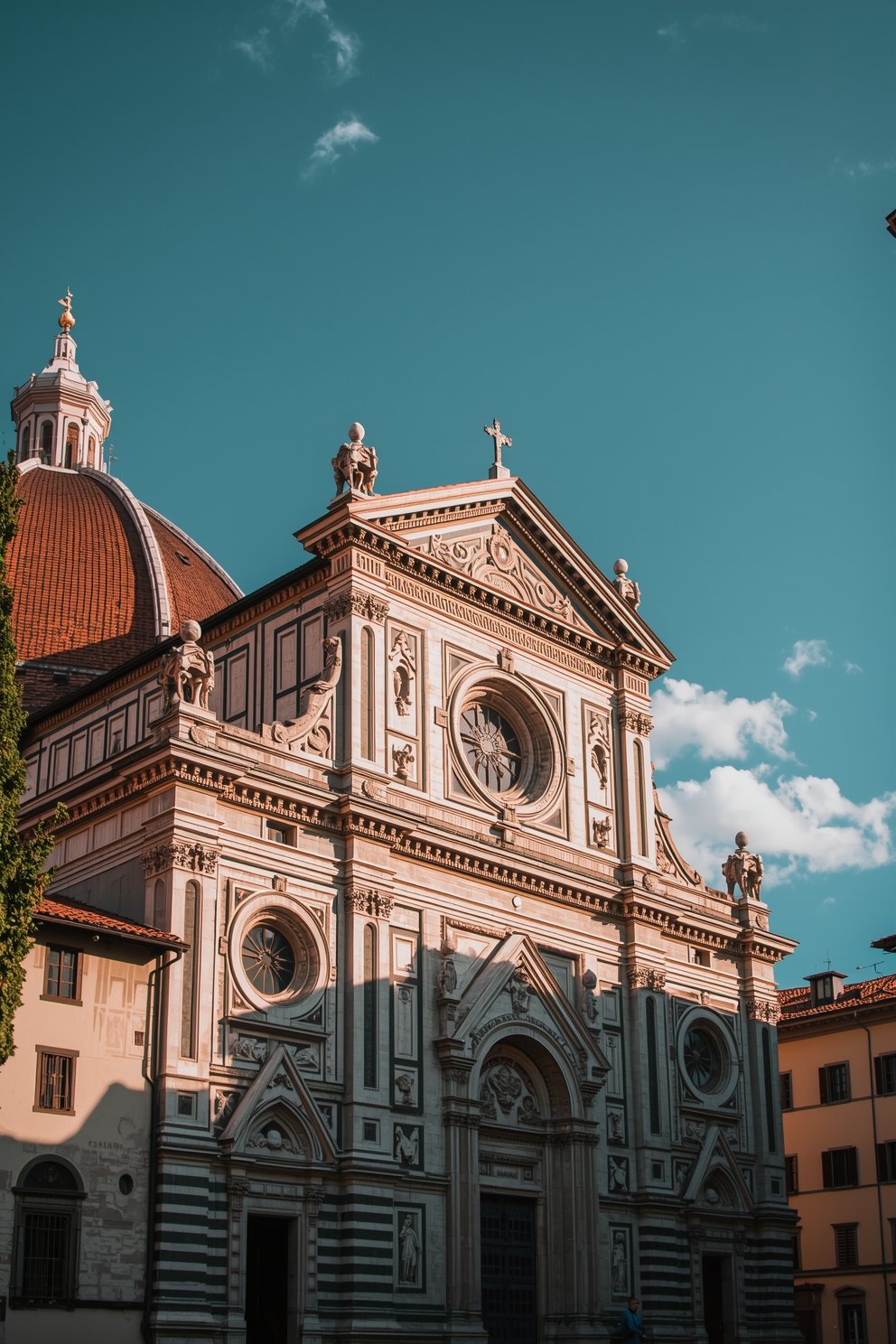
Florence doesn’t ease you in.
It just hits you.
The golden light on the stone buildings, the smell of leather and espresso mixing in the warm evening air — it’s almost too much to take in at once.
And honestly?
I kind of loved feeling overwhelmed by it.
This city has a way of making you feel small and alive at the exact same time.
If you’re planning a trip, or even just dreaming about one, I put together everything I wish I’d known before my first visit.
The First Morning — Don’t Rush It

Okay, first things first.
I know you’re going to want to hit every museum, every piazza, every rooftop view on day one.
But trust me on this — don’t.
When I first arrived in Florence, I made the classic mistake of trying to cram everything into 48 hours.
I was exhausted by noon.
The city actually rewards slowness.
Start your first morning with a walk through the streets near your accommodation before the crowds show up.
Just wander.
No map.
No agenda.
Let yourself get a little lost in the narrow cobblestone alleys — the ones where laundry hangs between windows and a cat is napping in a doorway.
Grab a cornetto and a cappuccino at a small local bar, standing at the counter like a local does.
That first slow morning set the tone for my entire trip.
It reminded me that Florence isn’t a checklist.
It’s an experience.
The Duomo — Yes, It’s Worth Every Single Ounce of the Hype

I was skeptical, honestly.
I’d seen so many photos of the Florence Cathedral that I figured it couldn’t possibly live up to them.
I was completely wrong.
Standing in the Piazza del Duomo for the first time, looking up at that massive terracotta dome — Brunelleschi’s masterpiece — I literally stopped mid-sentence talking to my travel buddy.
Words just… fell out of my head.
The facade is this insane mix of pink, white, and green marble that somehow works in a way nothing should.
You can climb to the top of the dome, and if you do, please know: it’s a lot of stairs.
Like, a lot.
But the view from up there — the terracotta rooftops stretching out in every direction, the hills rolling in the distance — it’s the kind of view that makes you feel like you’re inside a painting.
Book your time slot in advance.
The line without a reservation is brutal and I’d hate for you to waste half your day standing in it.
The Uffizi Gallery — Take It Slow, Not Fast

Here’s something nobody told me before I went to the Uffizi.
You cannot do it justice in two hours.
I tried.
I speed-walked past Botticelli’s Birth of Venus like I was late for a flight, and I felt vaguely ashamed of myself for the rest of the afternoon.
Go back if you do that.
The Uffizi is one of the most important art collections in the entire world, and the way the light comes through those long gallery corridors makes everything feel almost sacred.
My honest recommendation?
Pick three or four rooms that matter most to you and really sit with them.
The Botticelli rooms alone are worth the price of admission.
I stood in front of Primavera for probably twenty minutes.
The details in that painting — the flowers, the translucent fabric, the expressions — are something you genuinely can’t absorb from a screen.
Book tickets way ahead of time.
This is not a show-up-and-buy-at-the-door situation.
🗼 I Wrote a Book About My Japan Travel Catastrophes!
Before I landed in Tokyo, I thought I was the “Final Boss” of international travel. Spoiler alert: I WASN’T. 😅
🚅 I boarded the wrong Shinkansen and ended up in THE WRONG CITY. I confused locals with my “expert” bowing that was more awkward than accurate. I accidentally stumbled into a high-stakes Kendo practice thinking it was a tourist show. Sound like something you’d do?
“Things I Wish I Knew Before Going to Japan” is your shortcut to avoiding ALL my cringe-worthy mistakes. ✨ Inside, you’ll find practical, LIFE-SAVING tips on etiquette, transport, money, and hidden gems that will save you time, money, and a whole lot of confusion.
Ponte Vecchio and the Arno at Golden Hour

There’s a specific time of day to be on the Ponte Vecchio.
And that time is late afternoon, when the light turns that deep amber gold and hits the Arno just right.
The bridge itself is lined with goldsmiths and jewelers — it’s been that way since the 16th century, which is kind of mind-blowing when you think about it.
I didn’t buy anything.
But I spent a long time looking in those tiny lit windows, watching the craftsmen work.
The Arno from the bridge has this warm, glassy quality in the evening that makes you want to just stop and stare.
If I could do one thing every single day in Florence, it would be standing on that bridge at golden hour with a gelato in hand.
Speaking of which — get your gelato before you get to the bridge so you have something to do with your hands while you stare dramatically into the distance.
You’re welcome.
The Oltrarno Neighborhood — My Favorite Side of the River

Okay, so this is my personal gem.
Cross the Ponte Vecchio to the south side of the Arno, and you’re in Oltrarno.
And Oltrarno is where Florence feels real.
Less touristy, more lived-in.
The streets are quieter.
There are artisan workshops where you can peek in and watch someone restore an antique frame or hand-stitch a leather bag.
The restaurants are smaller and the menus are shorter — which, in Italy, is almost always a good sign.
I had one of the best lunches of my entire life at a tiny trattoria in Oltrarno where the owner was also the cook and probably the dishwasher too.
He brought out food I didn’t even order.
I just… ate it all.
No complaints.
Spend at least half a day on this side of the river.
Wander the Piazza Santo Spirito on a weekday morning when locals are just hanging around drinking coffee.
It has this low-key, neighborhood energy that I sort of fell in love with immediately.
Piazzale Michelangelo — The View That Changes Everything

Every travel blog will tell you to go to Piazzale Michelangelo.
I’m telling you again because it is absolutely, completely worth it.
It’s a large terrace up on a hill south of the city, and from it you get a panoramic view of Florence that is genuinely one of the most beautiful things I have ever seen in my life.
The Duomo.
The Arno.
The bridges.
The terracotta rooftops stretching toward the hills.
All of it, in one frame.
I went at sunrise and I went again at sunset.
Both times, I just kind of stood there in semi-disbelief.
The walk up takes about 20 minutes from the city center, and it’s a nice gentle climb through shaded paths.
Or you can take a bus if your legs are already done for the day.
No judgment.
Bring a snack, find a quiet spot away from the main crowd, and just breathe it in.
This is the view that makes you understand why people dedicate entire lifetimes to coming back to Florence.
The Food — This Deserves Its Own Entire Blog Post, Honestly

I could write about Florentine food for hours.
And I kind of want to.
The food here is Tuscan — hearty, simple, deeply satisfying.
Think thick-cut bistecca alla Fiorentina (the famous T-bone steak), ribollita (a rustic bread and vegetable soup that sounds boring and tastes like a hug), pappa al pomodoro, and hand-rolled pasta with wild boar ragù.
I’m obsessed with all of it.
Find a trattoria that doesn’t have a menu printed in five languages or a guy standing outside trying to usher you in.
Those are tourist traps and the food will disappoint you.
Walk a few streets away from the main squares.
Look for the place where locals are eating lunch at 1pm on a Tuesday.
Go there.
Order whatever the daily special is.
And please, for the love of everything good in this world, get the gelato from an artisan shop — the kind where the gelato is stored in covered metal containers, not piled high in colorful mounds.
That’s the real stuff.
Mercato Centrale — The Most Beautiful Market I’ve Ever Walked Through

The Mercato Centrale near San Lorenzo is two floors of absolute sensory overload.
And I mean that in the best way.
The ground floor is a working food market — fresh pasta, truffle products, aged cheeses, cured meats, fresh produce, olive oils, wines.
The smell alone when you walk in is worth the trip.
I spent probably an hour just wandering around, tasting samples, having small conversations with vendors who are clearly proud of what they sell.
The upper floor is a food hall where you can sit down and eat — everything from lampredotto sandwiches (don’t ask, just try it) to fresh pasta dishes to really excellent espresso.
This is a great spot for a casual lunch that won’t break the bank.
It’s also a solid rainy-day option if the weather turns on you.
Pro tip: go on a weekday morning before the tour groups arrive.
It has a totally different, quieter energy and the vendors have more time to chat.
The Boboli Gardens — Breathe Some Air Between the Art

Art fatigue is real.
I’m warning you now.
After a couple of days of museums and churches and galleries, your brain starts to go a bit numb and everything starts to blur together.
That’s when you need the Boboli Gardens.
The gardens sit behind the Pitti Palace on the Oltrarno side, and they are vast — 111 acres of terraced Renaissance landscape, fountains, sculptures, grottos, and shaded paths.
It’s the kind of place where you can just… exhale.
I spent an afternoon there doing basically nothing.
Sat on a bench in the sun.
Watched pigeons.
Ate a sandwich I’d packed from the market.
It was one of my favorite afternoons of the whole trip.
The view from the upper terraces back toward the city is also stunning — different from Piazzale Michelangelo but equally lovely in its own quieter way.
If you’re visiting in summer, this is also one of the most pleasant places in the city to escape the midday heat.
🗼 I Wrote a Book About My Japan Travel Catastrophes!
Before I landed in Tokyo, I thought I was the “Final Boss” of international travel. Spoiler alert: I WASN’T. 😅
🚅 I boarded the wrong Shinkansen and ended up in THE WRONG CITY. I confused locals with my “expert” bowing that was more awkward than accurate. I accidentally stumbled into a high-stakes Kendo practice thinking it was a tourist show. Sound like something you’d do?
“Things I Wish I Knew Before Going to Japan” is your shortcut to avoiding ALL my cringe-worthy mistakes. ✨ Inside, you’ll find practical, LIFE-SAVING tips on etiquette, transport, money, and hidden gems that will save you time, money, and a whole lot of confusion.
Santa Croce Basilica — The Place That Genuinely Moved Me

I’ll be honest — I almost skipped Santa Croce.
I had already seen so many beautiful churches that I figured one more wasn’t going to do much for me.
I was so wrong.
Santa Croce is the burial place of Michelangelo, Galileo, Machiavelli, and Dante (cenotaph), among others.
Walking through that space knowing who is buried beneath the floor — it’s a strange, heavy, moving feeling.
The interior is stunning, but it’s not flashy.
It’s solemn and grand and quiet in a way that makes you want to lower your voice.
The Pazzi Chapel inside the complex is considered one of the finest examples of early Renaissance architecture in the world.
I stood in it for a long time just looking at the geometry of the ceiling.
The cloister attached to the basilica is also one of those spots that feels like a secret.
Cool stone, a quiet garden, the distant sound of the city.
It’s worth every minute.
My Personal Tips for Getting Around Florence

Florence is a very walkable city, and that’s honestly one of my favorite things about it.
Almost everything worth seeing is within a 20-30 minute walk of the historic center.
Wear comfortable shoes.
I cannot stress this enough.
The cobblestones are gorgeous and completely unforgiving on anything with a heel or a thin sole.
I learned this the hard way on day two.
Get a city map from your hotel or accommodation — not because you’ll need it constantly, but because it’s genuinely helpful when you’re trying to figure out where you are after turning left three times in Oltrarno.
The best time to visit is shoulder season — late spring or early fall.
Summer is hot, crowded, and the lines are at their worst.
If you do go in summer, start every day before 9am.
You’ll have the streets almost to yourself for that first golden hour.
And book everything in advance.
I keep saying it because I mean it.
The Duomo, the Uffizi, the Accademia (Michelangelo’s David — obviously go see that) — all of them need timed entry tickets that sell out fast.
A Few Things I Wish I’d Known Before My First Visit

There’s a drinking fountain culture in Florence that I didn’t know about.
All over the city, there are small stone fountains called nasoni (little noses) that dispense fresh, cold, totally drinkable water.
Bring a refillable bottle.
You’ll thank yourself.
Churches in Florence often have a dress code — covered shoulders and knees.
Carry a light scarf or a packable layer and you’ll be fine.
Most of the smaller churches are free to enter, and some of them — the tiny neighborhood ones tucked into side streets — contain frescoes and altarpieces that would be major attractions in any other city.
Wander into any open church door you pass.
Seriously.
Also — and this is a big one — don’t eat right next to the major monuments.
The restaurants on the Piazza del Duomo or directly beside the Uffizi are typically overpriced and mediocre.
Walk two blocks in any direction and the quality immediately improves.
Florence rewards the curious.
The more you’re willing to wander away from the obvious, the better your experience is going to be.
That’s been true every single time I’ve been back.