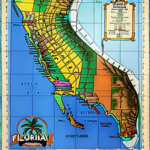
Short answer: Sinkhole Alley is three counties in the Tampa area of west-central Florida: Hernando, Pasco and Hillsborough.
What puts them on the map is insurance claims, not geology: between 2006 and 2010, 66 percent of the sinkhole claims reported to Florida’s insurance regulator came from those three counties.
That second sentence is the part most pages skip, and it changes how you should read the nickname (it changed how I read it, anyway).
I rewrote this post in October 2026.
The old version called the three counties “cities,” gave an unsourced sinkhole count for Brevard County, and never mentioned the most interesting finding about the Alley.
Here it is.
The Alley is about claims
In 2010, Florida’s Office of Insurance Regulation asked 211 insurers for their sinkhole numbers.
Claims had climbed from 2,360 in 2006 to 6,694 in just part of 2010, for 24,671 claims and about $1.4 billion over those years.
Two-thirds of them came from those three counties.
Now the twist, and it’s a weird one.
A December 2010 Florida Senate report, citing licensed geologists, said there was “no geological explanation” for a jump that big.
It also noted that other counties with similar geology, and plenty of new building, had nowhere near as many claims.
The state’s insurance commissioner worried that many claims were questionable.
One reason given: some homeowners could keep the cash from a claim without ever fixing the house.
So I read “Sinkhole Alley” as a map of where the paperwork piled up, and where public adjusters were busiest, rather than as a map of where the earth is weakest.
It doesn’t mean the ground near Tampa is about to open under your rental car.
Why that area gets sinkholes at all
You’re still in sinkhole country there, to be fair.
Florida’s state geologists described the area (they drew it to include Pinellas County too) as limestone close to the surface, covered by sand mixed with clay.
Water slowly dissolves limestone and leaves gaps.
When the cover can’t hold up anymore, it drops.
Turns out where you are in the state matters.
Central Florida gets the most collapses, and its limestone is old, 15 to 25 million years.
Out on the state’s fringes, the limestone is around 120,000 years old and sinkholes are rare or missing.
People can speed things up, too.
Pumping a lot of groundwater fast, like farms do to protect winter crops from frost in west-central Florida, can set off new ones.
The Alley isn’t even the only place with that geology.
The same report listed Orange, Marion, Citrus, Levy and a long string of other counties as similar.
Should you worry if you’re visiting?
Honestly, no. If I’d booked a week near Tampa, sinkholes wouldn’t make my list of worries (the line at the rental counter would).
Even among homeowners’ claims, the big scary kind is rare.
Back in 2010 the insurance commissioner said only about one percent of claims were catastrophic enough to make a home unlivable.
Many were cracks in foundations and driveways, often from a house settling.
Most were settled for $30,000 to $40,000.
Not nothing.
But not a house falling into a hole, either.
The famous exception is worth knowing, and it wasn’t even in the Alley.
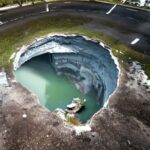
On May 8, 1981, a sinkhole opened in Winter Park, in central Florida, during record-low water levels in the aquifer.
It grew to 320 feet wide and 90 feet deep and swallowed a three-bedroom house, five Porsches at a repair shop and part of the city pool.
It’s a lake now.
Lake Rose.


🗼 I Wrote a Book About My Japan Travel Catastrophes!
Before I landed in Tokyo, I thought I was the “Final Boss” of international travel. Spoiler alert: I WASN’T. 😅
🚅 I boarded the wrong Shinkansen and ended up in THE WRONG CITY. I confused locals with my “expert” bowing that was more awkward than accurate. I accidentally stumbled into a high-stakes Kendo practice thinking it was a tourist show. Sound like something you’d do?
“Things I Wish I Knew Before Going to Japan” is your shortcut to avoiding ALL my cringe-worthy mistakes. ✨ Inside, you’ll find practical, LIFE-SAVING tips on etiquette, transport, money, and hidden gems that will save you time, money, and a whole lot of confusion.
If you’re buying, not visiting
Yeah, that’s where the Alley really matters, and where I’d slow down.
Under Florida law (section 627.706, as it reads in 2026), every insurer that sells property insurance here has to cover a “catastrophic ground cover collapse.”
That’s a narrow thing.
The ground has to collapse suddenly and leave a hole you can plainly see, the building has to be structurally damaged, and the government has to condemn it and order everyone out.
Settling or cracking alone doesn’t count.
For anything short of that, insurers must offer separate sinkhole coverage for an extra premium.
So if you’re buying in Hernando or Pasco, ask about it before you sign.
We go through the trade-offs in is sinkhole insurance worth it in Florida.
Where to see one on purpose
This is the bit I’d actually plan around.
Florida has sinkholes you can visit, and they’re a lot prettier than a cracked driveway:
- Devil’s Millhopper in Gainesville: a state park sinkhole about 120 feet deep and 500 feet wide, with twelve springs feeding a pond at the bottom.
- Lake Eola in downtown Orlando: the lake at the heart of Lake Eola Park is a sinkhole.
- Kingsley Lake near Starke: thought to have formed as a sinkhole, and almost perfectly round.
Curious about a town before you book a stay there?
Our Florida sinkhole map shows the reports near any Florida town.
For the bigger picture, read why Florida has so many sinkholes and what part of Florida has the least, or browse our Florida geography and sinkholes guide.