
No. Not one you can count on, anyway.
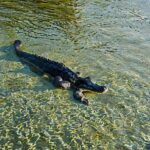
Alligators live in all 67 Florida counties and in every wild area of the state that can support them, about 1.3 million of them in all.
So the useful question isn’t which lake has none.
It’s where and when you can get in the water with the least chance of company, and what to do when you do see one.
Every Wild Lake Can Hold One, Big or Small

If you wanted to check every lake yourself, you’d be busy.
Florida has more than 7,800 naturally occurring lakes.
One older count put 88 percent of them under 16 acres each, and most are shallow (usually under 16 feet) because they started out as sinkholes.
Most are young, too, by lake standards: they first filled 6,000 to 8,000 years ago.
Small doesn’t save you.
Alligators prefer fresh water lakes and slow-moving rivers and the wetlands around them, and you can find them in brackish water and smaller bodies of water too.
The state even offers signs warning that alligators may be in ponds and canals.
Lakes can grow very big gators, too.
Both state records came out of lakes.
The record for length is a 14-foot, 3½-inch male from Lake Washington in Brevard County.
The weight record, a 1,043 pound male, came out of Orange Lake in Alachua County.
There’s more on one big lake in facts about alligators and lakes in Florida, with Lake Istokpoga as the example.
A “private” lake is private to people, not to wildlife.
They turn up on private property too, and a trapper needs the owner’s permission before taking one off it.
(Curious what the word means in the first place?
Here’s what makes a lake private in Florida.)
Weirdly, even a swimming pool isn’t a promise.
Small alligators wind up in swimming pools and garages and have to be removed.
Why Florida Wants Them in Its Lakes Anyway

Honestly, the gators earn their spot.
The alligator is a keystone species of Everglades National Park, and for real reasons.
In the winter dry season, alligators dig out “alligator holes” that hold water while the land around them dries up.
Other animals crowd into them to get through the drought (and yes, some of them get eaten, but the refuge is worth the risk).
Their nests matter too.
The females’ nesting helps make peat, and several turtles, the Florida red-bellied turtle among them, lay their eggs inside alligator nests, both active and abandoned ones.
And they nearly didn’t make it.
Hunting and lost habitat put the American alligator on the endangered list in 1967.
It came off in 1987, 20 years later, and it’s still thriving in Florida today.
One thing to keep straight: Florida has crocodiles too, and they’re a different animal with a different address.
Here’s alligators in Florida next to crocodiles, and how to tell the two apart.
How to Tell a Lake Has Alligators

Assume it does.
Then look for the proof, which is usually pretty much in plain sight.
- Read the signs. A park or a refuge doesn’t put one up for decoration. Believe it.
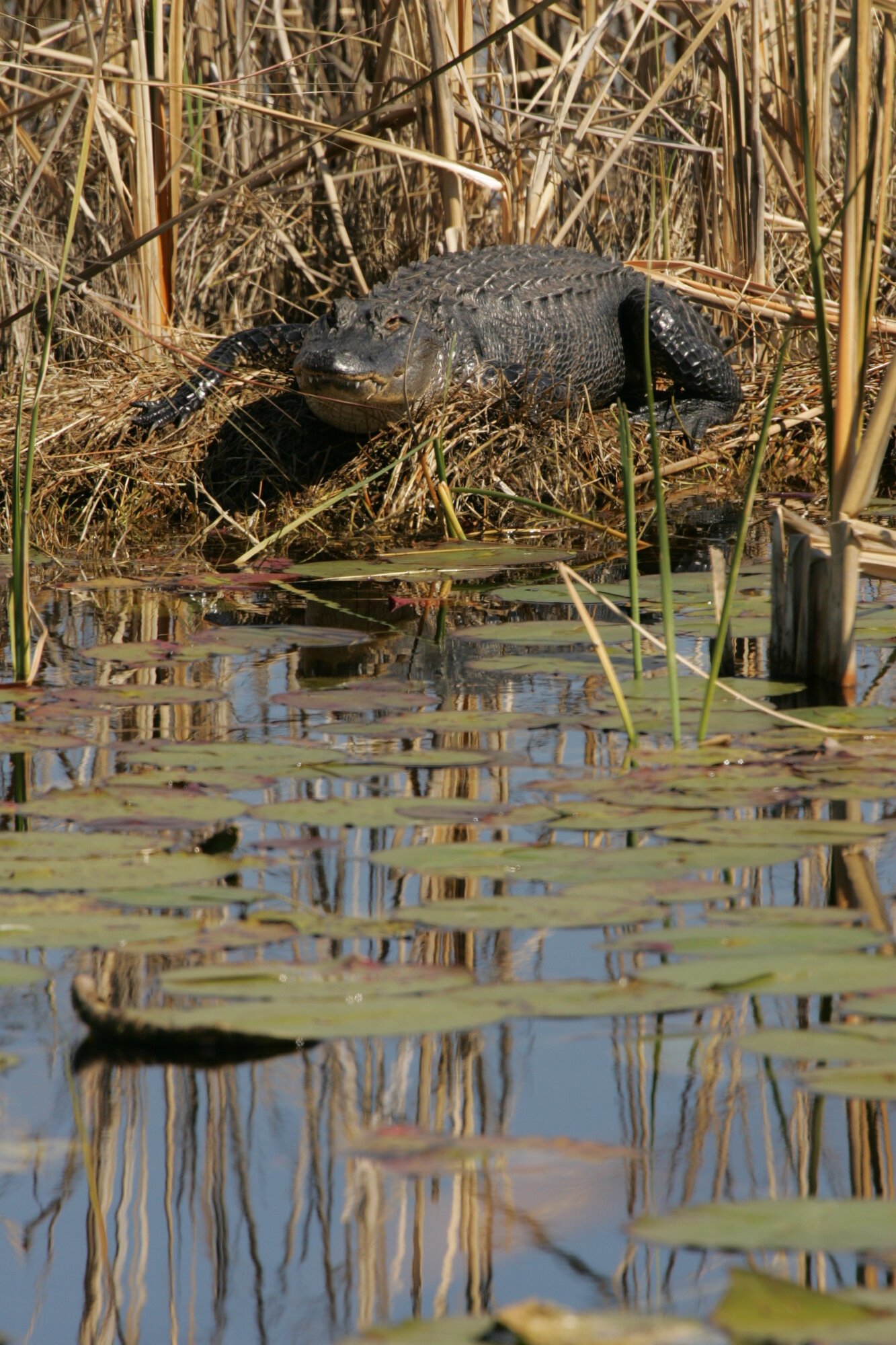
- Look at the banks on a sunny day. Alligators rely on outside heat, and they control their body temperature by basking in the sun. They’re most active between 82°F and 92°F.
- Shine a flashlight across the water at night. An alligator’s eye-shine is red. Two red dots low on the water are your answer.
- Listen. If an animal is hissing, you’re too close, even if you’re more than 15 feet away.
But not seeing one proves nothing.
A gator may look like a statue at times, but it’s alive and alert and can react lightning fast.
Since they’re in every wild area that can support them, a quiet-looking lake mostly means you didn’t spot it.

🗼 I Wrote a Book About My Japan Travel Catastrophes!
Before I landed in Tokyo, I thought I was the “Final Boss” of international travel. Spoiler alert: I WASN’T. 😅
🚅 I boarded the wrong Shinkansen and ended up in THE WRONG CITY. I confused locals with my “expert” bowing that was more awkward than accurate. I accidentally stumbled into a high-stakes Kendo practice thinking it was a tourist show. Sound like something you’d do?
“Things I Wish I Knew Before Going to Japan” is your shortcut to avoiding ALL my cringe-worthy mistakes. ✨ Inside, you’ll find practical, LIFE-SAVING tips on etiquette, transport, money, and hidden gems that will save you time, money, and a whole lot of confusion.
Where to Swim Instead

The answer is short.
Swim only in designated swimming areas, during daylight hours, and without your pet.
The daylight part is because alligators are most active between dusk and dawn, and they do most of their hunting then.
So the evening dip after a long drive is the one to skip.
That rule is the closest thing to an answer this question has.
If you’ve booked a rental on a lake, the dock out back isn’t a designated swimming area, no matter how nice the listing looks.
In plain terms, that’s a marked swim area that a park runs.
Winter is about as close to an off-season as Florida’s gators get.
They stop feeding below about 70°F, go dormant below 55°F and stay dormant through much of the winter, when you can find them in dens they dig beside open water.
Now and then they still come out to bask on a warm day, so it’s a slow season, not a closed one.
Snakes are the other thing people ask about near Florida water.
Here’s whether there are snakes like copperheads in Florida, and whether you should worry about alligators in Florida at all.
Salt Water Is Your Best Bet, With One Asterisk

If you want water with the lowest odds of an alligator, go to the beach.
Alligators are primarily freshwater animals and don’t live in the ocean.
They can put up with salt water for a few hours or even days, but home is swampy areas, rivers, streams, lakes and ponds.
Alligators can take some salt for short periods and turn up now and then in brackish water around mangrove swamps, even though they lack the salt-secreting glands crocodiles have.
So a mangrove creek is a place they visit, not where they live.
You probably won’t meet an alligator in the ocean.
Probably isn’t never, though, so don’t be too sure you won’t meet one on the beach.
Now the asterisk.
In south Florida, the American crocodile lives in the kind of water alligators only visit now and then: brackish and saltwater coves and the creeks of mangrove swamps.
By one state count there are more than 2,000 adults, up from fewer than 300 in 1975, and some have lately moved inland into fresh water in southeast Florida.
The 15-foot rule and the no-feeding rule cover crocodiles too.
Headed that far south anyway?
Here’s what accent South Floridians have, and for a plain beach day, how to spend a day on Sanibel Island.
Never Feed One, and Stay Back From the Edge

Feeding alligators is against the law, and it doesn’t make you lose your fear of them.
It’s the other way around: feeding is how the alligator loses its fear of you.
A fed alligator can lose its natural wariness and learn to link people with food, and that can end with it labeled a nuisance and removed from the wild.
Illegal feeding gets most of the blame when alligators attack people, because it makes them bolder, less wary of people and more likely to attack than to flee.
See someone doing it?
The Florida Fish and Wildlife Conservation Commission (FWC) runs a Wildlife Alert Hotline at 888-404-3922, and you can stay anonymous.
Out of the water isn’t safe either, so keep your pets on a leash and away from the water’s edge, because they often look like an alligator’s natural prey, small dogs especially.
And stay at least 15 feet from any alligator or crocodile.
Keep the risk in proportion, though.
Serious injuries from alligators are rare in Florida.
From 2012 to 2022, the state averaged eight unprovoked bites a year serious enough to need professional medical treatment.
That’s eight bites a year, in a state with about 1.3 million alligators and a whole lot of people in the water.
When FWC Takes an Alligator Away

Here’s the line FWC draws.
Generally, an alligator counts as a nuisance if it’s at least 4 feet long and the person calling believes it poses a threat to people, pets or property.
Call 866-FWC-GATOR (866-392-4286) and the state sends one of its contracted nuisance alligator trappers.
The little ones are a different story.
An alligator under 4 feet isn’t large enough to be dangerous to people or pets unless it’s handled.
So don’t handle it.
Their bites can cause a serious infection, and picking one up is illegal.
If a small one is in your pool or on your porch, call the same hotline.
Nuisance gators don’t get moved somewhere else, either.
Relocated alligators often try to get back to where they were caught.
The remote places that could take them already have settled alligators of their own, so a newcomer would likely start a fight that could kill one of them.
A removed alligator becomes the trapper’s property instead.
Most are processed for hide and meat, and once in a while one is sold alive to an alligator farm or a zoo.
Where do the run-ins come from?
Florida’s population has grown fast, more people want waterfront homes and more of them spend time on the water.
That can mean people and alligators meet more often, with more chance of conflict.
Thinking about joining them?
Here’s living in Florida and California compared on cost.
Before You Get In the Water

Here’s the short version:
- Treat any natural water in Florida, canals included, as water that can have an alligator in it.
- Swim only in designated swimming areas, in daylight, and leave the dog on shore.
- Stay out of the water from dusk to dawn.
- Keep at least 15 feet from any alligator, and back off further if it hisses.
- Never feed one, and report anyone who does: 888-404-3922.
- Worried about a gator near your home or rental? 866-FWC-GATOR.
Do that and a Florida lake is a pretty great place to spend a day.
Just not the whole night.
Sources
- Florida Fish and Wildlife Conservation Commission
- National Park Service
- NOAA’s National Ocean Service
- University of Florida
Sources checked early November 2026.