Belgium doesn’t try to impress you.
And that’s exactly why it does.
I landed in Brussels on a rainy Tuesday with zero expectations and a dead phone battery.
No plan.
No list.
Just a vague idea that I’d figure it out.
I ducked into the first café I saw, ordered something dark and local, and sat there watching the city move outside the window.
That was it.
That was the moment.
Something about the light, the old stone walls, the sound of the tram on wet cobblestones — it just hit different.
And from that one unplanned afternoon, Belgium completely rearranged my travel priorities.
The problem is, most people never slow down enough to let it do that.
They race through the highlights, check the boxes, and leave wondering why it didn’t quite land.
I’ve been that guy.
So let me save you the regret.
Brussels Is More Than the Grand Place (Go Deeper Into the Neighborhoods)

Most people land in Brussels, snap a photo of the Grand Place, and think they’ve “done” the city.
I get it.
The Grand Place is genuinely stunning.
But the real Brussels?
It lives in Saint-Gilles.
That’s the neighborhood I stumbled into on my second visit, and it completely rewired how I see this city.
Art Nouveau townhouses line the streets like something out of a fever dream.
The facades are ornate, almost theatrical — floral ironwork, curved stonework, golden detailing that catches the afternoon light in a way that makes you stop mid-step.
It’s sort of the architectural equivalent of finding a hidden track on your favorite album.
And then there’s Ixelles, right next door — full of tiny coffee shops, vintage bookstores, and this low-key creative energy that you just don’t get near the tourist center.
If I only had one afternoon in Brussels, this is where I’d spend it.
Skip the souvenir shops near the Manneken Pis.
Walk toward the parts of the city that feel a little worn-in, a little lived-in.
That’s where Brussels actually breathes.
Tap to Explore These Beauties
See my ideas in action 👇 Tap any image to explore full details.
Ghent Is the City That Makes Bruges Jealous

Here’s a slightly controversial take: Ghent is better than Bruges.
Now, Bruges is gorgeous.
I’ll say that openly.
But Bruges can feel like a snow globe — beautiful, preserved, a little frozen in time.
Ghent feels alive.
It has the same medieval bones — the canals, the Graslei waterfront, the castle rising out of nowhere — but it’s layered with a university-town energy that keeps it moving.
Street art wraps around old brick walls.
Craft beer bars sit inside what used to be guild houses.
There’s this stretch along the water at golden hour where the reflections of the towers shimmer in the canal, and I swear it looks like a painting.
A warm, slightly moody, incredibly cinematic painting.
I spent three days there once and still felt like I’d missed half of it.
The Gravensteen Castle is wild — medieval and slightly menacing, right in the middle of a modern city.
And the Graffiti Street (Werregarenstraat) is genuinely one of the coolest alleys I’ve walked through in all of Europe.
If you’re doing a Belgium trip and skipping Ghent, you’re leaving the best chapter unread.
The Belgian Beer Culture Goes Way Beyond What You Think

I’ll be honest — I thought I knew beer before Belgium.
I did not know beer.
Belgian brewing culture is something you have to experience slowly, deliberately, almost reverently.
It’s not about pounding pints.
It’s about sitting in a centuries-old café, holding a tulip glass, and tasting something that a monastery has been perfecting for generations.
Trappist beers are the ones that stopped me cold.
They’re brewed by monks — actual monks — and you can visit some of the breweries if you time it right.
Westvleteren 12 is often called the best beer in the world.
It’s only available at the abbey or in very limited quantities nearby.
I waited in a car queue for it once.
Worth every minute.
But beyond the famous names, there are tiny local breweries scattered across the country serving beers you’ll never find outside Belgium.
Go into a traditional Belgian café — called an estaminet — and just ask what’s local.
That’s where the magic happens.
The bartender will usually have a story about every bottle on the shelf.
And those conversations?
That’s Belgium at its best.
🗼 I Wrote a Book About My Japan Travel Catastrophes!
Before I landed in Tokyo, I thought I was the “Final Boss” of international travel. Spoiler alert: I WASN’T. 😅
🚅 I boarded the wrong Shinkansen and ended up in THE WRONG CITY. I confused locals with my “expert” bowing that was more awkward than accurate. I accidentally stumbled into a high-stakes Kendo practice thinking it was a tourist show. Sound like something you’d do?
“Things I Wish I Knew Before Going to Japan” is your shortcut to avoiding ALL my cringe-worthy mistakes. ✨ Inside, you’ll find practical, LIFE-SAVING tips on etiquette, transport, money, and hidden gems that will save you time, money, and a whole lot of confusion.
Bruges After Dark Is a Completely Different City

Everyone talks about daytime Bruges.
The boat tours, the chocolate shops, the Instagram spots at every corner.
And yeah, daytime Bruges is stunning.
But nighttime Bruges is something else entirely.
Once the tour groups leave — and they do leave, early — the city exhales.
The crowds thin out, the golden lamplight hits the canals, and suddenly you’re walking through something that feels genuinely medieval.
I remember standing on one of the stone bridges around 9pm on a quiet weeknight.
The water was still.
The reflections were perfect.
There was almost no sound.
It was one of those rare travel moments where you’re so present that your brain just goes quiet.
Stay overnight in Bruges.
Don’t just day-trip it.
Book a small hotel or a B&B near the center and give yourself an evening with nowhere to be.
Wander without a map.
Find a cozy bar — the kind with low wooden ceilings and candles on the tables — and just sit.
Order a dark Belgian ale.
Let the city settle around you.
That’s the version of Bruges most tourists never get.
The Belgian Coast Is Wildly Underrated

When someone says “European beach vacation,” Belgium doesn’t exactly top the list.
And I kind of love that.
Because it means the Belgian coast — this long stretch of North Sea shoreline from De Panne to Knokke — is refreshingly uncrowded and deeply authentic.
It’s not tropical.
It’s not warm-water Mediterranean stuff.
It’s windswept and dramatic and honestly a little moody, in the best way.
The beach towns have this retro charm that feels like stepping into a mid-century postcard.
De Haan is my personal favorite.
It’s one of the only Belgian coastal towns that hasn’t been over-developed, and it’s got this Belle Époque architecture that gives it a quiet elegance.
Walking along the promenade there on a grey autumn morning, wind coming off the North Sea, hot coffee in hand — that’s a vibe I genuinely crave.
Ostend has more energy — a real working port city with a great food scene and some interesting art history tied to James Ensor.
If you’re a beer and seafood person (and you should be), the Belgian coast will wreck you in the best way.
Fresh mussels.
Shrimp croquettes.
Cold local beer.
Done.
Dinant and the Meuse Valley Will Genuinely Surprise You

Most people drive right past this region.
And I kind of understand why — it doesn’t have the same name recognition as Bruges or Brussels.
But Dinant stopped me in my tracks.
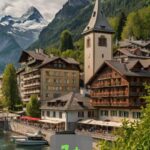
It’s this compact little town pressed between a sheer rock cliff and the Meuse River, with a citadel rising dramatically above it and a bulb-domed church right at the waterfront.
The whole scene is borderline cinematic.
The kind of place where you pull over, get out of the car, and just stand there for a minute.
The citadel is worth the climb — you get these sweeping views of the river valley that make you feel like you’re inside a landscape painting.
Dinant is also the birthplace of the saxophone, which is a fun fact that sounds made up but isn’t.
Adolphe Sax was born here, and the town celebrates it with colorful saxophones decorating the bridge.
Random and delightful.
The surrounding Meuse Valley is gorgeous for a slow drive or a bike ride along the river.
Small villages, castle ruins perched on hilltops, vineyards starting to appear as you go south.
If I had a rental car and a free day in Belgium, this is exactly where I’d point it.
Belgian Chocolate Deserves a Dedicated Afternoon (Not Just a Quick Shop)

I know.
You’ve heard about Belgian chocolate.
But I’m going to push back on how most travelers actually experience it.
Most people grab a box from a shop near a tourist site and call it done.
That’s fine.
But it’s a little like going to Nashville and only listening to country music in an airport bar.
The real experience is in the smaller chocolatiers — the family-run ateliers where you can watch the whole process.
In Brussels, there’s a whole cluster of them in the Sablon neighborhood.
The Saint-Gilles and Ixelles areas I mentioned earlier?
Also full of them.
I spent an afternoon once just slowly walking between chocolate shops in the Sablon, tasting single-origin truffles and asking questions.
The chocolatiers there love to talk about their craft.
They’ll explain the difference between couverture percentages, regional influences, why Belgian pralines have that specific texture.
It becomes genuinely fascinating.
And the pralines — the filled chocolates — are what Belgium is truly famous for.
Not bars.
Not truffles.
Pralines.
Get a mixed box from a proper artisan shop.
Sit somewhere quiet.
Eat slowly.
That’s the move.
The Ardennes Region Is Belgium’s Best Kept Secret

The Belgian Ardennes feels like a different country.
Dense forests.
Rolling hills.
Rivers cutting through limestone valleys.
It’s the kind of landscape that makes you want to hike for hours and then find a fireplace.
Bouillon is the town I always recommend first.
It’s built around a massive medieval castle — one of the best preserved in all of Belgium — that sits on a rocky peninsula in a bend of the Semois River.
The views from the castle walls are genuinely dramatic.
You’re looking down at red-roofed houses, forested hills in every direction, and the river wrapping around the town like a moat.
It’s cozy and wild at the same time, if that makes sense.
La Roche-en-Ardenne is another one.
Great base for hiking, kayaking on the Ourthe River, and eating extremely well.
The Ardennes is famous for its smoked ham — jambon d’Ardenne — and it’s the kind of thing you eat once and then spend years trying to recreate at home.
Go in autumn if you can possibly manage it.
The foliage is insane.
All that orange and gold reflected in the river water, morning mist hanging over the valleys.
It’s the kind of scenery that makes you feel deeply grateful to be somewhere.
Mechelen Is the Underdog City Nobody Talks About

I first heard about Mechelen from a Belgian friend who asked why tourists always skip it.
I had no good answer.
Because Mechelen — sitting quietly between Brussels and Antwerp — is genuinely one of the most beautiful small cities in the country.
The Great Market square is stunning in a way that feels earned rather than polished.
The Saint Rumbold’s Cathedral has this tower that’s been a UNESCO World Heritage Site forever, and it dominates the skyline in this grand, unhurried way.
The city has a real local energy to it.
Fewer tourists means more actual neighborhood life — people on bikes, market stalls, café terraces that aren’t priced for visitors.
I wandered into a local brown café there once, the kind with old wood paneling and beer mats tacked to the wall, and ended up spending two hours just talking to the owner about Belgian history.
That’s the kind of thing that happens in Mechelen.
There’s also a seriously underrated food scene here.
Mechelen asparagus — called “white gold” locally — is a seasonal delicacy that the whole country goes crazy for in spring.
If your trip overlaps with asparagus season, eating it here is the move.
Just trust me on that one.
🗼 I Wrote a Book About My Japan Travel Catastrophes!
Before I landed in Tokyo, I thought I was the “Final Boss” of international travel. Spoiler alert: I WASN’T. 😅
🚅 I boarded the wrong Shinkansen and ended up in THE WRONG CITY. I confused locals with my “expert” bowing that was more awkward than accurate. I accidentally stumbled into a high-stakes Kendo practice thinking it was a tourist show. Sound like something you’d do?
“Things I Wish I Knew Before Going to Japan” is your shortcut to avoiding ALL my cringe-worthy mistakes. ✨ Inside, you’ll find practical, LIFE-SAVING tips on etiquette, transport, money, and hidden gems that will save you time, money, and a whole lot of confusion.
The Comic Strip Culture Is a Whole Experience

Belgium gave the world Tintin, the Smurfs, Lucky Luke, and a whole universe of beloved characters.
And the country hasn’t been shy about celebrating that.
In Brussels, there’s an entire Comic Strip Route — murals painted across building facades throughout the city center.
And I want to be clear: these aren’t small street art tags.
These are massive, detailed, full-color works that stop you in your tracks.
Turning a corner and suddenly seeing a 6-story Tintin mural on the side of a building is sort of surreal and completely wonderful.
The Belgian Comic Strip Center in Brussels is one of those museums I went into half-heartedly and walked out three hours later.
It’s housed in a gorgeous Art Nouveau building, which is kind of perfect.
The exhibits are deep — covering the history, the artists, the cultural impact — and even if you didn’t grow up reading these comics, the craftsmanship is undeniable.
For me, the mural hunt through Brussels was actually one of the best urban walks I’ve ever done.
I downloaded a map, grabbed a coffee, and just started walking.
No agenda, no time pressure.
Just the city, the art, and a lot of happy stumbling.
That kind of wandering is what Belgium rewards.
Speculoos, Fries, and the Street Food You Cannot Leave Without Trying

Belgian food culture is deeply underrated and I will die on this hill.
Everyone knows about Belgian waffles and chocolate.
But the fries — the frites — are where I’d actually start.
Belgian fries are not like American fries.
They’re thicker, crunchier, cooked twice in beef fat, and served in a paper cone with a mountain of sauces to choose from.
Andalouse sauce is my personal obsession.
Samurai sauce if I’m feeling bold.
The best fries I ever had were from a tiny friterie stand in Liège at midnight.
No ambiance, no seating, just a paper cone and a plastic fork and the kind of satisfaction that’s sort of embarrassing to admit.
Speculoos is another thing — the spiced biscuit that’s been everywhere in Belgium forever.
You find it with coffee, in desserts, spread on toast.
It’s warmly spiced, slightly caramel, deeply comforting.
I brought back three packs once and they were gone in a week.
And then there’s waterzooi — a Ghentish stew that’s creamy and warming and exactly the kind of thing you want after a cold afternoon on the canals.
Eat locally.
Eat often.
Ask what’s regional.
That’s the whole strategy.