I booked San Salvador almost by accident.
A last-minute flight deal showed up in my inbox, and I almost deleted it — because I knew absolutely nothing about the city.
Zero.
I’d never met anyone who had been there.
I couldn’t name a single landmark.
And somehow, that ended up being exactly the reason I went.
There’s something kind of electric about showing up somewhere with no expectations and no mental image to compare it to.
San Salvador handed me experiences I never could have planned for.
Loud ones, quiet ones, deeply human ones.
And I’ve been telling people about it ever since.
Arriving in San Salvador: That First Raw Impression
The drive from the airport into the city already tells you a lot.
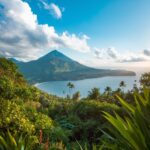
You pass volcanoes.
Actual volcanoes — green and massive and just sitting there on the horizon like it’s totally normal.
The highway opens up into a sprawling, hilly city that’s layered and dense and moving at its own pace.
My first instinct was to stay in and rest after the flight.
I didn’t.
I dropped my bag at the guesthouse, splashed some water on my face, and walked outside.
And within about ten minutes I was standing at a street cart eating something fried and delicious that I couldn’t fully identify — but ordered a second one of immediately.
That’s San Salvador.
It pulls you in fast.
The neighborhoods have distinct personalities — some polished and leafy, some raw and crumbling at the edges, some somewhere beautifully in between.
My tip for day one: don’t over-plan it.
Just walk a few blocks in any direction and let the city introduce itself.
You’ll know pretty quickly what kind of traveler this place is going to turn you into.
The Metropolitan Cathedral: More Than Just a Photo Stop
I know — a cathedral sounds like a basic tourist checkbox.
Stay with me here.
The Metropolitan Cathedral in the Historic Center is something I wasn’t prepared for emotionally.
It’s massive and slightly worn, and the light inside falls through the stained glass in these long, dusty columns that make the whole space feel sacred in a way that’s hard to articulate.
But what got me most was learning that Archbishop Oscar Romero — a deeply beloved figure in El Salvador — is buried beneath the altar.
I didn’t know much about him before I got there.
But the way locals interact with that space, the quiet reverence, the flowers left near his tomb — it made me want to understand more.
I ended up sitting in a pew for about twenty minutes just taking it all in.
Not praying exactly.
Just being still in a place that clearly matters to a lot of people.
If you’re the kind of traveler who wants to understand a city beyond its surface, start here.
Go on a weekday morning when it’s quieter.
Let yourself slow down.
Pupusas: The Food Experience You Will Think About for Years
I’m just going to say it plainly.
Pupusas are one of the best foods on the planet.
I feel strongly about this.
They’re handmade corn tortillas stuffed with cheese, refried beans, chicharrón — or all three — and cooked on a flat griddle until the outside is just slightly crispy and the inside is warm and molten.
I ate my first one from a woman at a roadside spot who was making them faster than I could watch.
She’d grab the masa, flatten it, stuff it, seal it, and have it on the griddle in about fifteen seconds.
I sat on a plastic stool and ate three in a row.
Then I asked for curtido — the tangy fermented cabbage slaw that comes alongside — and the salsa roja, and suddenly the whole thing made even more sense.
The curtido cuts through the richness perfectly.
Don’t skip it.
My personal recommendation: skip the tourist-facing restaurants for pupusas and look for the busy street spots with locals already sitting down.
Busy means good.
Always.
🗼 I Wrote a Book About My Japan Travel Catastrophes!
Before I landed in Tokyo, I thought I was the “Final Boss” of international travel. Spoiler alert: I WASN’T. 😅
🚅 I boarded the wrong Shinkansen and ended up in THE WRONG CITY. I confused locals with my “expert” bowing that was more awkward than accurate. I accidentally stumbled into a high-stakes Kendo practice thinking it was a tourist show. Sound like something you’d do?
“Things I Wish I Knew Before Going to Japan” is your shortcut to avoiding ALL my cringe-worthy mistakes. ✨ Inside, you’ll find practical, LIFE-SAVING tips on etiquette, transport, money, and hidden gems that will save you time, money, and a whole lot of confusion.
Exploring the Mercado Central Without Losing Your Mind
The Mercado Central is an experience, and I mean that in the fullest possible sense of the word.
It is overwhelming.
It is loud.
It smells like a hundred different things at once — raw produce, frying oil, incense, leather, something sweet and something sharp.
And I absolutely loved it.
The market is a dense, packed grid of vendors selling everything from fresh fruit and vegetables to handmade crafts to herbal medicine to electronics to things that genuinely defied categorization.
I wandered it for about two hours one morning with no shopping list and no agenda.
Just curiosity.
I came home with a small handwoven textile, a bag of dried hibiscus flowers, and a clay pot that somehow survived the flight home.
My tip: go in the morning when it’s busy but not yet at peak chaos.
Keep your bag in front of you.
And bring small bills — it makes everything easier and faster.
Don’t try to see all of it systematically.
Just let yourself wander and stop wherever something catches your eye.
Joya de Cerén: The Ancient Village Frozen in Time
This one changed the way I think about ancient history.
Joya de Cerén is a pre-Columbian Maya village that was buried under volcanic ash over a thousand years ago.
It’s been called the “Pompeii of the Americas” — and that comparison earns its weight.
But what surprised me was how personal it felt.
This wasn’t a royal site or a ceremonial complex.
It was a regular village — farmers and families going about their lives.
And you can see the evidence of those lives preserved in extraordinary detail.
Storage jars.
Sleeping platforms.
Garden rows.
I kept thinking about the people who lived there.
Ordinary people.
Their whole daily reality is just frozen under the earth.
It’s about 35 kilometers outside the city, so plan for a half-day.
I strongly recommend going with a local guide — the site is interesting on its own, but with proper context it becomes genuinely moving.
My guesthouse connected me with a guide named Carlos who was outstanding.
Don’t rush this one.
The Street Art of San Salvador: An Outdoor Gallery Nobody Warned Me About
I turned a corner near the university district and just stopped walking.
There was a mural covering an entire four-story building — figures and symbols and color so saturated it almost hurt to look at directly in the afternoon sun.
Nobody told me San Salvador had street art like this.
And it’s not just decorative.
The murals here are political and historical and deeply emotional.
They tell stories about the civil war, about Archbishop Romero, about resilience and identity and the country’s long, complicated relationship with its own past.
Some of them are abstract and wild and joyful.
Others will stop you in your tracks and make you stand quietly for a while.
The area around the Universidad de El Salvador is the densest for murals, but honestly you’ll find striking pieces all over the city if you’re paying attention.
My approach: I dedicated one full afternoon just to walking and photographing walls.
No other agenda.
It ended up being one of the most memorable days of the entire trip.
Art is sometimes the best translator a place has.
Lake Coatepeque: The Blue Water That Doesn’t Look Real
About an hour outside San Salvador, there’s a volcanic crater lake that I am still not fully over.
Lake Coatepeque is this impossible shade of blue-green — the kind of color that makes you check your camera settings because you’re convinced it’s not reproducing accurately.
It’s ringed by steep green hills and dotted with small lakeside spots where you can eat, swim, and completely decompress.
I rented a small motorboat for a few hours and just drifted around the perimeter.
The water is warm.
The hills are reflected perfectly in it on still mornings.
It is deeply, genuinely quiet out in the middle of it.
I had grilled fish and cold beer at a little dock restaurant afterward with my feet hanging over the water.
I was there for probably four hours total and could have easily stayed all day.
If you’ve got a car or can arrange a driver, do this as a day trip from the city.
Go on a weekday if you want it calm.
Go on a weekend if you want local energy and families making a full day of it.
Both versions are worth every minute of the drive.
Coffee Tasting in the City That Grows World-Class Beans
El Salvador produces exceptional coffee.
This is not marketing copy — it’s a fact backed by international competitions and the taste buds of anyone who’s actually had a well-prepared Salvadoran cup.
The country’s high-altitude farms produce beans with a brightness and sweetness that’s really distinct.
And in San Salvador, you can taste that story at independent cafés that take the sourcing seriously.
I spent a slow morning at a small café in Colonia Escalón where the owner walked me through the difference between washed and natural processed beans from different growing regions.
I’m not a coffee expert by any stretch.
But I could taste the difference.
And I kind of fell in love with the whole thing.
My personal hack: buy a bag of locally roasted beans to bring home.
It travels well, it clears customs without issue, and every morning brew becomes a small memory of the trip.
It’s one of those souvenirs that keeps giving.
The Ruta de las Flores: A Day Trip You Genuinely Can’t Skip
Okay — the Ruta de las Flores isn’t in San Salvador.
But I’d feel genuinely bad leaving it off this list.
It’s a scenic route through the western highlands — a string of small colonial towns surrounded by coffee farms, flower markets, and waterfalls tucked into the hills.
I rented a car and drove it over two days, but you can absolutely do a highlights version in one full day if you’re short on time.
Juayúa was the town that wrecked me in the best way.
On weekends there’s a food market there that is completely, unapologetically chaotic and delicious — smoked meats, fresh ceviche, cold beer, handmade tortillas, roasted corn.
The air along the whole route smells like rain and coffee and woodsmoke.
The towns are quiet and colorful and the kind of places where you end up sitting somewhere for an hour longer than you planned because it just feels good to be there.
Rent a car if you can.
The freedom to stop whenever something catches your eye is worth it.
🗼 I Wrote a Book About My Japan Travel Catastrophes!
Before I landed in Tokyo, I thought I was the “Final Boss” of international travel. Spoiler alert: I WASN’T. 😅
🚅 I boarded the wrong Shinkansen and ended up in THE WRONG CITY. I confused locals with my “expert” bowing that was more awkward than accurate. I accidentally stumbled into a high-stakes Kendo practice thinking it was a tourist show. Sound like something you’d do?
“Things I Wish I Knew Before Going to Japan” is your shortcut to avoiding ALL my cringe-worthy mistakes. ✨ Inside, you’ll find practical, LIFE-SAVING tips on etiquette, transport, money, and hidden gems that will save you time, money, and a whole lot of confusion.
Parque Balboa: Where the City Exhales
Some places exist just to remind you to slow down.
Parque Balboa is that place for San Salvador.
It’s up in the hills south of the city, and on a clear day the view stretches out over the entire urban sprawl and — if the visibility is right — all the way to the Pacific coast in the distance.
I went on a Sunday afternoon and the park was full of families.
Kids running.
Vendors selling aguas frescas and corn on the cob.
Couples sitting on benches in the shade.
I bought a mango on a stick covered in chili and lime from a cart, found a bench with a view, and just sat there.
For a long time.
No phone.
Just the view and the sound of the city in the distance below me.
If you’ve been going hard — the market, the historic center, the food spots — this is your built-in reset button.
Come here in the late afternoon when the light starts going gold.
The city looks completely different from up here.
Softer, somehow.
Nightlife in Zona Rosa: Casual, Warm, and Worth a Night Out
I’ll be upfront — I’m not a club guy.
But the Zona Rosa gave me a version of nightlife I actually enjoyed.
It’s the main social neighborhood in San Salvador — restaurants, bars, outdoor patios, a few spots with live music.
The energy isn’t trying to impress you.
It’s just warm and alive and easy to be in.
I ended up at an open-air bar on my second night with a group of travelers I’d run into earlier that day.
We stayed for hours.
Cold local lager, bar snacks I kept ordering more of, conversation that went in eight different directions.
The kind of night that happens by accident and ends up being one you remember.
My tip: eat dinner in Zona Rosa — there are genuinely good restaurants there — and then just walk around for a bit before deciding where to land for drinks.
Don’t book anything in advance.
Let the neighborhood show you where to go.
The best spots I found were the ones I walked into on instinct.
My Honest Advice on Staying Safe and Getting Around
Let’s talk practically for a second.
San Salvador has a reputation, and I’m not going to pretend that reputation appeared from nowhere.
Like any major city with a complicated history, it requires some common sense and awareness.
Here’s what actually worked for me.
I used ride-share apps for most of my transportation — cheap, trackable, and stress-free.
I stayed in the safer, more central neighborhoods — Zona Rosa, Colonia Escalón, and the area around the Historic Center for daytime exploration.
I didn’t wander unfamiliar neighborhoods after dark on my own.
And I talked to locals — guesthouse staff, café owners, my guide — about where to go and where not to.
Every single person I asked gave me straight, honest answers.
For longer day trips — Lake Coatepeque, Joya de Cerén, the Ruta de las Flores — I either rented a car or hired a private driver.
The private driver option is genuinely affordable and eliminates a ton of logistical stress.
San Salvador rewards the traveler who does a little homework upfront.
Show up prepared, stay aware, and the city opens up in ways that’ll genuinely surprise you.