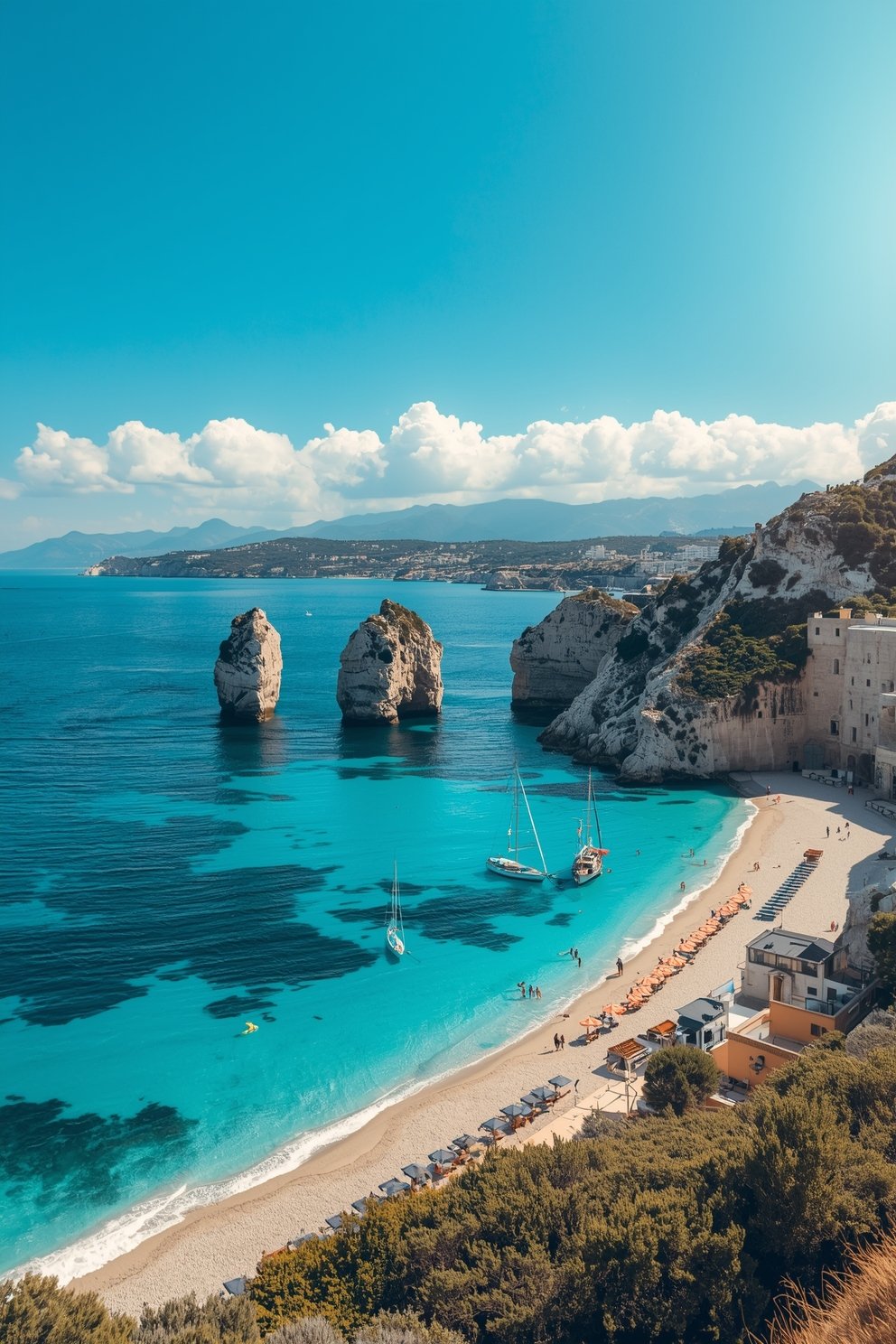
I still remember standing on a cliff in Sardinia, barefoot, with a cold Ichnusa beer in my hand, watching the water turn about six different shades of turquoise at the same time.
I kept thinking — nobody warned me it would look like this.
Not like a postcard.
Like something better than a postcard.
Sardinia doesn’t get the hype that the Amalfi Coast or Rome gets, and honestly?
That’s exactly why you need to go.
This island is raw, wildly beautiful, and the kind of place that makes you rethink your entire travel list.
So here are my go-to Sardinia vacation ideas — the ones I’d tell my best friend over a beer.
Why Sardinia Hits Different From Every Other Italian Destination

Sardinia is technically Italy, but it doesn’t really feel like Italy.
And I mean that as the highest possible compliment.
There’s no overwhelming tourist crush at every corner.
There’s no feeling of rushing from one landmark to the next just to say you did it.
The pace here is slow in a way that actually sinks into your bones after about day two.
When I first landed in Cagliari, the capital, I expected something similar to the mainland Italian cities I’d visited before.
What I got instead was this sun-baked, ancient city with layered history, local markets buzzing with energy, and an old quarter called Castello that sits high above everything like a medieval fortress.
The food is completely its own thing — it’s not classic Italian cuisine.
It’s deeper, earthier, more pastoral.
Think roasted meats, flatbread called pane carasau, aged pecorino cheese that tastes like someone bottled up a hillside.
And the people are warm but not performative about it.
You feel welcome without feeling like a transaction.
That combination — the landscape, the food, the genuineness of the place — is something I haven’t fully found anywhere else.
And that’s saying a lot.
Tap to Explore These Beauties
See my ideas in action 👇 Tap any image to explore full details.
The Beaches In Sardinia Are Not What You Expect (They’re So Much Better)

I’ve been to a lot of beaches.
Caribbean beaches, Greek island beaches, Southeast Asian beaches.
Sardinia’s beaches made me feel like a kid seeing the ocean for the first time.
The water at Cala Goloritzé, in the eastern Ogliastra region, is this unreal shade of blue-green that doesn’t look real until you’re literally floating in it.
You have to hike down to reach it — about 40 minutes on a rocky trail — and every single step is worth it.
If I could only tell you one beach to visit in Sardinia, it would honestly be a coin flip between Cala Goloritzé and La Pelosa in the northwest.
La Pelosa has this shallow, white-sand lagoon feel with a small medieval watchtower standing in the water nearby.
It’s sort of magical in that quiet, ancient way.
The one tip I’d give you?
Go early.
Like, embarrassingly early.
The most popular beaches get crowded by mid-morning in peak season.
I showed up to La Pelosa around 8 AM once and had the whole thing practically to myself.
That quiet, early-morning light hitting that turquoise water?
One of the best mornings of my traveling life.
Your Ultimate Caribbean Adventure Awaits!
Discover hidden coves, secret beaches, and the best rum punches in the islands. Your insider’s guide to Caribbean paradise.
Get Your Guide Now$15.99Exploring The Costa Smeralda Without Blowing Your Entire Budget

Costa Smeralda has a reputation for being the playground of the ultra-rich.
And, okay, that’s not entirely wrong.
Porto Cervo is full of superyachts, designer boutiques, and restaurants where a pasta dish costs what most people pay for a hotel room.
But here’s what a lot of travel guides won’t tell you.
You don’t need to spend like a billionaire to experience the Costa Smeralda coastline.
The beaches are public.
The views are free.
The sunsets are absolutely, stubbornly free.
I stayed in a small rental apartment in Arzachena — about 15 minutes inland from the coast — and used it as my base for exploring the whole area.
Way more affordable, still close to everything.
You can rent a scooter or a small car and cruise along the coast road, stopping at hidden coves and viewpoints along the way.
I’d pack a lunch of local bread, cheese, and olives from a nearby alimentari (that’s a small Italian deli/grocery) and make a full day of it.
Honestly, those scooter days were some of my favorite travel days ever.
Just wind, sea air, and no real agenda.
You feel free in a way that a guided tour or a packed itinerary rarely gives you.
Cagliari: The Capital City That Deserves So Much More Credit

Most people treat Cagliari as a stopover.
Fly in, maybe spend one night, then bolt to the beaches.
I made that mistake on my first visit.
On my second, I gave Cagliari three full days and completely changed how I felt about the city.
The Castello district — the old hilltop quarter — is genuinely stunning.
Narrow stone streets, pale yellow buildings, a cathedral that glows in the late afternoon light like something out of a painting.
I’d wander up there in the early evening, when the tour groups had thinned out and the locals were just starting their evening passeggiata (evening stroll).
The light at that hour is the kind of warm, honeyed gold that makes everything look cinematic.
The Poetto Beach, right on Cagliari’s doorstep, is long and wide and has a completely different vibe from the northern beaches — more local, more lived-in.
Families, old men playing cards, kids running into the water.
I loved that energy.
And the food scene in Cagliari is genuinely excellent.
Fresh seafood, traditional Sardinian pasta dishes like malloreddus (little gnocchi-shaped pasta with sausage ragù), and gelato that I still think about.
If I had a week in Sardinia, I’d spend at least two nights in Cagliari.
No question.
The Nuraghi: Sardinia’s Ancient Ruins That Most Tourists Walk Right Past

Okay, hear me out before you skip this section.
I know “ancient ruins” can sound like a school trip, but Sardinia’s nuraghi are something completely different.
These are massive, cone-shaped stone towers built by the Nuragic civilization thousands of years ago.
Nobody fully knows why.
The mystery of them is part of what makes them so magnetic.
The most impressive site is Su Nuraxi di Barumini, a UNESCO World Heritage Site in the central part of the island.
When I walked through it on a slightly overcast afternoon, it felt eerie in the best way.
Like standing inside something genuinely ancient and unknowable.
There are thousands of nuraghi scattered across Sardinia — some are just lone towers in the middle of a field, surrounded by sheep.
You’ll be driving through the countryside and just suddenly see one.
And it never stops being a little surreal.
My honest tip?
Hire a local guide for Su Nuraxi.
I almost skipped the guided tour because I’m sort of stubborn about those, but the guide I got was this passionate older Sardinian man who clearly loved every stone of the place.
He made the whole thing come alive in a way my solo wandering never would have.
Worth every euro.
Caribbean Paradise Unlocked
From pristine beaches to vibrant local culture, discover the Caribbean’s best-kept secrets with my comprehensive travel guide.
- 120+ Hidden Beach Secrets
- Local Cuisine Guide
- Budget Travel Tips
- Island Hopping Routes
Road Tripping Through Ogliastra: Sardinia’s Wild, Underrated East Coast

The Ogliastra region on Sardinia’s east coast is the kind of place that makes you feel like you’ve found something secret.
It’s rugged and dramatic in a way the north isn’t.
Steep limestone cliffs dropping straight into the sea, tiny fishing villages clinging to hillsides, roads that twist through mountains covered in dense Mediterranean scrub.
I did a three-day road trip through Ogliastra and it remains one of my top five travel experiences, full stop.
Baunei is a tiny mountain town that serves as the gateway to the Supramonte — a wild, rocky highland that stretches down to some of the island’s most remote and spectacular beaches.
Cala dei Gabbiani, Cala Sisine, Cala Luna — these beaches are accessible mainly by boat or on foot.
And because of that, they stay genuinely unspoiled.
I took a small boat tour one morning from Santa Maria Navarrese to visit a few of them.
The water was so clear I could see the bottom from the boat even in fairly deep water.
That electric blue color against the white limestone cliffs is just… a lot.
The driving itself through Ogliastra is sort of meditative.
Windows down, slow roads, occasional views that make you pull over just to stare for a minute.
Rent a car for this part.
Don’t rely on buses.
The freedom is the whole point.
Where To Stay In Sardinia Based On Your Vibe

The right home base in Sardinia depends entirely on what kind of trip you want.
And I’ve sort of tested most of the options at this point.
For beach focus and natural beauty?
The Orosei Gulf area or the Ogliastra coast is your best bet.
Small towns like Cala Gonone or Santa Maria Navarrese have good accommodation options and direct access to some of the island’s most spectacular coastline.
For a mix of culture, food, and beach access?
Cagliari is the move.
You get the city energy, the old town history, and Poetto Beach is right there.
For pure luxury and that see-and-be-seen Mediterranean vibe?
The Costa Smeralda and Porto Rotondo area in the north will deliver.
It’s expensive, but the scenery really is absurdly gorgeous.
My personal preference, after several visits, is to base myself in a small rental house or agriturismo in the countryside — somewhere central-ish — and use a car to explore different regions day by day.
That approach gives you the most flexibility and the most authentic experience.
You wake up to roosters and olive trees instead of a hotel lobby, and that sets a completely different tone for the whole trip.
The Best Time To Visit Sardinia (And What Nobody Tells You About Each Season)

The honest answer is that almost any time works, but they’re all very different experiences.
June and September are my sweet spots.
The water is warm, the crowds are noticeably thinner than July and August, and the prices drop significantly.
July and August are peak season — the beaches are packed, accommodation is expensive, and the heat can be intense.
That said, if peak beach season is what you want, Sardinia in full summer is undeniably spectacular.
Just book everything well in advance.
I’m talking months in advance, not weeks.
Spring — April and May — is genuinely beautiful.
The landscape is green, wildflowers are everywhere, the temperatures are mild, and the island feels alive without being overwhelmed.
It’s not beach weather in the classic sense, but it’s perfect for hiking, exploring inland towns, and eating a lot.
Which, frankly, is a vacation I’m fully here for.
October is an underrated gem.
The sea is still warm enough to swim in, the light is incredible — that low, golden autumn light — and you’ll find the place almost entirely to yourself.
I did a solo October trip once and it felt like having the island as my own personal playground.
Quiet roads, open restaurants, cool evenings perfect for long dinners.
Honestly, it might be my favorite version of Sardinia.
Your Ultimate Caribbean Adventure Awaits!
Discover hidden coves, secret beaches, and the best rum punches in the islands. Your insider’s guide to Caribbean paradise.
Get Your Guide Now$15.99Day Trips And Excursions That Are Totally Worth It

One of the best things about Sardinia is that it’s compact enough to cover serious ground in a single day.
From Cagliari, you can reach the flamingo lagoons at the Molentargius Natural Park in about 15 minutes.
Yes.
Flamingos.
In Sardinia.
In big, pink, ridiculous numbers.
I did not expect to be that moved by flamingos, but there I was.
The Gorropu Gorge in the Supramonte is one of Europe’s deepest canyons and an absolutely stunning half-day hike.
The scale of it — sheer limestone walls hundreds of meters high — gives you this overwhelming sense of smallness in the best way.
The island of Asinara, off Sardinia’s northwest tip, is a protected national park that used to be a maximum-security prison.
You can take a day trip there by boat and explore it on foot or by golf cart.
The beaches are pristine because access is so restricted, and there are wild white donkeys that roam freely.
Completely surreal.
The Sinis Peninsula, on Sardinia’s west coast, has ancient ruins of the Phoenician-Roman city of Tharros right on the water.
You walk through columns and mosaic floors with the sea glittering behind them.
One of those moments where history and landscape combine into something you can’t fully process in the moment.
The Feeling Sardinia Leaves You With

This one is hard to explain without sounding dramatic.
But I’m going to try.
Sardinia does something to you that most destinations don’t.
It slows your nervous system down.
By day three, you’re moving differently.
You’re not checking your phone every five minutes.
You’re sitting at a table for two hours over lunch without feeling restless.
You’re watching light change on water and not feeling like you need to be anywhere else.
I think it’s a combination of things — the pace, the natural scale of the landscape, the food, the warmth of the people, the absence of the kind of relentless commercialism that can hollow out other tourist spots.
Sardinia still feels like a real place where real people live their actual lives.
And you get to be a quiet, grateful guest in that for a little while.
When I left after my last trip, I sat in the Cagliari airport eating the last of my pane carasau — I’d bought a stack of it to bring home — and I already felt the low-grade sadness of leaving somewhere that had genuinely gotten to me.
That doesn’t happen everywhere.
It doesn’t even happen most places.
But Sardinia has a way of getting under your skin in the most beautiful, inconvenient way possible.
And honestly?
I wouldn’t have it any other way.