
Both.
Florida has the American alligator and the American crocodile, and south Florida is the only place where the two live side by side.
The numbers aren’t close, though: about 1.3 million alligators statewide, and somewhere between 1,500 and 2,000 crocodiles, not counting hatchlings.
So if you see something with teeth lying in a Florida pond, the odds say alligator.
Below you’ll find how to check, where each one lives, where you can actually see a crocodile (it takes a plan), and the rules that keep you out of the news.
Florida Has Both, but Only South Florida Has Them Together

Of the 23 species of crocodilians in the world, 2 are native to the United States, and south Florida is the only place where both of them coexist.
Alligators are the common ones.
They’re found in all 67 Florida counties, and their range runs from southeast Oklahoma and east Texas to North Carolina and Florida.
There’s more on alligators in Tampa and on which part of Florida has the most alligators.
Crocodiles are the rare ones.
American crocodiles live along coasts throughout the Caribbean, and south Florida and the Keys are the northern end of their range.
Florida is the only place in the United States where you can see them in the wild.
Their numbers used to be far lower.
When the crocodile was listed as endangered in 1975, Florida had 10 to 20 nests a year and fewer than 300 crocodiles.
These days there are more than 100 nests a year, and the federal listing has been downgraded to threatened.
How to Tell an Alligator From a Crocodile

Skip the color and look at the snout and the teeth first:
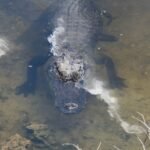
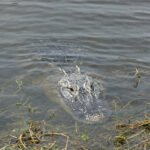
- Crocodile: a narrow, tapered snout, and the fourth tooth on the lower jaw shows when the mouth is closed. In the photo above, you can see a lower tooth standing up into a notch in the upper jaw.
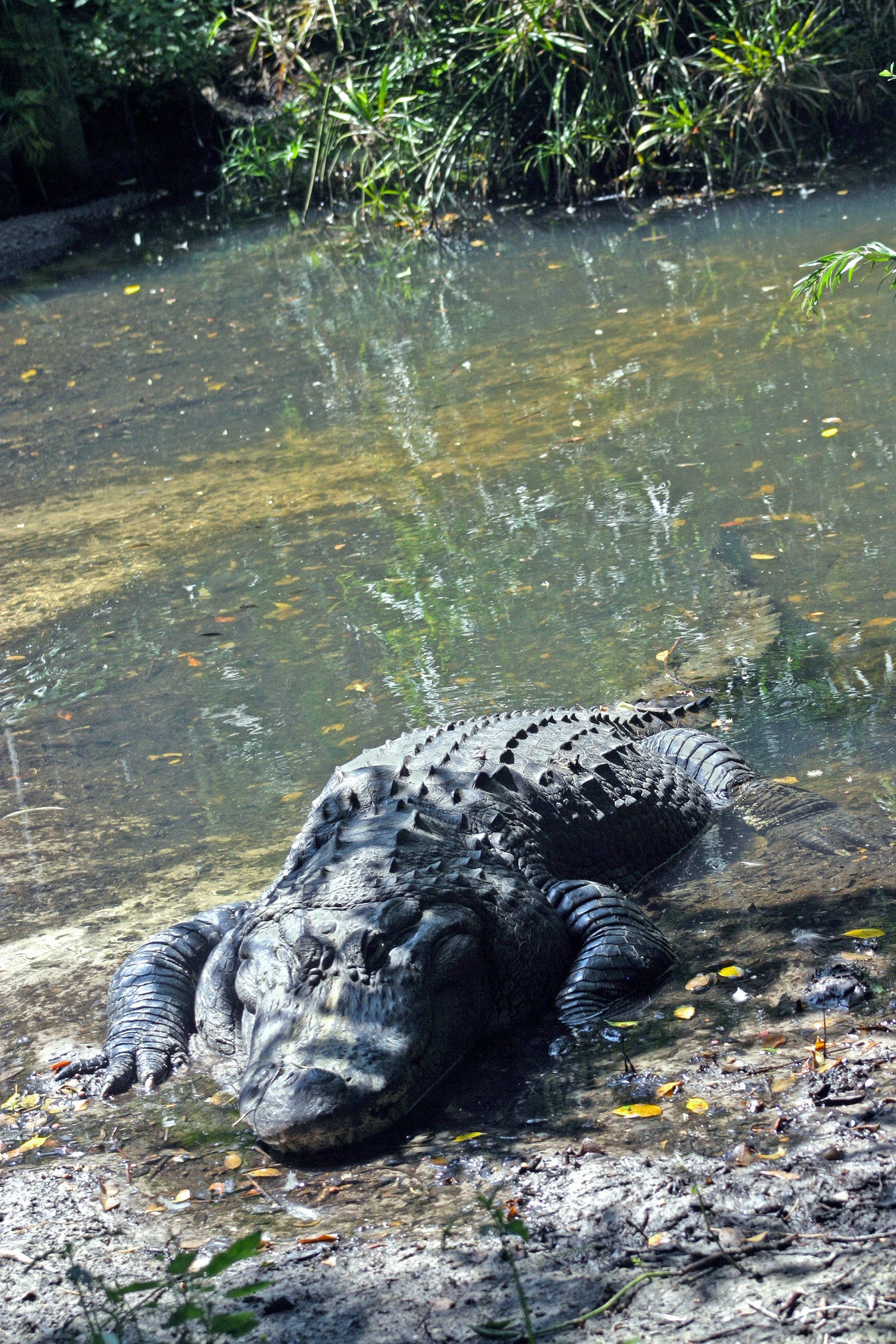
- Alligator: a broad, rounded snout, and only the upper teeth show when the mouth is closed.
- The young: baby crocodiles are light with dark stripes, and baby alligators are dark with yellow stripes.
Think of a “U”-shaped alligator and a “V”-shaped crocodile.
If you get a clear look at the closed mouth, you’ve pretty much got your answer.
Color is the weakest clue, honestly.
Crocodiles run grayish green and alligators black, but an adult alligator’s color varies with its habitat and can be olive, brown, gray or nearly black.
Water full of algae makes for greener skin.
So don’t call it on color alone.
Plus, there’s a third one in the mix: the common (or spectacled) caiman, which isn’t native.
It comes from Central and South America and has become established in the southeastern part of the state.
It looks more like a crocodile than an alligator, with a similar color but a shorter, more rounded snout.
It lives mostly in freshwater canals and lakes and rarely tops 5 feet.
It’ll probably stay confined to south Florida, because it can’t tolerate cold.
And whatever you’re checking, check it from a distance.
I’d bring binoculars and use them.
The safety section below has the actual numbers.
How Big They Get

Alligators first.
Females rarely grow past 10 feet, while males can get much larger, occasionally reaching 13 to 15 feet.
Both sexes tend to be smaller in south Florida.
Florida’s two record alligators are both males.
One holds the length record at 14 feet 3.5 inches, from Lake Washington in Brevard County.
The other holds the weight record: 1,043 pounds, from Orange Lake in Alachua County, and 13 feet 10.5 inches long.
That’s more than half a ton.
Crocodiles have the higher ceiling, at least on paper.
Males can reach about 20 feet but rarely go past 14 feet in the wild, and breeding females run about 8 to 12 feet.

🗼 I Wrote a Book About My Japan Travel Catastrophes!
Before I landed in Tokyo, I thought I was the “Final Boss” of international travel. Spoiler alert: I WASN’T. 😅
🚅 I boarded the wrong Shinkansen and ended up in THE WRONG CITY. I confused locals with my “expert” bowing that was more awkward than accurate. I accidentally stumbled into a high-stakes Kendo practice thinking it was a tourist show. Sound like something you’d do?
“Things I Wish I Knew Before Going to Japan” is your shortcut to avoiding ALL my cringe-worthy mistakes. ✨ Inside, you’ll find practical, LIFE-SAVING tips on etiquette, transport, money, and hidden gems that will save you time, money, and a whole lot of confusion.
Where Each One Lives, and Where They Overlap

Short version: alligators are freshwater animals and crocodiles are coastal ones.
The line between them is salt.
Alligators mostly live in freshwater swamps and marshes, though you’ll also find them in rivers and lakes and in smaller bodies of water.
They can handle some salt for short periods (they turn up now and then in brackish water around mangrove swamps).
But they lack the salt-secreting glands crocodiles have.
Crocodiles stick to brackish or salt water.
Think ponds and creeks in the mangrove swamps of south Florida and the Keys, plus coves.
They do sometimes turn up inland in fresh water along the southeast coast, thanks to the area’s extensive canal system, and they’ve recently moved northward within their range.
So the overlap is a south Florida thing.
If you’re on a dock in the Keys, you’re in crocodile range.
If you’re not sure where your trip falls, here’s whether Tampa counts as north or south Florida.
And if you’re headed down to the islands, here’s more on the crocodiles in the Florida Keys.
Where You Can Actually See a Crocodile

Seeing an alligator in Florida takes very little effort.
A crocodile takes a plan.
Your best bets are Everglades National Park and Biscayne National Park, plus Ding Darling National Wildlife Refuge.
One name that sounds like the obvious pick isn’t.
Crocodile Lake National Wildlife Refuge, one of the Fish and Wildlife Service’s Florida Keys refuges, is where the crocodile lives and nests in saltwater mangroves.
But the refuge is not open to the public.
What you can visit is its community butterfly garden and kiosk area, open during daylight hours, and its special events, which generally happen in the winter.
Timing matters too.
Both animals are most active between dusk and dawn, and they do most of their hunting then.
If you’ve booked a rental car for the drive down, sort out the tolls before you go.
Our post on whether SunPass is only for Florida residents covers that.
The Safety Rules for Both

Some perspective first: serious injuries from alligators are rare in Florida.
From 2012 to 2022 the state averaged eight unprovoked bites a year that were serious enough to need professional medical treatment.
Conflicts between crocodiles and people?
Extremely rare.
Rare isn’t never, though.
The rules:
- Keep at least 15 feet away. That’s the number at Everglades, and if an animal is hissing, you’re too close, even at more than 15 feet.
- Never feed one. It’s illegal and dangerous. Fed alligators and crocodiles can lose their wariness of people and learn to connect people with food. For crocodiles, indirect feeding counts too, which can happen when you feed other wildlife or throw away fish scraps the wrong way.
- Swim only in designated swimming areas, during daylight hours, and without your pet. These animals are most active between dusk and dawn.
- Keep pets on a leash and away from the water’s edge. Pets often look like their natural prey. Keep small children away from the water’s edge too, especially at night.
Two things that look scary but aren’t: a crocodile lying with its mouth open is “gaping,” which helps it control its body temperature and isn’t a sign of aggression.
And a crocodile splashing away into the water is frightened.
If an alligator or a crocodile worries you, call FWC’s toll-free Nuisance Alligator Hotline at 866-FWC-GATOR (866-392-4286).
The same number covers both.
FWC generally treats an alligator as a nuisance if it’s at least 4 feet long and believed to pose a threat to people, pets or property.
For alligators, FWC sends a contracted nuisance alligator trapper.
If you see someone feeding an alligator, the Wildlife Alert Hotline is 888-404-FWCC (888-404-3922), and you can stay anonymous.
Can an Alligator Mate With a Crocodile?

As far as anyone knows, no. They aren’t even in the same genus: Alligator mississippiensis and Crocodylus acutus.
What is on record is crocodile with crocodile, and it happens in Cuba.
American crocodiles got into Cuba’s Zapata Swamp through canals built in the 19th century, and American and Cuban crocodiles there are now interbreeding and producing hybrids.
The worry is that the traits that make the Cuban crocodile unique (its long legs and striking color patterns among them) get diluted over time.
Cuban crocodiles have also interbred with Siamese crocodiles in captivity.
So the answer is short: no alligator-crocodile hybrid on record, and a real hybrid problem among crocodiles in Cuba.
Sources checked early November 2026: the Florida Fish and Wildlife Conservation Commission’s alligator and crocodile pages and its two “living with” brochures, the National Park Service’s pages for Everglades and Biscayne, the U.S. Fish and Wildlife Service’s pages on the crocodile and its Crocodile Lake refuge, the Smithsonian’s National Zoo and the University of Michigan’s Animal Diversity Web.
Related read: The Caribbean Travel Guide — Instant PDF + Kindle download. Secure checkout by Stripe