“You hunting for sea glass in Florida?
Good luck, buddy.”
Florida isn’t California or the Great Lakes where sea glass practically blankets the shore.
But here’s the thing—I’d just slipped three pieces of cobalt blue into my pocket, and I knew something he didn’t.
Florida has sea glass.
You just have to know where to look.
And after months of hunting up and down both coasts, I can finally tell you which beaches actually deliver.
Why Florida Sea Glass Is So Darn Hard to Find

Let me be real with you.
Florida isn’t exactly a sea glass paradise because we’ve gotten better at recycling, and plastic bottles have replaced glass.
That means fewer glass bottles end up in the ocean in the first place.
Add to that the fact that the best sea glass beaches are usually surrounded by cliffs with big, aggressive waves that pound garbage back into bays—and Florida doesn’t exactly have rugged coastlines.
Our beaches are gorgeous, sure, but they’re mostly flat and sandy.
So when someone tells you Florida doesn’t have sea glass, they’re kinda right.
But when you find it?
Man, it feels like striking gold.
The thrill is real because it’s rare.
Tap to Explore These Beauties
See my ideas in action 👇 Tap any image to explore full details.
The Atlantic Side vs. Gulf Coast: Where Should You Hunt?

Here’s what I learned the hard way.
The Atlantic side is best because of the wave tumbling which makes the glass smooth and opaque.
The Gulf is beautiful—I love it for sunsets and chill vibes—but for sea glass?
The Atlantic wins.
The waves on the east coast do the heavy lifting, frosting and smoothing the glass over years.
On the Gulf side, the water is calmer, which means less tumbling action.
That doesn’t mean you won’t find anything on the Gulf—you totally can—but if I had to pick one side for a dedicated sea glass hunt, I’m heading to the Atlantic every time.
Trust me on this.
My Top Pick: Hutchinson Island (Coral Cove Park)

If you’re only hitting one beach on this list, make it this one.
The crown jewel of this beach on Hutchinson Island is its sea glass, multicolored pieces of discarded bottles and jars turned to treasure by salt water and churning surf.
I spent an entire morning here last spring, and I walked away with more sea glass than I’d found in the previous six months combined.
Coral Cove Park is a lesser-known spot characterized by rocky shorelines and clear turquoise waters that boasts a considerable amount of sea glass.
The rocky areas are key—that’s where the glass gets trapped and concentrated.
Don’t just walk the open sand; get close to those limestone boulders.
That’s where the magic happens.

🗼 I Wrote a Book About My Japan Travel Catastrophes!
Before I landed in Tokyo, I thought I was the “Final Boss” of international travel. Spoiler alert: I WASN’T. 😅
🚅 I boarded the wrong Shinkansen and ended up in THE WRONG CITY. I confused locals with my “expert” bowing that was more awkward than accurate. I accidentally stumbled into a high-stakes Kendo practice thinking it was a tourist show. Sound like something you’d do?
“Things I Wish I Knew Before Going to Japan” is your shortcut to avoiding ALL my cringe-worthy mistakes. ✨ Inside, you’ll find practical, LIFE-SAVING tips on etiquette, transport, money, and hidden gems that will save you time, money, and a whole lot of confusion.
Navarre Beach: The Panhandle’s Hidden Gem

Okay, so this one surprised me.
Tucked away in Florida’s panhandle, Navarre Beach is one of the best spots in the state for discovering sea glass, with plenty of wind coming off the Gulf and constantly shifting sand dunes.
I didn’t expect much from a Gulf beach, but Navarre proved me wrong.
The wind here is relentless, and those shifting dunes mean new treasures get exposed constantly.
Navarre is a quiet, undeveloped spot where nature rules, which inevitably means more beautiful glass to find.
If you want to escape the tourist crowds and actually have a shot at finding something, this is your spot.
Plus, it’s just beautiful—even if you strike out on sea glass, you won’t regret the trip.
Jacksonville Beach to Cinnamon Beach: My Favorite Stretch

This is where I’ve had my most consistent luck.
The stretch of coastline that runs from Jacksonville to Cinnamon Beach is another great location in Florida to go hunting for sea glass.
Jacksonville Beach, located on Florida’s northeast coast, offers a promising hunting ground with long sandy shorelines interspersed with rock jetties.
Those jetties are your best friend.
Walk along them during low tide, and you’ll find little pockets where sea glass accumulates.
I’ve found everything from the usual browns and greens to a stunning piece of aqua that now sits on my desk.
The whole northeastern coast just has better conditions—more wave action, more history, more glass.
Venice Beach: Known for Shark Teeth, But Don’t Sleep on the Sea Glass

Most people know Venice Beach as the Shark Tooth Capital of the World.
And yeah, Venice Beach is often dubbed ‘The Shark’s Tooth Capital of the World’ and is also known for an abundant supply of Florida sea glass.
I went looking for shark teeth and ended up finding almost as much sea glass.
Ocean currents frequently wash ashore a variety of sea glass pieces, and the optimal time for collection is usually after a storm or during low tide.
Pro tip: Go the morning after a storm.
That’s when I found my best pieces here—the churned-up water brings everything to the surface.
Plus, you get shark teeth as a bonus.
Win-win.
Sanibel and Captiva Islands: Shell Heaven with a Sea Glass Surprise

Full disclosure: these islands are tough for sea glass hunting.
Not because there isn’t any, but because Sanibel Island is a hugely popular spot for shelling and beachcombing, but the quantity of shells often hides the glass itself.
I felt like I was searching for a needle in a haystack.
Bowman’s Beach is one of the best stretches of sand on the island to go sea glass hunting, given its remote location and lack of development.
If you’re patient and willing to dig through shell piles, you’ll find treasures.
But honestly?
I’d recommend this more for shelling and save your sea glass energy for the Atlantic beaches.
Siesta Key: Worth a Shot, But Manage Your Expectations

Siesta Key is stunning—those white sand beaches are unreal.
Siesta Key is renowned as a great place for sea glass collecting, with the Florida Keys being full of shipwrecks and near a busy sea route.
I found a few pieces here, but nothing like the Atlantic side.
The sand is so fine and white that spotting sea glass is actually harder.
My advice?
Hit Siesta Key for the beach experience and sunset, and consider any sea glass you find a bonus.
Don’t go there specifically for sea glass unless you’re already in the area.
What Colors Can You Actually Find?

Let me set realistic expectations.
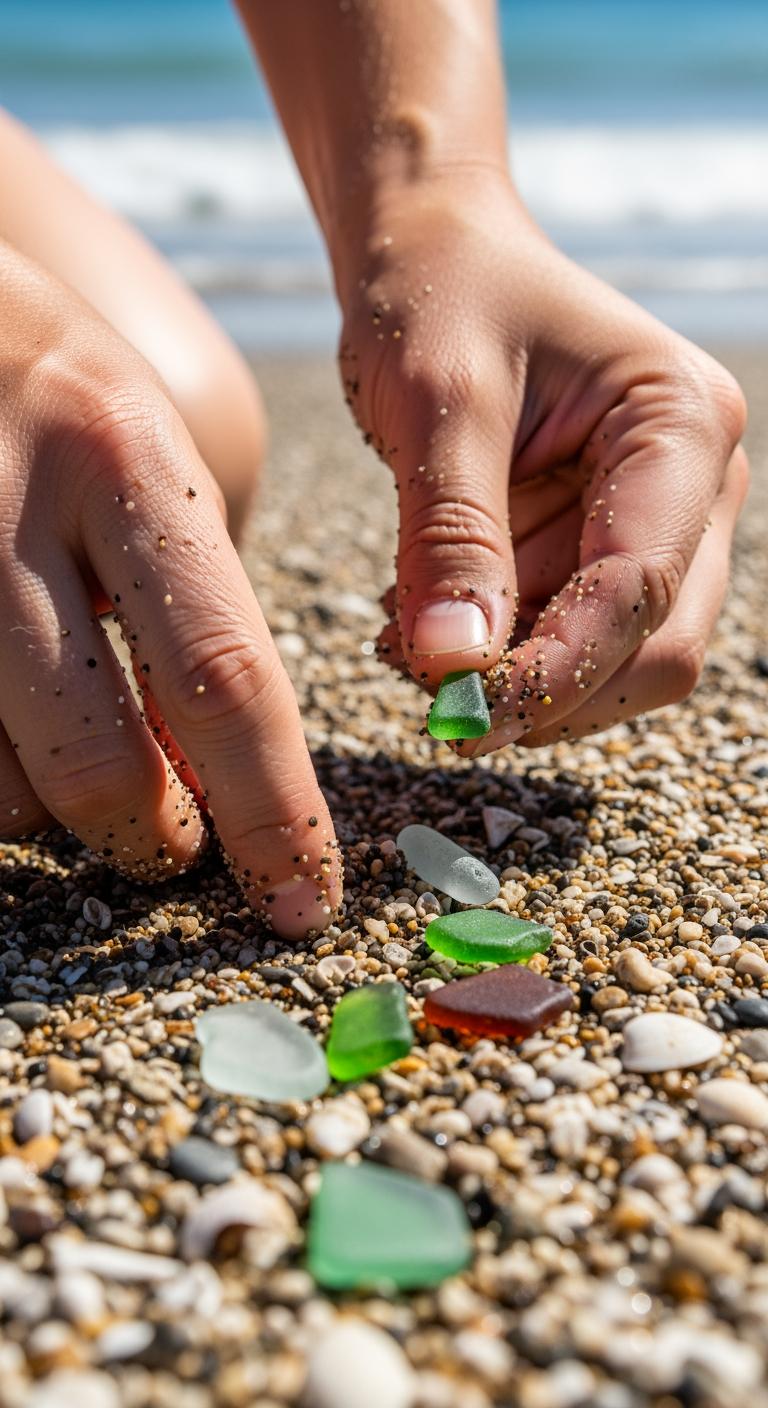
The most common sea glass colors found in Florida include clear, green, and shades of brown—remnants of beer bottles and soda bottles.
That’s what you’ll find 90% of the time.
But here’s where it gets exciting: The cobalt blue, true lilac, red, and orange pieces are likely from historic shipwrecks.
I’ve found blues and even one piece of lilac in my time hunting Florida beaches.
Those rare colors?
They’re out there, and finding one will make you feel like you’ve discovered pirate treasure.
Because in a way, you kinda have.
🗼 I Wrote a Book About My Japan Travel Catastrophes!
Before I landed in Tokyo, I thought I was the “Final Boss” of international travel. Spoiler alert: I WASN’T. 😅
🚅 I boarded the wrong Shinkansen and ended up in THE WRONG CITY. I confused locals with my “expert” bowing that was more awkward than accurate. I accidentally stumbled into a high-stakes Kendo practice thinking it was a tourist show. Sound like something you’d do?
“Things I Wish I Knew Before Going to Japan” is your shortcut to avoiding ALL my cringe-worthy mistakes. ✨ Inside, you’ll find practical, LIFE-SAVING tips on etiquette, transport, money, and hidden gems that will save you time, money, and a whole lot of confusion.
When Should You Actually Go Hunting?

Timing is everything, my friend.
The optimal time for collection is usually after a storm or during low tide.
I’ve learned to check the weather and plan my trips around storms—not during, obviously, but the morning after.
That’s when the ocean has churned everything up and deposited fresh finds on the shore.
Low tide is non-negotiable.
You want as much exposed beach as possible, especially around rocks and jetties.
Early morning is best before other hunters get there and before the sun gets brutal.
Pack water, sunscreen, and maybe a small mesh bag for your finds.
My Personal Sea Glass Hunting Kit

I’ve refined my setup over the years.
Here’s what I bring: a small mesh bag (not plastic—let the sand fall through), polarized sunglasses (they cut the glare and help you spot glass), a hat, tons of sunscreen, and water.
Some people bring little shovels or sifters.
I’ve tried that, but honestly?
I prefer just using my hands and eyes.
There’s something meditative about it.
Slow down, scan the waterline, crouch when something catches your eye.
The hunt itself is half the joy.
Also, bring a buddy if you can—my girlfriend and I make it a competition, and it’s way more fun that way.
Is It Even Legal to Take Sea Glass in Florida?

Good question, and I’m glad you asked.
The answer varies widely—some areas like national parks strictly prohibit removing natural objects, while in other locales taking small amounts is legal and even encouraged as beach cleanup.
It’s essential for collectors to research local regulations before starting their collection.
I always check before I hunt, especially in state parks.
Most regular beaches?
You’re fine taking a few pieces.
But respect protected areas and always leave the beach cleaner than you found it.
Pick up plastic trash while you’re at it—help the ocean out.
Why I Keep Coming Back for More

Here’s the thing about sea glass hunting in Florida.
It’s not easy, and you won’t fill buckets like you might in California.
But that’s exactly why I love it.
My husband asks me when it will be “enough,” but if you are a beachcomber you know that enough is never enough—it’s about the thrill of the find.
Every piece tells a story—a discarded bottle from decades ago, tumbled by waves, polished by sand, and finally discovered by you.
In a world where everything is instant and easy, there’s something deeply satisfying about earning your treasures.
Florida might not be the easiest place to find sea glass, but when you spot that flash of blue in the sand?
That feeling never gets old.