
Kayak fishing in the Florida Keys starts on land, with a Florida saltwater fishing license.
A visitor’s 3-day license is $17, and you need it even if every fish goes back.
Some of them have to go back.
Bonefish and tarpon are catch-and-release only in Florida.
And parts of the reef are closed to fishing altogether: the sanctuary’s preservation areas, marked with round yellow buoys, with one narrow trolling exception I’ll get to.
That’s the short answer.
The rest is detail: where to put in, what you can keep, when you can keep it, and what the law wants in the kayak with you.
A promise of “hidden channels” in Key Largo that only a few anglers know about doesn’t hold up.
Honestly, a channel described on a public web page isn’t hidden.
I read “hidden gem” in a listicle as a warning to expect company.
The facts here come from the Florida Fish and Wildlife Conservation Commission’s (FWC) license, fish, boating and wildlife pages, NOAA’s rules for Florida Keys National Marine Sanctuary, a National Park Service page on one shipwreck, and the Florida State Parks pages for four Keys parks, as of early November 2026.
The rules and prices below come from those pages, and rules change, so check FWC the week you go.
You Need a Florida Saltwater License, Even to Let Fish Go

FWC doesn’t leave much wiggle room here: “If you cast a line or catch and release, you need a fishing license.”
The saltwater license is required to take or attempt to take saltwater fish.
For visitors, a 3-day license is $17 and a 7-day one is $30.
A full year is $47.
Florida residents pay $17 a year.
Residents can also get a no-cost shoreline-only license, but it won’t help on this trip.
FWC says it’s not valid when fishing from a vessel, and FWC’s own equipment page puts canoes and kayaks in with its smallest class of boats.
So, yes, your kayak is a vessel.
Two permits sit on top of the license: $10 a year for snook and $5 a year for spiny lobster.
Check the season before you buy the snook one.
FWC says all sales are final, even if the fish you wanted turns out to be closed to harvest.
A tarpon tag is $51.50, sold only at tax collector’s offices, and it’s for someone chasing a Florida state or world record.
Everyone else lets tarpon go.
More on that below.
Anyone under 16 is exempt from the license, and so are Florida residents 65 or older.
So is anyone fishing from a for-hire vessel with a valid charter license, like a guide’s boat.
Booking a guided kayak trip?
I’d ask the outfitter whether that exemption covers you before assuming it does.
There are also license-free saltwater days.
Two come later in the year, the first Saturday in September and the Saturday after Thanksgiving, and the other is a weekend: the first Saturday and Sunday in June.
On those days FWC waives the snook and spiny lobster permits too.
One more, and it’s free.
If you’ll fish for certain reef fish from a private vessel, FWC requires the State Reef Fish Angler designation for anglers 16 and older, and seniors 65 and up still have to sign up for it.
The list includes mutton and yellowtail snapper, plus hogfish.
You can get it online at GoOutdoorsFlorida.com, in the Fish|Hunt Florida app, by phone at 1-888-FISHFLORIDA, or at a tackle shop.
Sort it out at home, the way you’d pack a carry-on.
Where to Launch a Kayak: Four State Parks on the Overseas Highway

Four Florida State Parks down the Overseas Highway make easy starting points.
All four open at 8 a.m. and close at sunset, every day of the year.
John Pennekamp Coral Reef State Park, Key Largo
Pennekamp, at 102601 Overseas Highway, bills itself as the country’s first undersea park and covers 70 nautical square miles.
The park says canoeing and kayaking are popular there and that fishing is permitted in designated areas.
Entry is $8 per vehicle, plus 50 cents per person.
Bring patience if you’re towing anything.
Construction has closed one of the park’s two boat ramps, and the park says boat trailer parking “has been significantly reduced.”
Got time ashore?
We covered whether you can walk around Key Largo and whether you can swim in the ocean in Key Largo.
Long Key State Park
Long Key, at 67400 Overseas Highway, lists flats fishing among its activities.
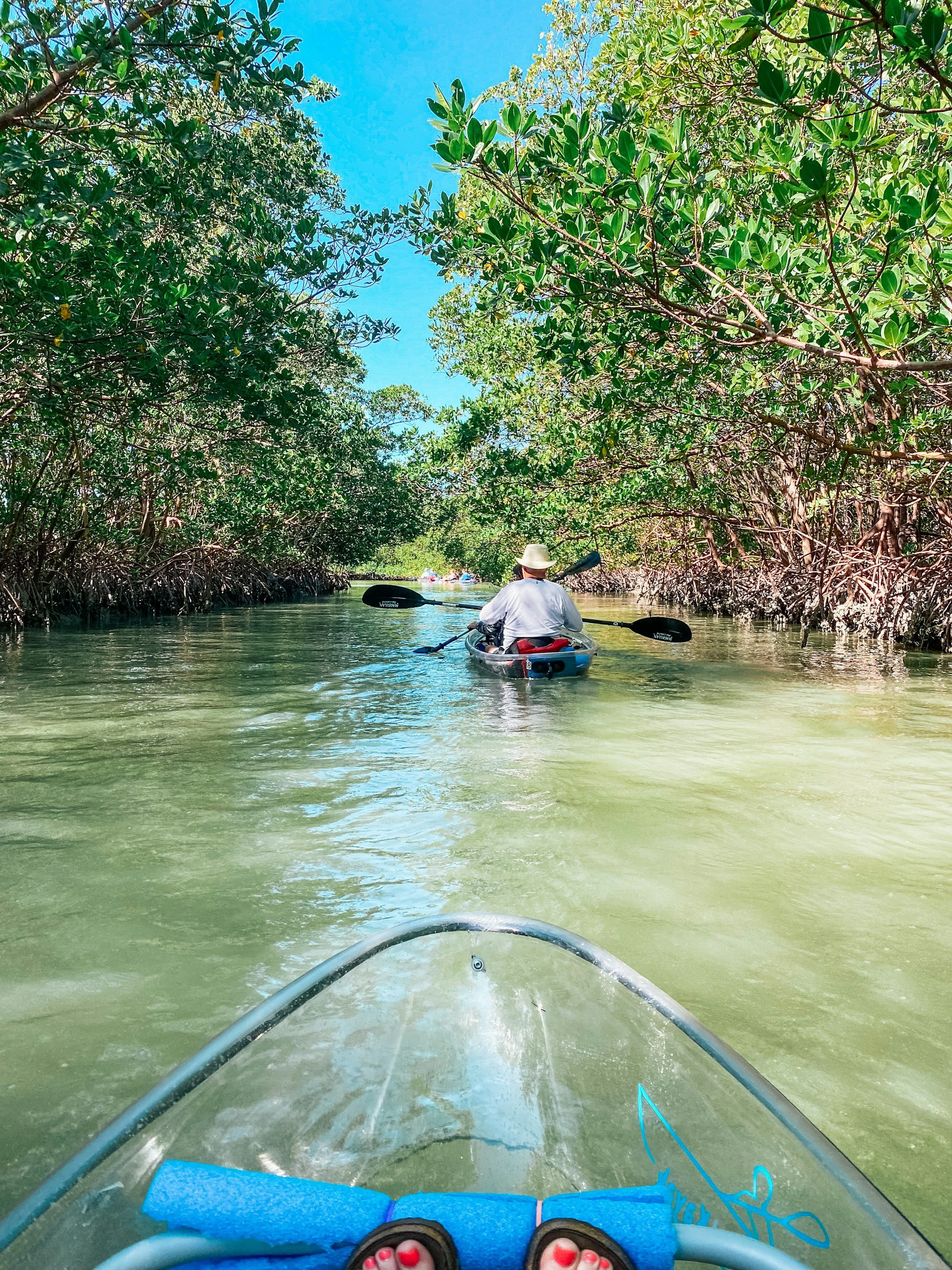
You can bring your own kayak or rent one from the ranger station and paddle along a natural shoreline.
Entry is $4.50 for one person, or $6 for two or more, plus 50 cents per extra person.
Two notices on the park’s page are worth reading before you drive down.
Since September 26, 2026, it may close for parts of the day when king tides flood it.
And since July 12, 2026, primitive camping and the Golden Orb trail have been closed for construction.
Fishing here isn’t a new idea, either.
In the early 20th century this was Henry Flagler’s Long Key Fishing Camp, where author Zane Grey and U.S. presidents fished.
The Labor Day Hurricane of 1935 destroyed it, and it never reopened.
Curry Hammock State Park, Marathon
Curry Hammock, at 56200 Overseas Highway in Marathon, is the largest undeveloped parcel of land between Key Largo and Big Pine Key.
On calm days it belongs to paddlers; on windy days, to kiteboarders.
Entry costs the same as at Long Key.
The park’s list of what kayakers there have encountered includes manatees and dolphins, along with horseshoe crabs and upside-down jellyfish.
Its mangroves and seagrass beds are habitat for many fish species.
Curry Hammock and Long Key also share a ranger-led paddle tour on Fridays at 9 a.m. It alternates between the two parks and depends on weather and tide.
Space is limited, so call before you count on it: 305-289-2690 for Curry Hammock, 305-664-4815 for Long Key.
Bahia Honda State Park, Big Pine Key
Bahia Honda, at 36850 Overseas Highway, is $8 per vehicle, and its concession rents kayaks.
The park’s own page has the practical version: it may close when its day-use areas reach capacity, and it recommends arriving early on weekends and holidays.
Towing a boat?
The marina’s trailer parking is limited, and when it fills up on holidays, you can’t launch a boat at the park.
If the beach matters as much as the fishing, here’s which Florida Key has the whitest sand.
Key West, and Paddling Elsewhere in Florida
Farther down the road, we have a separate rundown of where to launch a kayak in Key West.
For more mangroves around the state, see our list of mangrove kayaking spots in Florida.
And if you’d rather paddle spring water, here are the best springs in Florida to kayak.
Where You Can’t Fish: The Sanctuary’s Yellow Buoys

NOAA’s Florida Keys National Marine Sanctuary runs on what it calls marine zoning.
In its sanctuary preservation areas and conservation areas, fishing by any means is prohibited.
So is touching or standing on coral, living or dead.
Those zones are marked by 30-inch round yellow buoys (the Tortugas North and South conservation areas aren’t marked).
See yellow, reel in.
NOAA’s one exception is narrow: catch-and-release fishing by trolling is allowed in the Conch Reef, Alligator Reef, Sombrero Reef and Sand Key preservation areas only.
Wildlife management areas work differently.
They can be idle speed/no wake, no motor, no anchoring for vessels under 164 feet, or no entry at all, and they’re marked by white and orange spar buoys and signs.
Turns out a “no motor” zone still lets you in by paddle, which is one spot where a kayak beats a bass boat.
A few rules apply across the whole sanctuary, with certain exceptions.
You can’t anchor on living coral, hit coral or seagrass with your boat, dive or snorkel without a dive flag, or take protected wildlife.
Alligator Reef has a story of its own.
The National Park Service says the wreck of USS Alligator, a Navy schooner that ran aground in November 1822, lies 200 feet southwest of the Alligator Reef lighthouse off Islamorada, in 3 to 12 feet of water.
It’s inside the sanctuary, where moving or removing historical resources is prohibited.
Look, don’t take.
If you’re picking an island by the color of the water, we looked at which Florida Key has the bluest water.
And if you’ve wondered whether the islands themselves are natural or manmade, we answered that too.

🗼 I Wrote a Book About My Japan Travel Catastrophes!
Before I landed in Tokyo, I thought I was the “Final Boss” of international travel. Spoiler alert: I WASN’T. 😅
🚅 I boarded the wrong Shinkansen and ended up in THE WRONG CITY. I confused locals with my “expert” bowing that was more awkward than accurate. I accidentally stumbled into a high-stakes Kendo practice thinking it was a tourist show. Sound like something you’d do?
“Things I Wish I Knew Before Going to Japan” is your shortcut to avoiding ALL my cringe-worthy mistakes. ✨ Inside, you’ll find practical, LIFE-SAVING tips on etiquette, transport, money, and hidden gems that will save you time, money, and a whole lot of confusion.
Bonefish and Tarpon Go Back in the Water

Bonefish have been catch-and-release only since September 1, 2013, after FWC’s commissioners approved it that June.
FWC calls them “grey ghosts of the flats” and says the shallow flats of the Keys and Biscayne Bay are considered a world-class destination for trophy-sized bonefish.
You can catch them year-round in the Keys, but FWC says peak season is generally March through October.
FWC has the numbers, too.
A University of Miami study put the value of a single Keys bonefish at $3,500 a year, nearly $75,000 over its life.
A fish worth that much swimming isn’t dinner.
One gear rule: FWC prohibits using a multiple hook with live or dead natural bait when you’re fishing for bonefish.
Tarpon is catch-and-release only too.
A tarpon over 40 inches must stay in the water unless you’re going for a state or world record with a tarpon tag, and it’s hook and line only.
FWC also recommends not fishing for tarpon from bridges or piers.
Hook a big one there and you’d have to cut the line and leave a long line trailing behind the fish.
Not great for the fish.
And if a shark shows up mid-fight, FWC’s advice is to bring the tarpon in quickly and cut the line as close to the hook as possible.
Its best practices also call for non-stainless, non-offset, barbless circle hooks when you fish with bait.
Snook and Permit: One Fish, If the Calendar Says Yes

Snook in the Keys fall under FWC’s Southwest Region, which extends through the Florida Keys to the Monroe/Miami-Dade county line.
The season there is closed from December 1 through the end of February and from May 1 through September 30.
That leaves March and April, then October and November.
The slot is 28 to 33 inches total length, one fish per person per day, hook and line only, and you need the $10 snook permit on top of the license.
Permit (the fish, not the paperwork) have their own rules in FWC’s Special Permit Zone: state and adjacent federal waters south of a line running due east from Cape Florida at 25° 40′ North, plus Biscayne Bay south of the Rickenbacker Causeway.
All four parks above sit south of that line, going by the coordinates on their own pages.
In the zone, permit are closed from April 1 through July 31.
The minimum is 22 inches fork length, with 1 per harvester and no more than 2 per vessel, and it’s hook and line only in state waters.
What You Can Keep: Snapper and Spiny Lobster

Yellowtail snapper: a 12-inch minimum (total length), up to 10 per person within the 10-snapper aggregate bag limit.
Open year-round.
Gray (mangrove) snapper in state waters: 10 inches total length and 5 per person, inside the same 10-snapper aggregate.
Also open year-round.
Snappers count as reef fish, so FWC’s reef fish gear rules apply on board a vessel in state waters.
Carry a dehooking device and a descending device or venting tool rigged and ready, and use non-stainless steel hooks when you fish natural bait.
FWC says even a pair of needle-nose pliers counts as a dehooking tool, which is about as low-tech as the rules get.
Yellowtail and mutton snapper are also on the State Reef Fish Angler list from the license section, so from a private vessel you’ll want that free designation too.
Spiny lobster runs on its own calendar.
The regular season is August 6 through March 31, with 6 lobsters per person a day and a carapace longer than 3 inches, measured in the water.
You need the license plus the $5 lobster permit, and the lobster has to come home whole.
Before that comes the two-day sport season, the last Wednesday and Thursday of July.
In Monroe County the limit stays at 6, and taking lobster by diving at night is prohibited during those two days.
Pennekamp is closed to lobster harvest for the sport season, and lobster harvest is prohibited at all times in the sanctuary’s no-take areas.
Our Florida lobster season tool tells you whether it’s open on your date where you’ll be.
If you snorkel off the kayak for lobster, the dive-flag rule from the sanctuary section applies.
Crocodiles and Manatees: Who Else Is on the Water

Yes, the Keys have crocodiles.
They’re American crocodiles, which FWC says occur at the northern end of their range in south Florida and the Keys.
They live in brackish or saltwater areas and can be found in ponds, coves and creeks in mangrove swamps.
That’s kayak water.
They’re also shy.
Florida’s population has recovered from a few hundred to as many as 2,000 adults and is listed as threatened, and FWC calls them “shy and reclusive.”
A crocodile splashing noisily into the water is frightened, and one sunning with its mouth open is regulating its body temperature, not acting aggressively.
Concerned about one?
FWC’s number is 866-392-4286 (866-FWC-GATOR).
If you want to see one on purpose, the first place on FWC’s list is Everglades National Park.
We’ve covered whether there are saltwater crocodiles in the Keys, and the other animals to spot in the Florida Keys.
Then there are manatees.
NOAA says that in the winter months, manatees are often found in shallow, quiet waters of the sanctuary where seagrass beds or vegetation flourish, and that because they’re slow-moving, they’re often struck by boats.
FWC puts Florida’s population at a minimum of 8,350 animals.
FWC’s viewing rules suit a kayak just fine.
Look but don’t touch.
Don’t feed them or give them water.
Don’t chase one, paddling included, and don’t separate a cow and her calf.
Harassing a manatee breaks state and federal law.
Under Florida’s law, a conviction can mean a fine of up to $500 and/or up to 60 days in jail; at the federal level, a fine of up to $50,000 and/or a year in prison.
The Safety Gear Florida Requires on a Kayak

FWC puts canoes and kayaks with its Class A vessels, the under-16-foot group.
Here’s what that class has to carry:
- One U.S. Coast Guard-approved wearable life jacket for each person, readily accessible. Anyone under 6 must wear one while the vessel is underway.
- A sound-producing device, like a bell, horn or whistle.
- Visual distress signals for nighttime use, on coastal waters. FWC’s definition of coastal waters covers the Atlantic and the Gulf, plus bays and sounds with an entrance over 2 miles wide.
- Navigation lights between sunset and sunrise and in reduced visibility. FWC points you to Coast Guard Navigation Rules 20 through 25 for your type of vessel.
No fire extinguisher, though: FWC says non-motorized boats are exempt.
FWC’s extra suggestions are written with motorboats in mind, but two still fit a kayak: an anchor with enough line, and a way to get water out, like a bilge pump.
Just keep the anchor off living coral.
After dark, the lights and the night distress signals above aren’t extras.
They’re the law.
When to Go: The Keys Calendar, Fish by Fish

The Keys don’t really have an off-season for fishing so much as a rotating list of what’s closed:
- Bonefish: release only. Peak season is generally March through October, though they’re caught year-round.
- Tarpon: release only.
- Snook: open in March and April, then October and November.
- Permit: closed April 1 through July 31.
- Yellowtail and gray snapper: open year-round.
- Spiny lobster: August 6 through March 31, plus the two-day sport season in late July.
- Manatees: NOAA’s note is about the winter months.
- License-free days: a June weekend (the first Saturday and Sunday), plus the first Saturday in September and the Saturday after Thanksgiving.
Lay it out and October and November line up best on paper.
Snook are open, permit are open, lobster is in season, and October is still inside the bonefish peak.
Weather is its own question, so check a forecast before you get anything booked.
🗼 I Wrote a Book About My Japan Travel Catastrophes!
Before I landed in Tokyo, I thought I was the “Final Boss” of international travel. Spoiler alert: I WASN’T. 😅
🚅 I boarded the wrong Shinkansen and ended up in THE WRONG CITY. I confused locals with my “expert” bowing that was more awkward than accurate. I accidentally stumbled into a high-stakes Kendo practice thinking it was a tourist show. Sound like something you’d do?
“Things I Wish I Knew Before Going to Japan” is your shortcut to avoiding ALL my cringe-worthy mistakes. ✨ Inside, you’ll find practical, LIFE-SAVING tips on etiquette, transport, money, and hidden gems that will save you time, money, and a whole lot of confusion.
Getting There, and the Rest of Your Keys Trip

Every park above sits on the Overseas Highway, so the drive is part of the plan.
We’ve worked out whether the drive from Miami to Key West is worth it and whether the drive from Key Largo to Key West is worth it.
There’s also how long it takes to drive the length of the Florida Keys.
And for the record, we answered whether you can walk from Key West to Key Largo.
Still sorting out the basics?
Start with whether the Florida Keys are the same as Key West, then how many days you need in Key West.
For the hours off the water, there’s the question of why there are no beaches in the Florida Keys.
Or why Florida is known for key lime pie, if you’d rather eat.
We’ve also got a list of unique Florida souvenirs.
Get the license, learn the yellow buoys, let the bonefish and tarpon go, and give the crocodiles their space.
The rest is paddling.