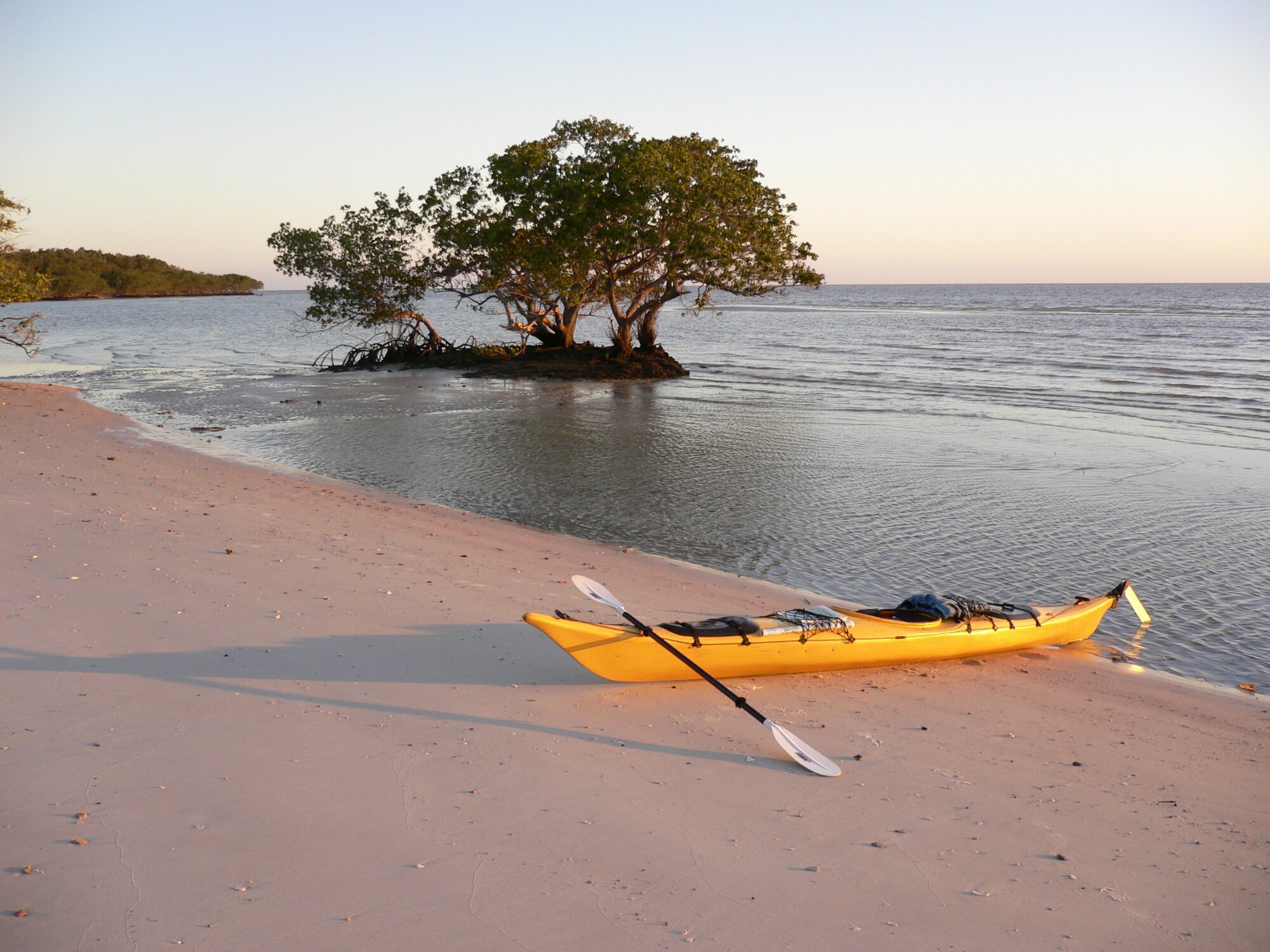

Mangrove kayaking in Florida means paddling the shallow, salty edges of the state, where the trees stand in the water on their own roots and the channels between them close into green tunnels.
Mangroves can’t survive freezing temperatures, so they mostly grow on the southern part of the Florida peninsula: south of Cedar Key on the Gulf side and south of St. Augustine on the Atlantic side.
For the tide on your own beach day, see the free Florida tide times.
The spots below are spread along the Gulf side, from the Chassahowitzka north of Tampa down to the Ten Thousand Islands.
The Keys are a trip of their own; if that’s where you’re headed, start with launching a kayak in Key West.
The tide runs a lot of these paddles.
Several mangrove trails turn shallow and muddy at low tide, so check the tide chart before you pick a launch time.
So, where is the best mangrove kayaking in Florida?
1. Weedon Island Preserve
Weedon Island Preserve covers about 3,000 acres on Tampa Bay in north St. Petersburg, and most of it is marine, with some uplands.
More than 4.7 miles of boardwalks and trails cross it, some through tidal flats and mangrove forest.
Admission is free.

The paddle to plan on is the South Paddling Trail, a loop of about four miles from the canoe launch next to the fishing pier at the end of Weedon Drive NE.
It winds through mangroves and seagrass flats, between the preserve’s islands and along the edge of the bay.
There’s a second paddling trail on the north side, but it’s closed for now.
I’d go at mid to high tide and bring a tide chart, because many of the trails are hard to get through when the water drops.
Look for reddish egrets, roseate spoonbills and white ibis; below you, the water holds oysters and stingrays (even small sharks).
- About 3,000 acres on Tampa Bay, in north St. Petersburg
- The South Paddling Trail: a four-mile loop from the launch at the end of Weedon Drive NE
- Best at mid to high tide; canoe and kayak rentals from ECOmersion
2. Ten Thousand Islands National Wildlife Refuge
If you want mangroves with no rental stand and no tour desk, Ten Thousand Islands National Wildlife Refuge is the one I’d pick.
It protects about 35,000 acres of a South Florida coastal ecosystem, with red mangroves growing thick at the water’s edge.

Most of the refuge is best reached by boat, and the two main access points are Goodland and Port of the Islands.
On land, the Marsh Trail has an 18-space parking lot, a mile-long hiking and biking trail, paddling trails for canoes and kayaks, and a two-story observation tower over the marsh.
The refuge doesn’t rent paddles or run guided tours.
So you bring your own boat or book an outfitter, and I’d bring a chart or a GPS app too.
It was set up in 1996 and is critical habitat for Florida manatees, wood storks and several kinds of sea turtles.
From fall to spring you can also camp, primitive style, on some of its barrier islands.
- About 35,000 acres, established in 1996
- Boat access from Goodland and Port of the Islands; the Marsh Trail on land
- No rentals or guided tours from the refuge itself
3. Lovers Key State Park
Lovers Key State Park is at 8700 Estero Boulevard in Bonita Springs, on four barrier islands where developers once planned luxury condos.
The state acquired the islands in 1983 and in 1996 merged them with the county park next door.
On busy weekends and holidays its parking tends to fill to capacity, so come early or come back an hour or two later.

The paddle here is the park’s 2.5-mile estuary, sheltered by mangroves, with canals and lagoons where manatees graze.
On the paddle you may see dolphins, alligators, ospreys and bald eagles.
There’s an ADA-accessible kayak launch, and Matt’s Beach Shack in the park rents kayaks and paddleboards (239-366-6624).
Getting in costs you $8 per vehicle, and the park is open from 8 a.m. to sunset every day of the year.
Pack lunch and water: the park has had no gift shop, bait shop or food and beverage service since May 1, 2026.
- A 2.5-mile estuary paddle, sheltered by mangroves
- Kayak and paddleboard rentals daily; an ADA kayak launch
- $8 per vehicle, 8 a.m. to sunset

🗼 I Wrote a Book About My Japan Travel Catastrophes!
Before I landed in Tokyo, I thought I was the “Final Boss” of international travel. Spoiler alert: I WASN’T. 😅
🚅 I boarded the wrong Shinkansen and ended up in THE WRONG CITY. I confused locals with my “expert” bowing that was more awkward than accurate. I accidentally stumbled into a high-stakes Kendo practice thinking it was a tourist show. Sound like something you’d do?
“Things I Wish I Knew Before Going to Japan” is your shortcut to avoiding ALL my cringe-worthy mistakes. ✨ Inside, you’ll find practical, LIFE-SAVING tips on etiquette, transport, money, and hidden gems that will save you time, money, and a whole lot of confusion.
4. J.N. “Ding” Darling National Wildlife Refuge
J.N. “Ding” Darling National Wildlife Refuge, on Sanibel Island, covers more than 6,400 acres, and over 40 percent of that is federal wilderness.
It’s part of the largest undeveloped mangrove ecosystem in the United States, and that’s about as good a case for a mangrove paddle as I can think of.

Tarpon Bay Explorers, the refuge’s official concessionaire, rents kayaks and canoes between 8 a.m. and 3 p.m. and runs guided trips, including a Kayak Trail Tour, a Low Tide Kayak Tour and a Sunset Rookery Paddle.
If it’s your first time in mangroves, I’d book one of the guided paddles.
If you want to drive Wildlife Drive the same day, it’s a four-mile, one-way road with a 15 mph limit, and it costs $10 per vehicle.
But it’s closed every Friday, all year, so I wouldn’t build a drive-and-paddle day around a Friday.
- More than 6,400 acres, over 40 percent federal wilderness
- Kayak and canoe rentals and guided paddles through Tarpon Bay Explorers
- Wildlife Drive: $10 per vehicle, closed Fridays
5. Estero Bay Preserve State Park
Estero Bay Preserve State Park, south of Fort Myers, protects Estero Bay, Florida’s first aquatic preserve.
It’s more than 11,000 acres with over 10 miles of shoreline and more than 7,000 acres of mangroves, and the water is the best way to see that part of it.

The public launches are at Lovers Key State Park and Koreshan State Park, and from either one you paddle the bay’s shallow water.
From Koreshan you start on the Estero River, a brackish tidal river that runs about 3 miles before it joins the bay, where river otters and alligators turn up, and so do manatees and dolphins.
Koreshan charges $5 per vehicle and doesn’t rent canoes or kayaks, so bring your own.
My advice: launch from Lovers Key if you need a rental, Koreshan if you don’t.
On land, the preserve charges $2 per vehicle and has two trail systems: the Estero River Scrub trails, about 10 miles in all, and the Winkler Point loops, about 6 miles through flatwoods, salt marsh and mangroves.
Both are seasonally wet, and the Winkler Point trails are under water most of the year, so plan on October through May for the Estero River Scrub trails and January through May for Winkler Point, when each is usually at its driest.
- More than 11,000 acres, with over 7,000 acres of mangroves
- Launch at Lovers Key or Koreshan State Park
- No rentals at Koreshan; Lovers Key rents kayaks
6. Chassahowitzka River
The Chassahowitzka River starts at the Chassahowitzka Spring Group in Citrus County, a first-magnitude group of springs listed as an Outstanding Florida Spring, and flows as a tidal river through Chassahowitzka National Wildlife Refuge, on the Gulf about 15 miles south of Crystal River.
If you like the best springs in Florida to kayak, this river sits between the two kinds of paddle: spring water at the top, brackish marsh at the bottom.

Downstream, the refuge is a mix of saltwater bays, estuaries, brackish marshes and hardwood swamp, and it’s an important place for West Indian manatees.
Most of it is reached by boat; on land, the Salt Marsh Trails on South Mason Creek Road in Homosassa have a paddle launch.
The Chassahowitzka River Campground, next to Seven Sisters Springs, has waterfront access to the river, and visitors come mainly to kayak.
In September 2025, Citrus County signed on to run it for the next 40 years, after the water district had planned to close it over damage from the 2024 hurricanes.
Call the campground about launching before you drive up: in June 2026 its dock area was still closed because of that hurricane damage.
- A spring-fed tidal river in Citrus County
- Manatee habitat in the refuge downstream
- Call the campground before you go: its dock was closed for hurricane damage in June 2026
7. Delnor-Wiggins Pass State Park
Delnor-Wiggins Pass State Park is on Gulfshore Drive in Naples.
The paddle starts at its boat launch, where a mangrove canopy opens into Water Turkey Bay.
From there you can follow the edge of the mangrove swamp, go under bridges, head east up the Cocohatchee River or go north through the bay channels toward Estero Bay.

Bring your own boat: you launch your own kayak, canoe or paddleboard here.
Wiggins Pass, the cut out to the Gulf of Mexico, can have dangerous currents and riptides, so I’d leave it alone unless you know what you’re doing.
Overhead there are eagles and ospreys (owls too).
In the water, look for dolphins and manatees, plus stingrays and snook.
Entry is $6 per vehicle, 8 a.m. to sunset; since Sept. 28, 2026, you pay by credit or debit card at kiosks around the park and at the boat ramp, and leave the printed receipt on your dashboard.
The boat ramp has a separate $5 fee on top of entry, so check with the park whether it applies to a kayak.
Lovers Key, Estero Bay and Koreshan are state parks too, so if you’ll visit several in a year, look at a Florida State Parks annual pass.
- Launch your own boat at the park’s boat launch
- A mangrove canopy into Water Turkey Bay, the Cocohatchee River beyond
- $6 per vehicle, plus $5 at the boat ramp; dangerous currents in Wiggins Pass
Best Mangrove Kayaking in Florida: The Chart
Here are the launches and boats at each spot, at a glance.

| Spot | Where | The paddle | Boats |
|---|---|---|---|
| Weedon Island Preserve | St. Petersburg, on Tampa Bay | The South Paddling Trail, a four-mile loop through mangroves and seagrass flats | Rentals from ECOmersion |
| Ten Thousand Islands NWR | Goodland and Port of the Islands | Coastal waterways best reached by boat; canoe and kayak trails at the Marsh Trail | Bring your own or book an outfitter |
| Lovers Key State Park | Bonita Springs, on Estero Boulevard | A 2.5-mile estuary sheltered by mangroves | Kayak and paddleboard rentals daily |
| J.N. “Ding” Darling NWR | Sanibel Island | Rentals or guided paddles from Tarpon Bay | Tarpon Bay Explorers |
| Estero Bay Preserve State Park | Estero Bay, south of Fort Myers | A shallow bay with more than 7,000 acres of mangroves | Launch at Lovers Key or Koreshan |
| Chassahowitzka River | Citrus County | A spring-fed tidal river into a wildlife refuge | Call the campground to ask about the launch. |
| Delnor-Wiggins Pass State Park | Naples | A mangrove canopy into Water Turkey Bay | Bring your own |
| Everglades National Park | Flamingo and Everglades City | Designated canoe trails, among them the 1.9-mile Noble Hammock loop through mangrove creeks and the West Lake route, 8.1 miles one way | Rentals at Flamingo and in Everglades City |
| Cayo Costa State Park | A barrier island reached only by boat or kayak | 9 miles of undeveloped shoreline | Private boats only while the ferry is out of service |
| Great Calusa Blueway | The Fort Myers area | A paddling trail of nearly 200 miles through coastal waters and inland creeks | Depends on where you put in |
Paddle Your Way: Top Tips for Kayaking in the Mangroves
Planning a mangrove paddle?
Good.
Here’s what I’d sort out first, because a few things decide whether it’s a great morning or a long one.
None of them are about strength.
They’re about the tide and the sun.
And patience.

1. Wear the right clothes. Light, quick-drying clothes, a hat and sunglasses do most of the work, because open water gives you very little shade.
I’d wear closed-toe shoes that can get wet, since you may have to step out onto mud or oyster shell.
Long sleeves also help with mosquitoes, which are worst at dawn and dusk, on overcast days and in summer.
Pack repellent or a head net even in the dry season.
2. Stay hydrated. Bring more water than you think you need.
I’d rather haul a spare bottle back to the car than run dry on a falling tide.
Some parks don’t sell food or drinks at all right now, Lovers Key among them, and Delnor-Wiggins has had no drinking water since April 2025.
Pack a few snacks too.
A hungry, tired paddler makes worse calls about wind and tide than a fed one.
3. Use a waterproof bag. I’d put your phone and keys (the car fob too) in a dry bag clipped to the boat, not in a pocket.
And that phone is also your map and your way to call for help, so start the day with it charged.
4. Respect the environment. Mangroves are protected by law in Florida, and their roots are nursery habitat for young fish.
Don’t break branches to squeeze through a tight spot, and don’t climb on the roots.
Pack out everything you bring in.
And don’t feed any wildlife: it’s a bad idea everywhere, and in places like Everglades National Park it’s illegal.
5. Know your limits. I’d pick a trail you can finish with energy to spare, and turn around before you’re tired.
Wind matters more than distance; West Lake in the Everglades isn’t recommended on windy days because its open water gets rough.
Leave a plan with a friend or family member: which trail you’re on and when you expect to be back.
Do those five things and a mangrove paddle is one of the calmer ways to spend a Florida morning.
Put the life jacket on, not under the seat, and go.
🗼 I Wrote a Book About My Japan Travel Catastrophes!
Before I landed in Tokyo, I thought I was the “Final Boss” of international travel. Spoiler alert: I WASN’T. 😅
🚅 I boarded the wrong Shinkansen and ended up in THE WRONG CITY. I confused locals with my “expert” bowing that was more awkward than accurate. I accidentally stumbled into a high-stakes Kendo practice thinking it was a tourist show. Sound like something you’d do?
“Things I Wish I Knew Before Going to Japan” is your shortcut to avoiding ALL my cringe-worthy mistakes. ✨ Inside, you’ll find practical, LIFE-SAVING tips on etiquette, transport, money, and hidden gems that will save you time, money, and a whole lot of confusion.
Explore Florida’s Mangrove Forests: 5 Self-Guided Kayak Routes
If you’re a nature lover who’d rather paddle at your own pace than follow a guide, these five routes are marked, or simple enough to do on your own.
Each starts from a public launch; Lovers Key rents boats on site, and at Weedon Island you can rent from ECOmersion.

- Lovers Key State Park: the 2.5-mile estuary from the park’s kayak launch, through canals and lagoons where manatees graze. Rentals are in the park.
- Delnor-Wiggins Pass State Park: from the boat launch, through the mangrove canopy into Water Turkey Bay and up the Cocohatchee River. Stay out of Wiggins Pass itself unless you’re ready for strong current.
- Nine Mile Pond, Everglades National Park: a loop of about 5 miles, with a 3.5-mile shortcut, through shallow grassy marsh with scattered mangrove islands, marked with numbered white poles. Water levels can change a lot, and the trail may be impassable near the end of the dry season, so ask a ranger about conditions and turn back if you hit shallows. Watch for wading birds, plus alligators and crocodiles. Rentals are at Flamingo, and the Everglades Institute runs guided paddles on the pond, canoes supplied, when water levels permit.
- Koreshan State Park: down the Estero River, a brackish tidal river, about 3 miles to Estero Bay. Entry is $5 per vehicle; bring your own boat.
- Weedon Island Preserve: the South Paddling Trail, a four-mile loop on Tampa Bay through mangroves and seagrass flats. Time it for mid to high tide.
If you’d rather see the bottom of a river than a wall of mangrove roots, Florida’s spring runs are the other half of the state’s paddling, and the best of them are crystal clear.
Whichever route you pick, check the tide and the weather the morning you go.
A mangrove trail can go from easy to impassable with the water level.
Is It Safe to Kayak in the Mangroves?
Yes, for most people, with some planning.
I’d worry about the weather long before I’d worry about an alligator.
Plan for the ordinary problems: sunburn, dehydration, a falling tide, a stiff wind, or a wrong turn in a creek that looks like every other creek.
Give wildlife room, too.
Here’s what keeps a mangrove paddle safe.

Stay alert and aware of your surroundings. Mangrove creeks look alike, which is why the better trails are marked.
Nine Mile Pond uses numbered white poles, and the Hell’s Bay trail in the Everglades is marked with more than 160 poles; old-timers called it “Hell to get into and Hell to get out of.”
Keep track of the markers you pass, and carry a map or a GPS app that works without a cell signal.
Wear appropriate safety gear. I’d wear the life jacket instead of stowing it, and clip a whistle to it.
A whistle carries a lot farther across open water than your voice does.
Plan your route ahead of time. Check the tide, the wind and the trail’s status before you go.
Some Everglades routes are impassable at low tide or in low water, and in Naples, Wiggins Pass can have dangerous currents and riptides.
On the Gulf Coast side of the Everglades, the Nathaniel P. Reed Visitor Center answers questions about water levels at (239) 695-1168.
Don’t touch or feed the wildlife. Keep at least 15 feet from alligators and crocodiles, and if one hisses, you’re too close.
In Everglades National Park, feeding or harassing an animal is a criminal offense that carries a fine.
Stay alert, wear the gear, plan the route, drink your water and give animals room.
That covers nearly everything.
Watch Out for These Wild Creatures in Florida’s Mangroves
Florida’s mangroves are packed with life, which is the point of paddling them.
A few of the residents make people nervous, so here’s what you might meet and what to do about it.
The two that come up most are snakes and alligators, with sharks a distant third.

Yes, you might see snakes and alligators in Florida’s mangroves. Neither is a reason to stay home, and both are a reason to keep your hands in the boat.
I’d start with the numbers.
Only six of Florida’s 50 native snake species are venomous: the eastern coral snake, the southern copperhead, the cottonmouth, the eastern diamondback rattlesnake, the timber rattlesnake and the dusky pygmy rattlesnake.
Copperheads aren’t a mangrove worry at all, because copperheads in Florida live only in the Panhandle.
The snake built for this habitat is the saltmarsh snake, a harmless watersnake about 15 to 30 inches long.
Its mangrove form lives in coastal habitats from Levy County on the Gulf, around the south end of the state, to Brevard County on the Atlantic, with a likely gap along the Palm Beach County coast, and on barrier islands too.
It may bite if someone grabs it, and that’s about it.
The venomous one to know is the cottonmouth.
Cottonmouths live in every Florida county and on many nearshore islands, including the Upper Keys.
They aren’t aggressive, and most bites happen when someone steps on one or bothers it.
A bite can be very dangerous, though, so if one bites you, get medical care right away.
Telling them apart from a kayak isn’t easy, since Florida has eight harmless watersnakes that look like cottonmouths.
Seen from above, a cottonmouth’s eyes are hidden while a watersnake’s are easy to see, and a cottonmouth has cat-like pupils and a pit between the nostril and the eye.
From a kayak, I wouldn’t get close enough to check any of that, so I’d keep my distance from every snake.
For more on telling them apart, see this rhyme for telling a venomous snake from a harmless one.
Then there’s the big invasive one.
Burmese pythons are large constrictors, not venomous, and live mainly in and around the Everglades, where they threaten native wildlife.
You can also read up on anacondas in Florida.
Alligators come next.
Females rarely grow past 10 feet and males get bigger.
Florida’s length record is a male 14 feet, 3.5 inches long, and the weight record is a 1,043-pound male.
They prefer fresh water but live in brackish water too.
They often lie still, but don’t read that as sleepy.
Alligators and crocodiles can react lightning fast and do most of their hunting from dusk to dawn.
Keep at least 15 feet away (farther if it hisses) and never feed one, and if an alligator seems to be a threat, Florida’s nuisance alligator hotline is 866-392-4286.
Sharks are the third.
Young lemon sharks use seagrass flats, mangrove forests and tidal creeks as nurseries, so small sharks in the shallows are part of the habitat.
Lemon sharks have been involved in only a few bites on people, none of them fatal; if you’d like to plan around them, check when Florida sees the most sharks.
Manatees deserve a mention for the opposite reason: they’re the animal everyone hopes to see, and Lovers Key, the Estero River and the Chassahowitzka refuge all have them.
I’d give them room and let them pass.
A roseate spoonbill on a mangrove branch beats most Florida souvenirs if you ask me, and the photo costs you nothing but patience.
The rule for every animal out there is the same: give it space, don’t touch it, don’t feed it, and paddle on.
FAQs

1. What should I wear when kayaking through mangroves in Florida?
Light, quick-drying clothes and a hat, plus sunscreen and sunglasses.
Add closed-toe shoes that can get wet.
I’d wear long sleeves and pants for the mosquitoes, which are worst at dawn and dusk and in summer, and a dry bag keeps your phone and keys safe.
2. Do I need to bring my own kayak?
It depends on the spot.
Lovers Key rents kayaks, Ding Darling’s rentals run through Tarpon Bay Explorers, Weedon Island has rentals through ECOmersion, and Flamingo in the Everglades has them too.
Koreshan doesn’t rent canoes or kayaks, Ten Thousand Islands refuge doesn’t rent or guide, and at Delnor-Wiggins you launch your own.
3. What should I bring with me when kayaking through mangroves?
My list: a life jacket (worn, not stowed), water, snacks, a first-aid kit, a whistle, a dry bag, a charged phone, a map of the trail and a tide chart.
Add mosquito repellent in any season.
4. Is it safe to kayak through mangroves in Florida?
It can be, if you plan for sun and heat, the tide and the wind, and getting lost.
I’d plan the route, check the tide and wear the life jacket.
Give wildlife room: at least 15 feet from alligators and crocodiles, and never feed anything.
5. What is the best time of year to kayak through mangroves in Florida?
In the Everglades, the dry season, roughly December through April, is the favorite, and I’d pick it too: low humidity, average highs around 77°F and the biggest variety of wading birds.
But it’s also the busy season, so expect company on the water and book guided paddles ahead.
Late in the dry season some trails, Nine Mile Pond among them, can get too shallow to paddle, so ask a ranger about water levels before you go.
In the Everglades, summer, the wet season from about May to November, is the off-season for a reason: frequent thunderstorms, highs in the low 90s and a lot of mosquitoes.
Hurricane season runs from June 1 to November 30, so check the forecast before any trip.
A Kayaker’s Dream: Picking Among Florida’s Mangrove Trails
Mangrove kayaking is one of the closest looks you can get at wild Florida.

If you want rentals and an easy start, I’d go to Lovers Key.
If you want a guide, book one of Ding Darling’s paddles through Tarpon Bay Explorers; a guided paddle also makes a good Florida birthday outing.
If you want mangroves with nobody selling you anything, that’s my pick: the Ten Thousand Islands, in your own boat.
Near Tampa, Weedon Island’s south loop is the easy pick; just time it for the tide.
Koreshan, on the Estero River, is for people who bring their own boat, and so is Delnor-Wiggins, with a mangrove canopy right at the launch.
And if spring water sounds better than a salt creek, the Chassahowitzka is the one; just call the campground before you drive up.
Whichever you pick, three things decide the day: the tide, the wind and the season.
I’d check all three the morning you go.
Park hours, fees and rules can change, especially after a hurricane season, so check each park’s page the week you go.
Then grab a paddle and sunscreen (and a full water bottle), and go see the mangroves.