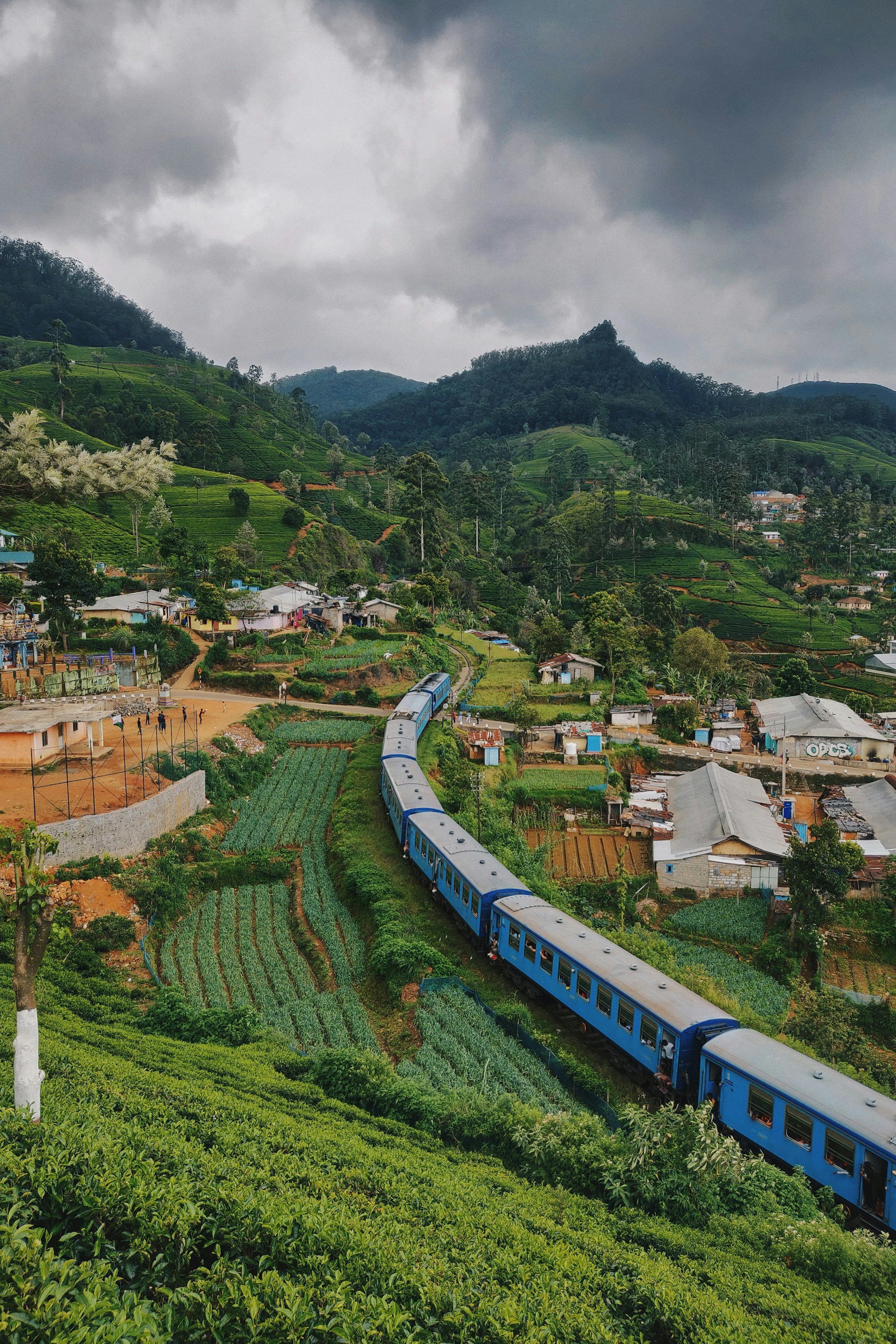


Every Sri Lanka trip plan I’ve ever been sent has the same big moment in it: a blue train rolling through the tea hills toward Ella.
It’s a great ride.
This winter only half of it is running, and that’s the second thing to sort out, not the first.
The first thing is the weather.
Sri Lanka gets two monsoons, from two directions, at two different times of year.
So “Sri Lanka in December” doesn’t mean the island.
It means one side of it.
Pick the wrong coast and you’ve flown 20-plus hours (a layover in the Gulf and a week of jet lag thrown in) to sit in a guesthouse and watch the rain come sideways.
I know because I did exactly that on my first trip.
East coast, January.
It cost me 4 days of a 10-day trip.
Here’s the short version for a trip between December and March, then the long one.
One Island, Two Rainy Seasons

The southwest monsoon runs from May to September.
It soaks the west and south coasts, and the hill country gets it too.
The northeast monsoon runs from December to February and lands on the north and the east.
In between, it can rain almost anywhere.
October and November are the messy months, when storms don’t care which coast you picked.
March and April are hot and sticky, with afternoon thunderstorms.
So for a winter trip, the rule is simple.
The south and west coasts are in season, and so are the hills.
The east coast is in its wet months, which makes it a summer trip.
That’s the whole trick.
Most “best time to visit Sri Lanka” lists bury it under a paragraph about how the island is “great all year”.
It is great all year.
Just not on both sides at once.
December to March, Go South and West

Winter is high season on the south coast, and honestly it earns it.
The sea calms down and the sky clears.
The beach towns that are half shut in the off-season fill back up.
Galle and Mirissa sit on the same stretch of coast (Unawatuna is about 5 km past Galle, and Hikkaduwa is in the same district), so they’re easy to string together.
From the airport north of Colombo, a car on the expressway gets you to Galle in about 2.5 to 3 hours.
How long exactly depends on the Colombo traffic when you land.
After a long haul, it’s the only drive I’d do on day one.
Book early if you’re going over Christmas and New Year.
The good-value guesthouses go first.
And the line of people asking at the door on December 26 is not a line you want to be in.
Galle Fort Is Worth a Night, Not a Day Trip

Most people do Galle Fort as a few hours from the beach.
I did too, the first time, and I was back on the bus by 4 p.m. wondering what the fuss was about.
That was a mistake.
The old town inside the walls is a UNESCO World Heritage Site.
The Portuguese founded it in the 16th century, and the stone ramparts most people walk today went up under the Dutch.
The day crowd thins out by late afternoon.
That’s when you want to be there, walking the ramparts toward the lighthouse while the sun goes down over the water.
Stay one night inside the fort and you get the quiet evening plus the cool early morning, which is when the streets are at their prettiest.
It’s worth it.
Eat dinner outside the walls if you’re watching money.
Prices inside are fort prices (you’ll see what I mean the first time you order a lime juice).
🗼 I Wrote a Book About My Japan Travel Catastrophes!
Before I landed in Tokyo, I thought I was the “Final Boss” of international travel. Spoiler alert: I WASN’T. 😅
🚅 I boarded the wrong Shinkansen and ended up in THE WRONG CITY. I confused locals with my “expert” bowing that was more awkward than accurate. I accidentally stumbled into a high-stakes Kendo practice thinking it was a tourist show. Sound like something you’d do?
“Things I Wish I Knew Before Going to Japan” is your shortcut to avoiding ALL my cringe-worthy mistakes. ✨ Inside, you’ll find practical, LIFE-SAVING tips on etiquette, transport, money, and hidden gems that will save you time, money, and a whole lot of confusion.
Mirissa’s Whale Boats Run Through April

The whale watching season off Mirissa lines up with the dry months on that coast, roughly November to April.
Blue whales are the headline, and sperm whales turn up too.
Boats leave early, and the trip out is long and choppy.
Eat something light before you go.
I’ve done it twice.
The first boat came back with nothing but sunburned noses.
The second found a blue whale inside the first hour, which turns out to be how it goes: nobody sees one every day.
So if a whale is the point of your trip, put it near the start of your stay, not on your last morning, and leave room for a second try.
Pick an operator that keeps its distance from the animals instead of racing other boats to them.
If the captain is chasing, ask to go back.
You paid for a trip, not a stampede.
Bring a dry top or a light jacket, too.
Wet spray and wind at 7 a.m. feel a lot colder on a boat than the word “tropics” suggests.
The Hill Train Is Only Half Running Right Now

Now the famous train.
Cyclone Ditwah hit Sri Lanka in late 2025 and tore up the main line through the hills in a lot of places.
The scenic end sat idle for about 7 months, and repairs have gone section by section ever since.
Here’s where it stands this fall.
Since June 20, 2026, four trains a day have run between Nanu Oya and Badulla.
The thing is, that’s the scenic stretch.
Ella and the Nine Arch Bridge are both on it, and so is Haputale.
North of Nanu Oya, it’s broken.
In early November there were no trains from Colombo to Kandy, and none from Kandy up to Nanu Oya.
A landslide near Kadigamuwa shut the line at midnight on October 25, and the bridge into Kandy at Peradeniya was still being rebuilt.
There’s no firm date for the whole 292 km line from Colombo to Badulla.
Dates on this line have slipped before.
But don’t build a non-refundable trip around the Kandy to Ella ride.
Plan on the road for the first half and treat any train north of Nanu Oya as a bonus.
Check the railway’s notices the week you fly, because this is the part of the plan most likely to change.
How to Get to Ella Without the Kandy Train

Get yourself to Nanu Oya by road, then take the train from there.
Nanu Oya is a main-line station in the tea country near Nuwara Eliya, about 207 km from Colombo by rail.
From Kandy it’s a 2 to 3 hour drive up through the estates, and Colombo to Kandy is another 3.5 to 4 hours by road.
You can hire a driver or take the bus.
The bus is cheaper and slower, and it gives you a front-row seat to how people actually drive on mountain roads (fast, with a lot of horn).
From Nanu Oya, the train does the part everyone came for.
Tea estates and tunnels, little stations with flower beds, then Ella.
Reserved seats are sold on the railway’s own site, seatreservation.railway.gov.lk, about 30 days ahead.
In the winter rush they go fast, so book the day your dates are firm.
If you miss out, the unreserved carriages still run.
You’ll stand for some of it.
Standing in a train door in the hills is half the fun anyway.
Travel light for this leg.
A carry-on and a daypack fit on the train racks.
A big hard suitcase turns a crowded carriage into a contact sport.
The East Coast Is a Summer Trip
Arugam Bay and Trincomalee are lovely, and in winter they’re on the wet side of the island.
The northeast monsoon brings their rain from December to February, which is exactly when the south coast is at its best.
Their season is the other half of the year.
Arugam Bay’s surf season runs from about May to October, and whale boats work out of Trincomalee over roughly the same months, once Mirissa’s season is over.
So if you’re flexible, a second trip in July covers what a December trip can’t.
You could go east in January anyway.
You’d find it quieter and cheaper.
Then you’d find out why it’s quieter and cheaper, the way I did.
The ETA Is Free for Americans Now, but You Still Apply
Good news on paperwork.
Since May 25, 2026, citizens of 40 countries get Sri Lanka’s tourist ETA free, the United States and Canada among them, plus the UK and Australia.
It’s good for 30 days with two entries, which helps if you’re tacking on the Maldives.
Free doesn’t mean skip it.
You still apply before you fly, on the official ETA site.
For most other passports the same 30-day, double-entry visa is US$50.
Kids under 12 of any nationality get theirs free, and it can be extended in Sri Lanka for up to 6 months if your plans grow.
Use the government site and nothing else.
Lookalike sites charge a “service fee” for filling in the same form, and they show up first in search results more often than they should.
Keep the approval email on your phone, plus a screenshot in case the airport Wi-Fi isn’t cooperating.
The airline can ask to see it at check-in, before you ever reach Colombo.
Getting Around: The Bus, a Driver or a Tuk-Tuk

Sri Lanka is cheap to get around if you have time, and easy to get around if you have money.
Pick one.
The bus goes pretty much everywhere and costs almost nothing.
It’s also packed, and driven with real conviction.
A hired car with a driver is what a lot of visitors end up doing for the hill country, especially now that the train only covers the bottom half.
Tuk-tuks fill the gaps.
Agree on the fare before you get in, every single time, or use a ride app like PickMe where it works.
The one ride I didn’t agree on first cost me about double — and the driver was very friendly about it.
Carry small notes.
Tuk-tuk drivers and bus conductors rarely have change for a big one, and the cash machine at the airport will hand you mostly big ones.
Break them at a supermarket or your guesthouse on day one.
If I had 10 days this winter, I’d land and go straight down the expressway to the south coast for 4 or 5 nights.
Then I’d hire a car up to Nanu Oya and ride the train to Ella.
That’s the trip the weather wants you to take right now — and the only train you can count on is waiting at the end of it.