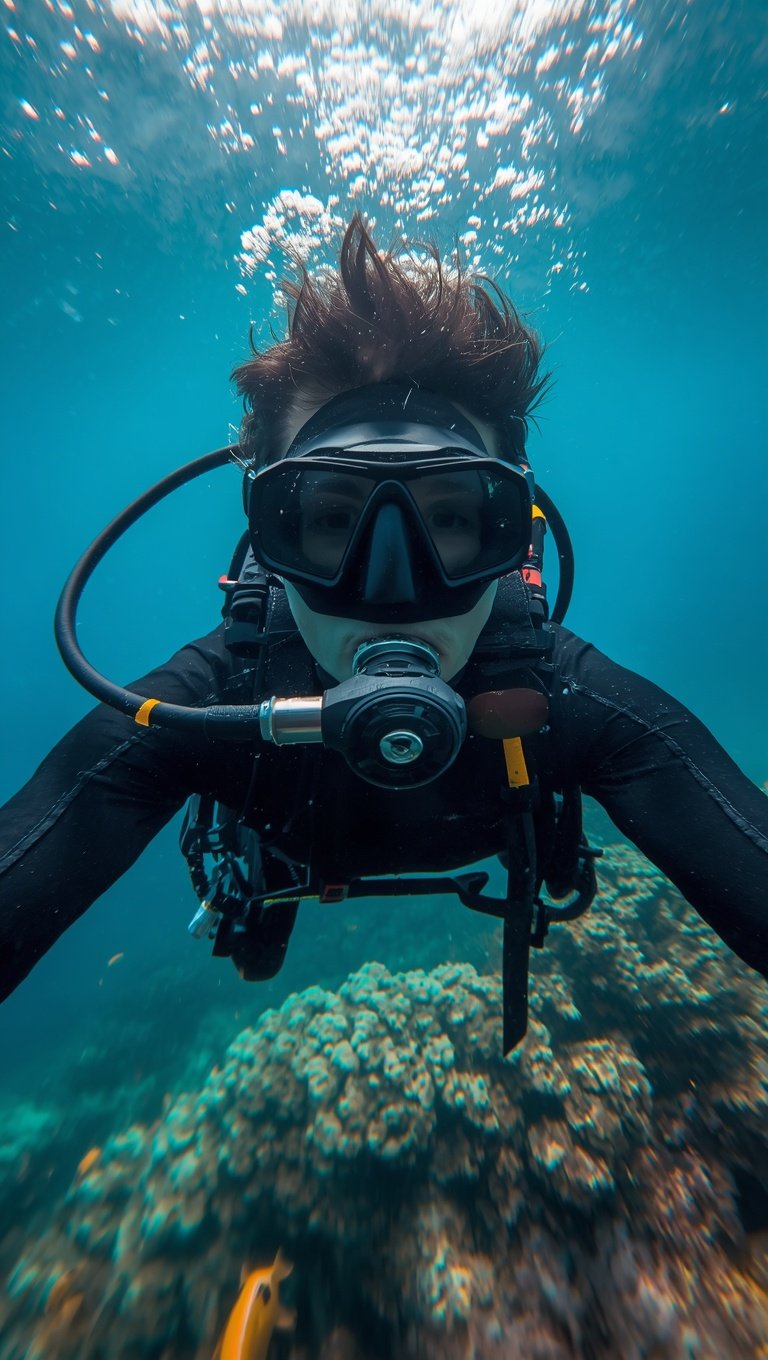
The first time I put a regulator in my mouth and sank below the surface, I genuinely forgot to breathe.
Not because I was scared — well, okay, I was a little scared — but because nothing in my life had ever felt that quiet.
Like the whole world just… paused.
No notifications.
No noise.
Just blue.
If you’ve been thinking about trying scuba diving but keep putting it off because it feels complicated, expensive, or just plain intimidating — I get it.
I was you.
And I want to walk you through everything I learned the not-so-graceful way, so your first dive feels a whole lot smoother than mine did.
What Scuba Diving Actually Feels Like (Spoiler: It’s Nothing Like You’d Expect)

People always ask me, “Is it scary?”
And honestly?
The anticipation is scarier than the actual dive.
Once you’re underwater, something shifts.
Your nervous system kind of… relaxes.
There’s this weightlessness that takes over your body that no yoga class or float tank has ever come close to replicating for me.
You’re not swimming hard.
You’re just… gliding.
The sound of your own breathing becomes this meditative rhythm — in, out, bubbles rising — and it genuinely pulls you into the present moment in a way that feels almost spiritual.
When I tackled my first open water dive off the coast of Cozumel, I remember thinking, “Why did I wait so long?”
The colors below the surface are nothing like what you see in photos.
They’re warmer, stranger, more alive.
A school of parrotfish passed maybe three feet from my face and I almost choked on my regulator from the sheer joy of it.
So if you’re on the fence — this is me, Jeff, telling you to jump off it.
Understanding the Basic Gear (Without Overwhelming Yourself)

I’m not going to throw a 47-piece equipment list at you.
You don’t need that right now.
What you do need is a basic understanding of the core gear so you don’t show up to your first lesson looking completely lost.
The BCD — that’s your buoyancy control device — is basically the vest you wear that lets you float up, sink down, or hover in the middle.
Think of it as your underwater remote control.
Then there’s the regulator, which is the mouthpiece connected to your tank that delivers air when you breathe in.
Your mask is way more important than people think — a bad seal means a flooded face, and that’s a miserable way to spend a dive.
Fins give you propulsion without burning your arms out.
And your wetsuit keeps you warm, protects your skin, and honestly makes you feel like a total badass.
When I rented gear for the first time, I asked the dive shop guy to walk me through each piece before I put anything on.
Best decision I made.
Don’t be afraid to ask questions — dive shop people love talking about this stuff.
The Open Water Certification: What It Is and Why You Need It

Here’s the thing nobody tells you upfront.
You can’t just… go scuba diving.
Well, you can do a “discover scuba” experience with an instructor right next to you — but to dive independently, you need a certification.
The most common one is the Open Water Diver certification, and it’s more accessible than it sounds.
Most courses take about 3–4 days total.
You’ll do some classroom or e-learning sessions covering theory — pressure, buoyancy, dive tables, safety stops — and then you’ll do pool sessions to practice your skills in a controlled environment before heading into open water.
Those pool sessions are where I went from panicked to confident.
Something about practicing in shallow, clear water with no current just builds your muscle memory in a way that sticks.
The open water dives at the end feel like graduation day.
My instructor, a super calm guy named Marco, told me before my final dive: “You already know how to do this. Now just do it.”
And he was right.
The certification opens up the whole underwater world to you — and it’s yours to keep forever.

🗼 I Wrote a Book About My Japan Travel Catastrophes!
Before I landed in Tokyo, I thought I was the “Final Boss” of international travel. Spoiler alert: I WASN’T. 😅
🚅 I boarded the wrong Shinkansen and ended up in THE WRONG CITY. I confused locals with my “expert” bowing that was more awkward than accurate. I accidentally stumbled into a high-stakes Kendo practice thinking it was a tourist show. Sound like something you’d do?
“Things I Wish I Knew Before Going to Japan” is your shortcut to avoiding ALL my cringe-worthy mistakes. ✨ Inside, you’ll find practical, LIFE-SAVING tips on etiquette, transport, money, and hidden gems that will save you time, money, and a whole lot of confusion.
How to Choose Your First Dive Destination

Not all beginner dive spots are created equal.
And picking the wrong one can genuinely put a damper on what should be one of the coolest experiences of your life.
For your first few dives, you want warm water, good visibility, calm conditions, and gentle marine life.
Cold, murky, current-heavy water is for experienced divers.
You’ll get there eventually — but not on dive one.
Some of my personal favorite beginner-friendly dive destinations include the Florida Keys, the Caribbean islands like Cozumel or Bonaire, Bali, and the Great Barrier Reef.
Warm, clear, stunning — and all super well set up for newer divers with plenty of reputable dive operators.
When I was choosing where to get certified, I asked around in a few online diving communities and the consensus was pretty clear: go somewhere warm, go somewhere shallow for your first dives, and go somewhere with a reliable, safety-first dive school.
I ended up in Cozumel and I’d make that same call again in a heartbeat.
Do a little research on the dive operator before you book — read reviews, check certifications, ask about instructor ratios.
My Tips for Managing Pre-Dive Nerves

Okay, real talk.
Even now, after dozens of dives, I still get a little flutter in my chest right before I roll backwards off the boat.
That’s completely normal.
What matters is how you manage it.
One thing that helped me enormously was slow, deliberate breathing before entering the water.
Not a “breathe deeply and think happy thoughts” kind of way — I mean literally practicing your breathing rhythm before you descend.
In through the regulator.
Out slow.
Repeat.
Your body responds to that rhythm and it calms your nervous system down almost immediately.
I also found it helped to stay focused on the task right in front of me rather than thinking about being 30 feet underwater.
Put your fins on.
Check your gear.
Give the okay signal.
One step at a time.
And if you feel overwhelmed at any point during a dive, you can always signal your instructor, slow down, and hover for a minute.
There’s no shame in taking a beat.
Some of my most peaceful underwater moments have come right after a shaky start.
What to Expect on Your Very First Dive

Let me paint you a picture of what that first dive actually looks like — because nobody painted it for me and I kind of freaked out a little.
You’ll gear up on a boat or from shore.
You’ll do final buddy checks.
You’ll enter the water — either by stepping off a platform or doing a giant stride entry from the boat.
Then you’ll do a surface check before slowly deflating your BCD to begin descending.
The descent is the weirdest part for most beginners.
Your ears need to equalize as the pressure changes, so you’ll do this thing called the Valsalva maneuver — you pinch your nose and gently blow.
It feels odd but it’s essential.
Once you’re down and hovering at depth?
That’s when the magic happens.
The first time I was fully underwater, neutrally buoyant, just floating in the blue with a reef right in front of me — I let out this involuntary laugh through my regulator.
Bubbles everywhere.
My instructor gave me a thumbs up.
That moment is burned into my memory forever.
Your first dive will probably be shallow — somewhere between 20 and 40 feet — and honestly, that’s where all the best stuff is anyway.
Buoyancy: The Skill That Changes Everything

If there’s one skill that separates a stressed-out diver from a relaxed, happy one — it’s buoyancy control.
And it takes practice.
Like, genuine, repetitive practice.
The goal is to hover effortlessly in the water without sinking to the bottom or floating up uncontrollably.
You do this by adjusting the air in your BCD and controlling your breathing.
Breathe in a little — you rise.
Breathe out — you sink.
It sounds simple but in the moment, it feels like patting your head and rubbing your stomach simultaneously.
When I first started, I was either dragging along the seafloor or constantly fighting to stay down.
My instructor eventually told me: “Stop fighting. Let your breath do the work.”
And once that clicked?
Everything got easier.
Buoyancy is also really important for reef conservation — crashing into coral with bad technique can damage ecosystems that took centuries to grow.
Good buoyancy is both a skill and a responsibility.
Take the time to practice it in the pool before you dive on a reef.
It’s worth every second.
Marine Life: What You’ll See and How to Behave Around It

This is honestly one of the things I get most excited talking about because the underwater world is just… wild.
On a good dive, you might encounter sea turtles, moray eels, octopuses, rays, reef sharks, lionfish, barracuda, and thousands of fish species in colors that don’t seem real.
But here’s the code of conduct every new diver needs to understand.
You don’t touch anything.
Not the coral.
Not the sea life.
Nothing.
Beyond the safety risk — some things bite, sting, or are toxic — touching marine life and coral is genuinely damaging to the ecosystem.
Watch, don’t touch.
That’s the rule.
I remember seeing a massive green sea turtle glide right past me on a dive in the Cayman Islands and my entire instinct was to reach out.
I didn’t.
I just watched it disappear into the blue.
And that restraint made the moment feel more sacred, somehow.
A good dive is a low-impact dive.
You’re a guest in that world.
Act accordingly.
What to Do If Something Goes Wrong

I want to talk about this honestly because I think it’s important.
Things can go sideways underwater, and knowing how to respond is the difference between a minor inconvenience and a serious situation.
The most important rule in scuba diving?
Never hold your breath.
Seriously.
This is drilled into you in your certification course and for good reason — ascending while holding your breath can cause a lung overexpansion injury that’s genuinely dangerous.
Always breathe continuously.
If your mask floods, stay calm — there’s a technique to clear it and your instructor will walk you through it in the pool.
If you feel panicked, signal your buddy, stop moving, and breathe slowly.
If you need to ascend, do it slowly and do a safety stop at 15 feet for about 3 minutes.
Ascending too fast can cause decompression sickness, which nobody wants.
These aren’t meant to scare you.
They’re meant to empower you.
Knowing what to do if something goes wrong actually makes you calmer underwater because you’re not operating from fear of the unknown.
Trust your training.
Trust your instructor.
And always dive within your limits.
🗼 I Wrote a Book About My Japan Travel Catastrophes!
Before I landed in Tokyo, I thought I was the “Final Boss” of international travel. Spoiler alert: I WASN’T. 😅
🚅 I boarded the wrong Shinkansen and ended up in THE WRONG CITY. I confused locals with my “expert” bowing that was more awkward than accurate. I accidentally stumbled into a high-stakes Kendo practice thinking it was a tourist show. Sound like something you’d do?
“Things I Wish I Knew Before Going to Japan” is your shortcut to avoiding ALL my cringe-worthy mistakes. ✨ Inside, you’ll find practical, LIFE-SAVING tips on etiquette, transport, money, and hidden gems that will save you time, money, and a whole lot of confusion.
The Gear You’ll Eventually Want to Own

You don’t need to buy anything for your first dive.
Rental gear is totally fine and most dive shops have quality equipment.
But if you catch the bug — and trust me, you probably will — there are a few pieces of gear worth investing in personally over time.
Your mask is the first thing I’d recommend buying.
A mask that fits your face perfectly, sealed properly, is a game-changer for comfort.
Your dive computer comes next.
It tracks your depth, bottom time, and ascent rate in real time — and having your own means you know exactly where you’re at on every dive.
Over time, I also bought my own wetsuit (sizing matters a lot for warmth) and eventually my own BCD and regulator.
But that’s a longer-term investment.
Start by owning your mask and a good pair of fins.
Build from there.
And honestly, talk to your dive instructor before buying anything — they’ll steer you toward what actually suits your diving style and budget without pushing unnecessary gear on you.
How to Keep Diving After You’re Certified

Getting certified is just the beginning.
And one of the best pieces of advice I ever got was: dive as much as possible right after you certify.
The skills are fresh.
Your confidence is building.
Don’t let months go by without getting in the water or you’ll feel like you’re starting over.
Join a local dive club if there’s one near you — they’re usually super welcoming to new divers and often organize group trips.
Consider advancing your certification to Advanced Open Water, which lets you dive deeper and try specialties like night diving, wreck diving, or underwater photography.
I did my Advanced course about six months after getting certified and it opened up a whole new level of diving that I hadn’t even known existed.
Night diving in particular?
Absolutely surreal.
The ocean transforms after dark in a way that I genuinely can’t describe.
You just have to experience it.
Keep a dive log — either a physical book or a digital app.
Tracking your dives, the sites, the depth, the marine life you saw, the conditions — it becomes this beautiful record of your underwater life.
And flipping back through mine always gives me that itch to book another trip.
I’ve done a lot of things in my life that I’d call “experiences.”
Road trips.
Summiting mountains.
Skydiving once — never again, honestly.
But scuba diving has given me something that none of those things did.
It gave me a completely parallel world.
A place that exists just below the surface of this one that most people never see.
And every single time I descend below that waterline, I feel this rush of gratitude that I actually learned how to do this.
It’s a skill.
A real, tangible, life-enriching skill.
It makes you more patient.
More calm.
More present.
It teaches you to breathe.
Literally and figuratively.
If you’ve been sitting on the idea of trying scuba diving — consider this your sign.
Book the discover dive.
Sign up for the certification course.
Tell your fear to take a back seat and go see what’s underneath the surface.
I promise you — it’s worth it.
Related read: The Caribbean Travel Guide — Instant PDF + Kindle download. Secure checkout by Stripe