
Every road trip packing list online is the same sixty things in a different font.
Socks, snacks, phone charger.
Fine.
You were going to bring socks.
What actually makes a long drive easier is where things sit in the car.
Pack by when you’ll need each thing, not by what it is.
Heavy stuff you hope never to touch goes down low.
Soft stuff fills the gaps.
Anything you want while the car is moving rides up front, in reach, the way you’d treat a carry-on on a plane.
I think of the car in four zones.
Here’s what goes where (and the one place your feet don’t go).
The Trunk Floor: Heavy Things Go Down Low

This is about as good as a trunk gets.
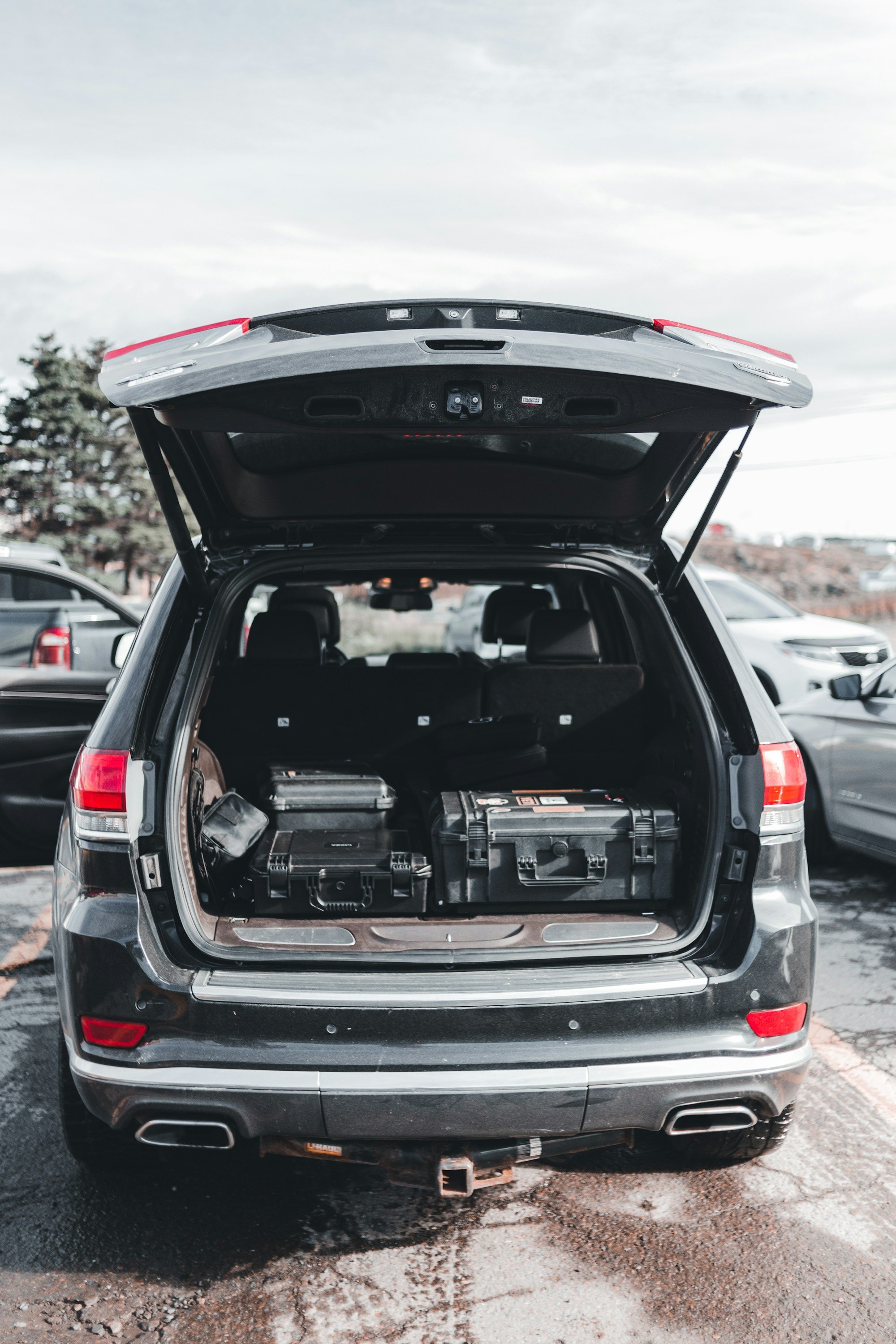
Hard cases, flat on the floor, nothing stacked up past the window line.
It isn’t about looking tidy.
Popular Science, citing Volvo’s loading advice, says a 44-pound object can hit with the force of more than 2,200 pounds in a head-on collision at just 30 mph.
So the cooler, the cases and the water jug go on the bottom of the trunk and away from people.
Nothing heavy rides loose on the back shelf or on a seat next to a kid.
The floor is also where the stuff you hope you’ll never use lives.
Ready.gov’s list for a car kit is short and boring, which is the point: jumper cables, flares or a reflective triangle, an ice scraper, a car phone charger, a blanket, a map, and cat litter or sand.
Yes, cat litter.
No, you don’t need a cat.
Put all of it in one bag and load that bag first.
You’ll forget it’s there, and honestly that’s where it belongs.
One more thing before you load anything.
Check the tires while they’re cold, meaning the car hasn’t been driven for at least three hours.
NHTSA says the right pressure is the one your car’s maker lists on the Tire and Loading Information label on the driver’s side door edge or post, not the number printed on the tire itself.
Check the spare too.
Nobody checks the spare, which is kinda the whole problem with spares.
Up Front: The Map Stays, the Feet Come Down

I like this photo a lot and I’d never ride like this.
NHTSA’s advice is to keep at least 10 inches between you and the air bag cover, and for the front passenger, that cover is in the dashboard.
Feet up on the dash put your legs right where the bag comes out.
Sit back, feet on the floor, and let the view do the work.
Keep the map, though.
Google Maps lets you save an area to your phone and use it offline, and you should do that before any drive through spotty coverage.
But Google’s own help page says offline maps can’t be downloaded in some countries or regions.
A paper map doesn’t need a signal or a charger.
It’s on that Ready.gov list for a reason.
This front zone is the car’s carry-on.
The map, sunglasses, the charging cable, water, snacks and a pen go in the door pockets and the console.
If you have to pull over to reach it, it’s packed in the wrong place.
The Soft Bag Fills the Gaps

Hard cases stack well.
Soft bags go where hard cases can’t, and every trunk has those spaces: the wheel wells, the strip by the liftgate, the gap on top of the cooler.
Popular Science’s advice is the same.
Fill the nooks and crannies with soft, pliable stuff like blankets, pillows or jackets.
Look at the vest, too.
I’ll argue a vest is the most useful thing you can wear on a long drive.
A car in full sun gets warm, a gas station at night doesn’t, and a vest goes on and off without a fight with the seatbelt.
My rule for the soft bag is simple.
It holds tonight’s clothes and tomorrow’s, and nothing else, so it’s the only bag you carry into the motel you booked.
Everything else stays in the car.

🗼 I Wrote a Book About My Japan Travel Catastrophes!
Before I landed in Tokyo, I thought I was the “Final Boss” of international travel. Spoiler alert: I WASN’T. 😅
🚅 I boarded the wrong Shinkansen and ended up in THE WRONG CITY. I confused locals with my “expert” bowing that was more awkward than accurate. I accidentally stumbled into a high-stakes Kendo practice thinking it was a tourist show. Sound like something you’d do?
“Things I Wish I Knew Before Going to Japan” is your shortcut to avoiding ALL my cringe-worthy mistakes. ✨ Inside, you’ll find practical, LIFE-SAVING tips on etiquette, transport, money, and hidden gems that will save you time, money, and a whole lot of confusion.
Sunglasses Beat Every Gadget on the List

This one’s a map of Iceland, but look at what the photo is really about.
Low sun, straight through the windshield.
The map loses.
If you only upgrade one thing for a road trip, make it the sunglasses.
I’d skip the gadget aisle and spend the money here.
The American Academy of Ophthalmology says polarized lenses cut the glare bouncing off reflective surfaces like water or roads.
Turns out polarization by itself doesn’t block UV, though, so the label still has to say 100% UV protection.
They don’t have to be expensive.
The AAO says a drugstore pair labeled 100% UV-blocking is a better choice than designer sunglasses with no protection.
Keep a pair in the car for good and you’ll stop squinting through every sunset drive.
Stops: Plan the Nap Like You Plan Gas

People plan the gas stops and skip the nap.
That’s backwards.
NHTSA’s advice for a drowsy driver is to drink one to two cups of coffee and pull over for a short 20-minute nap in a safe place, such as a lighted, designated rest stop.
Coffee alone isn’t the plan.
The nap is.
So pack for it.
I don’t buy anything special.
The blanket from the emergency bag and one pillow from the soft-fill pile are the whole nap kit, and they’re already in the car.
Shoes off is optional, but this van clearly voted yes.
If the drive is the point of the trip, my ranking of six national park road trips has the routes that earn the miles.
Renting the car?
Read these rental car tips before you get to the counter.
Only got two days?
The 48-hour weekend road trip plan is built for exactly that.