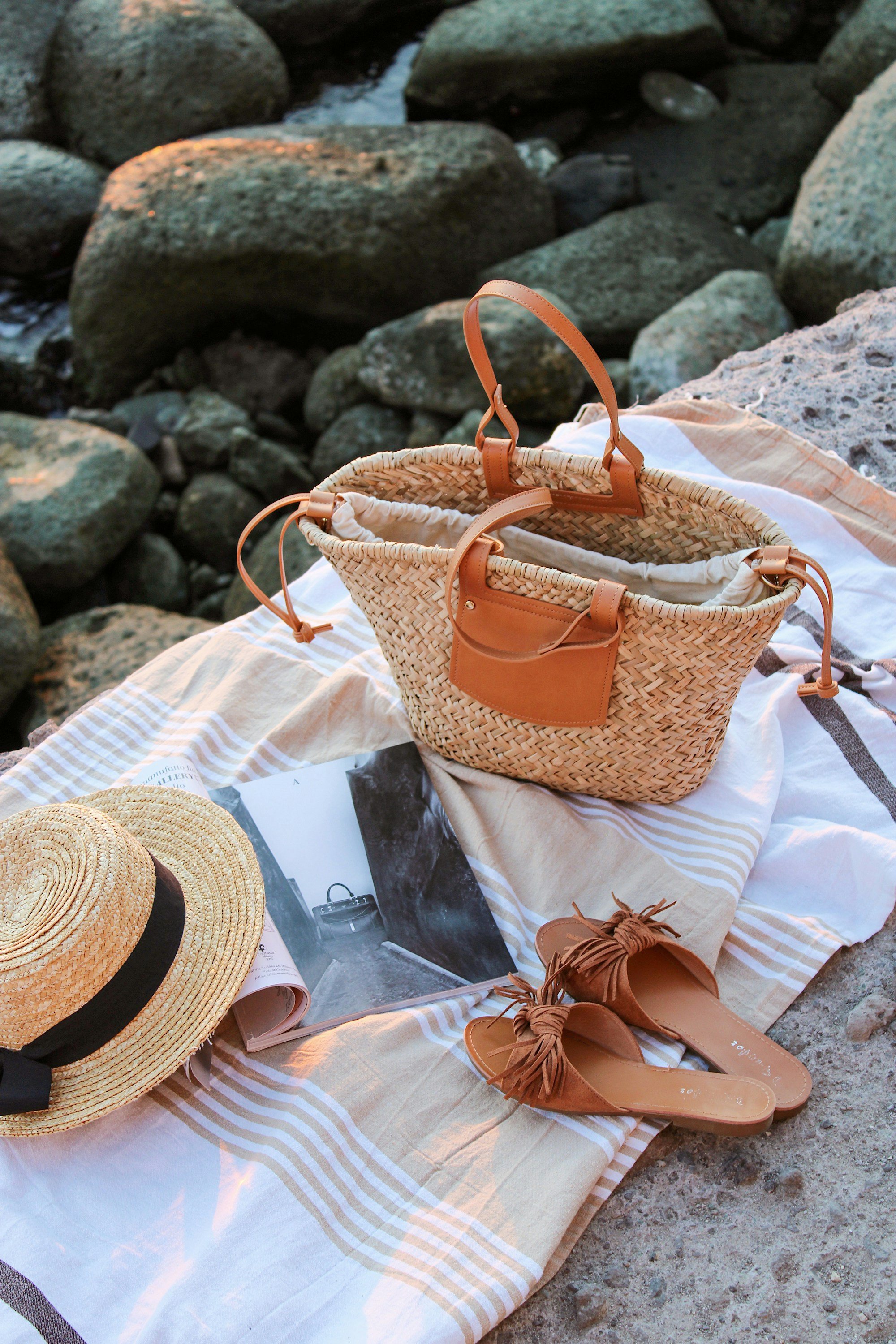

Most beach day packing lists start with what goes in the bag.
I’d start with the bag.
Pick the wrong one and you spend the day digging for the sunscreen, brushing sand out of a lining and holding a wet towel because it won’t fit anywhere.
So, the bag first.
Then the towel, the shade, the sunscreen math and where to put your stuff down.
In that order.
Start With an Open Straw Basket

This is the beach bag I’d pick every time.
An open straw basket with real handles.
No zipper to jam with sand.
No lining to trap it.
Wide open at the top, so you can see the sunscreen without pulling everything else out first.
When you pack up to leave, you tip it upside down, give it a shake, and it’s done.
Look at what’s around it, too.
A hat, a magazine, a pair of slides and a thin towel.
That’s honestly most of a good beach day already.
The Bag Not to Bring

Pretty bag.
Wrong beach.
A small structured handbag is built for a phone, keys and a card.
A beach day needs more than that, and the sunscreen alone proves it.
The American Academy of Dermatology says most adults need about one ounce per application (roughly enough to fill a shot glass) and should reapply every two hours, and right away after swimming or sweating.
Do the math on a 10-to-4 beach day.
That’s at least three applications, so about three ounces for one adult, more if you swim.
Two adults?
About six ounces of sunscreen, and that bottle won’t go in a bag like this one.
I’d also keep good leather well away from wet sand.
Save this one for dinner.
Towels: Thin for the Bag, Thick for After

The towel in this shot is the thin, flat-woven kind, often sold as a Turkish towel.
It’s what I’d carry.
It folds small, it’s light, and there’s less of it to hold water, so it dries faster than thick terry.
Shake it once and the sand comes off.

Thick terry like this stack is great after a shower.
On the sand it turns into a heavy, damp, sandy blanket by noon.
If the hotel you booked hands out beach towels, take those and keep your own for the walk back.
Otherwise, one thin towel per person and you’re good.

🗼 I Wrote a Book About My Japan Travel Catastrophes!
Before I landed in Tokyo, I thought I was the “Final Boss” of international travel. Spoiler alert: I WASN’T. 😅
🚅 I boarded the wrong Shinkansen and ended up in THE WRONG CITY. I confused locals with my “expert” bowing that was more awkward than accurate. I accidentally stumbled into a high-stakes Kendo practice thinking it was a tourist show. Sound like something you’d do?
“Things I Wish I Knew Before Going to Japan” is your shortcut to avoiding ALL my cringe-worthy mistakes. ✨ Inside, you’ll find practical, LIFE-SAVING tips on etiquette, transport, money, and hidden gems that will save you time, money, and a whole lot of confusion.
Shade: Carry One or Rent It

An empty beach with one umbrella is kinda the off-season dream.
On a busy summer day, you either carry your own shade or rent it.
Carrying one is a total pain on a long walk from the parking lot.
I’d still rather carry it, because it’s the only shade you can count on.
If the beach has a rental stand, check its hours and its season before you leave your umbrella at home.

Rented or not, shade isn’t sunscreen.
The CDC says shade under an umbrella lowers your risk, but you still need sunscreen and protective clothing even in the shade.
So the umbrella’s a bonus, not the plan.
Watch the Shadows

Long shadows like these mean the sun is low.
That’s the easy part of the day.
The CDC says UV rays are strongest from 10 a.m. to 4 p.m. in the continental US.
Those are the hours your bag has to cover.
Pick a broad-spectrum, water-resistant sunscreen with SPF 30 or higher, which is what the AAD recommends, and put it on before you get to the sand.
The AAD says it takes about 15 minutes to absorb.
Water resistant doesn’t mean waterproof, either.
The FDA only lets a label claim 40 or 80 minutes of water resistance.
After that, back to the bottle.
Turns out “reapply” is the part of the instructions nobody reads.
Set Up Where You Can See the Lifeguard

Where you put the bag down matters more than what’s in it.
The National Weather Service puts it plainly.
Only swim at a beach with lifeguards, because the chances of drowning at a beach with lifeguards are 1 in 18 million, a figure it credits to the U.S. Lifesaving Association.
It also says to talk to the lifeguard and check the local beach forecast before you go in.
And rip currents often form on calm, sunny days, so a pretty day isn’t proof of a safe one.
So I set up within sight of the stand, every time, and I ask the guard about the water before anyone runs in.
My bag, all in: the straw basket, one thin towel each, a full-size bottle of SPF 30, a hat, water, snacks and a book.
If you’re planning the whole day around it, here are more things to do at the beach, and if anyone in your group breaks out in bumps after a sunscreen day, read can sunscreen cause a prickly heat rash.
Staying past sunset?
Plan a beach bonfire night.