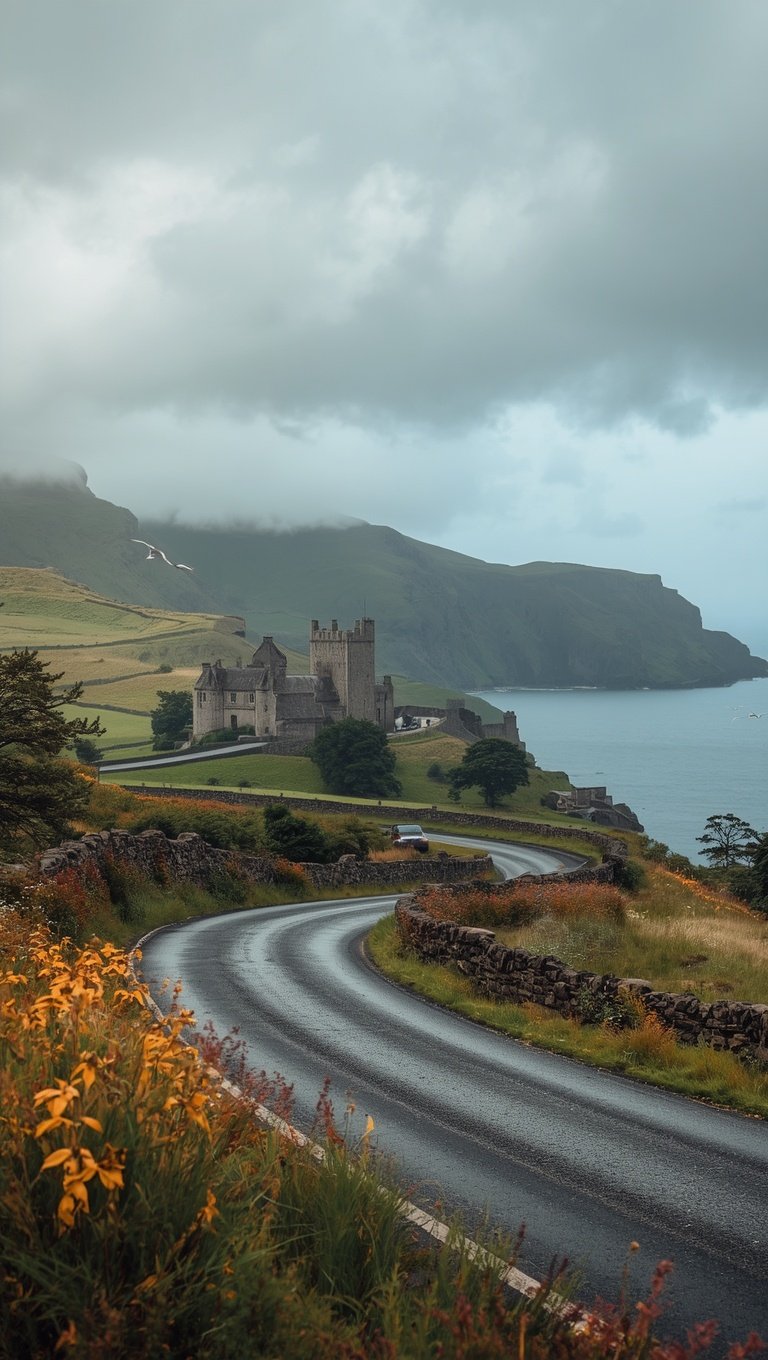
There’s this moment — somewhere between Galway and Clifden — where you pull over because you literally cannot keep driving.
Not because you’re tired.
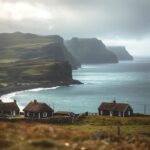
Because the Atlantic is just there, crashing against black rock like it’s been doing it for a thousand years and doesn’t care one bit that you’re watching.
I sat on the hood of my rental car for maybe twenty minutes.
No music.
No podcast.
Just wind and water and that specific kind of quiet that only exists when you’re somewhere truly wild.
That’s Ireland.
That’s the Wild Atlantic Way.
And I’m going to tell you everything — the stuff the travel guides skip, the stops I almost missed, and the ones I’ll think about for the rest of my life.
Why I Chose to Drive Ireland Instead of Tour It

I want to be upfront about this: I almost booked a group tour.
It was cheaper.
It was easier.
And I was a little intimidated about driving on the left side of the road.
But here’s the thing — Ireland is not a country you experience through a bus window.
It’s too textured for that.
Too unpredictable.
You need to be able to stop when a random road sign points toward a ruin down a one-lane road.
You need to be able to pull into a village pub at 3pm on a Tuesday because the music drifting out the door is too good to pass up.
When I tackled the Wild Atlantic Way solo last fall, I realized pretty fast that the best moments weren’t planned at all.
They were the ones I stumbled into because I had the freedom to say “yeah, let’s see what’s down there.”
Renting a car felt scary for about the first forty minutes.
After that, it felt like the only way to do this right.
If you’re on the fence — rent the car.
Trust me on that one.
Getting Your Head Around the Route (Before You Leave)

The Wild Atlantic Way is roughly 1,500 miles of marked coastal road.
It runs from Donegal in the north all the way down to Cork in the south.
And no, most people don’t do the whole thing — at least not in one trip.
I had twelve days, and I focused mostly on the western stretch: starting in Galway, pushing north through Connemara, looping up to Mayo and Sligo, then cutting back down.
What I’d tell anyone planning this: don’t try to optimize it too hard.
Pick a general direction.
Book a few key accommodations in advance, especially if you’re traveling in summer.
Leave the middle days loose.
Some of my favorite stops happened because I had nothing on the schedule and decided to just… follow a sign.
Also — get a physical map or download offline maps before you go.
Cell service along parts of the WAW is genuinely spotty, and your GPS will confidently point you down roads that are more “suggestion” than “road.”
That’s part of the charm.
But still.
Offline maps.
Don’t skip it.
The Cliffs of Moher: Yes, They’re Worth It (But Go Early)

I know.
Everyone goes to the Cliffs of Moher.
I almost skipped them because of that, which would have been one of my dumbest travel decisions ever.
Here’s my honest advice: get there before 9am.
When I arrived just after sunrise, there were maybe a dozen people.
The light was low and golden, the fog was still sitting in the valleys below, and I stood at the edge of those 700-foot cliffs feeling genuinely small in the best possible way.
By 10am?
Buses.
Crowds.
Gift shops buzzing.
Still beautiful, but a completely different experience.
The cliffs stretch for about 8 miles, and most people only walk the main paved section near the visitor center.
If you follow the trail further south toward Hag’s Head, it gets quieter and honestly more dramatic.
That walk wrecked me — in the best way.
The wind was strong enough to lean into.
The ocean below was this deep, churning green-gray.
And there was nobody else out there.
That’s the version of the Cliffs of Moher I’ll remember.
🗼 I Wrote a Book About My Japan Travel Catastrophes!
Before I landed in Tokyo, I thought I was the “Final Boss” of international travel. Spoiler alert: I WASN’T. 😅
🚅 I boarded the wrong Shinkansen and ended up in THE WRONG CITY. I confused locals with my “expert” bowing that was more awkward than accurate. I accidentally stumbled into a high-stakes Kendo practice thinking it was a tourist show. Sound like something you’d do?
“Things I Wish I Knew Before Going to Japan” is your shortcut to avoiding ALL my cringe-worthy mistakes. ✨ Inside, you’ll find practical, LIFE-SAVING tips on etiquette, transport, money, and hidden gems that will save you time, money, and a whole lot of confusion.
Connemara: The Part of Ireland That Feels Like Another World

If the Cliffs of Moher are the postcard, Connemara is the secret.
It’s this wild, boggy, mountain-meets-sea region in County Galway that just looks like nowhere else on earth.
The landscape is kind of unreal — dark peat bogs, small lakes called loughs, and these low stone walls running across open moorland as far as you can see.
I drove the Sky Road loop outside Clifden on a overcast afternoon and nearly lost my mind.
The road climbs up above Clifden Bay and wraps around a peninsula, and you get these sweeping views of islands and inlets that are almost too beautiful to be real.
It took maybe an hour to drive the full loop.
I did it twice.
The town of Clifden itself is genuinely charming — small, colorful, full of good pubs.
I had the best bowl of chowder of my entire life there at a tiny spot near the main square.
Thick, creamy, loaded with seafood.
It was the kind of meal you think about on the flight home.
If I had to pick one region to spend extra days in, Connemara would be it.
Galway City: The Heartbeat of the West

You need at least two full nights in Galway.
Minimum.
It’s not just a stopover — it’s a destination.
Shop Street and Quay Street are lined with colorful storefronts, buskers, and pubs that spill out onto the cobblestones.
I wandered in on a Saturday afternoon and ended up staying until midnight, hopping between three different sessions of live traditional music.
And I mean real sessions — not tourist-facing performances, but local musicians sitting in a circle, playing for the love of it.
The atmosphere is warm and a little electric.
Galway has this energy that’s hard to describe — young and creative and deeply proud of its culture.
I stayed in a small guesthouse just outside the city center, walked everywhere, and ate extremely well.
The seafood along the west coast is consistently incredible, but Galway’s restaurant scene has serious range.
Don’t leave without trying the local oysters.
The Galway Bay oysters are small, briny, and perfect.
Also — the Spanish Arch area at golden hour.
Just go.
Sit on the wall by the river.
Watch the city do its thing.
It’s one of those simple travel moments that ends up meaning more than the big attractions.
The Aran Islands: A Day Trip That Feels Like a Time Warp

You can take a ferry from Rossaveel or a small plane from Connemara Airport out to the Aran Islands.
I took the ferry to Inis Mór, the largest of the three, and it’s one of the best decisions I made on the whole trip.
The island feels genuinely removed from the modern world.
Stone walls everywhere, people speaking Irish, and roads that were made for bikes and horse carts — not rental cars.
I rented a bicycle at the ferry dock (everyone does this) and spent the day pedaling out to Dún Aonghasa, a prehistoric stone fort sitting on the edge of a sheer 300-foot cliff.
No railing.
No barrier.
Just ancient stones and a straight drop to the Atlantic.
You inch up to the edge on your stomach.
It is terrifying and magnificent at the exact same time.
The island is small enough to explore in a day, but it packs more atmosphere per square mile than almost anywhere I’ve been.
Take the last ferry back so you have the full afternoon.
And pack a lunch or grab something at the small shop near the dock — options are limited once you’re out on the road.
Achill Island: The Stop I Almost Skipped

Achill Island is connected to the mainland by a bridge, so technically it’s not an island you need a ferry for.
But it feels completely separate from the rest of the world.
I almost drove past the turnoff.
I’m so glad I didn’t.
Achill is massive — the largest island in Ireland — and it has these enormous beaches that, in summer, are actually swimmable.
Keem Bay in particular stopped me cold.
It’s a horseshoe-shaped bay tucked beneath dramatic headlands, with water that’s this impossible turquoise color.
In Ireland.
Turquoise water.
I know.
The drive down to Keem Bay is itself a little terrifying — single track road, serious drop-offs, sheep wandering across your path.
But you come around a bend and suddenly the bay opens up below you and it’s just breathtaking.
I spent a couple of hours there, walked the beach, and watched the light change over the cliffs.
There’s also a deserted village on the slope of Slievemore mountain — roofless stone cottages from the Famine era.
Walking through it is sobering and quietly moving.
Achill does that.
It mixes wild beauty with heavy history.
Sligo: Yeats Country and Genuinely Underrated

Most people zoom through Sligo on the way to Donegal.
That’s a mistake.
Sligo is W.B. Yeats territory — the poet grew up here and is buried in the churchyard at Drumcliffe, in the shadow of a flat-topped mountain called Ben Bulben.
Ben Bulben is kind of extraordinary.
It rises out of the landscape like a tabletop, all vertical cliffs on the sides, green and flat on top.
On a clear day it looks almost cinematic.
The town of Sligo itself has a cool, low-key arts scene, great coffee, and some seriously good restaurants.
I had an exceptional dinner at a small spot near the river — local lamb, roasted vegetables, really good brown bread.
It was the kind of meal that made me feel like I was eating the landscape.
Rosses Point, just outside town, has a long beach with views back toward Ben Bulben that are worth the short detour.
Sunset from Rosses Point is the kind of thing you take too many photos of and none of them do it justice.
Sligo doesn’t have one big, famous thing.
It just has a lot of really good things.
And that’s sometimes better.
Driving Tips That Would Have Saved Me Stress

Okay, let me be real with you about the driving situation.
It is fine.
You will be fine.
But there are things I wish someone had told me before I picked up my rental.
First: the roads narrow dramatically outside of cities.
I’m talking one lane shared by two directions of traffic, with hedgerows so close they brush your mirrors.
Pull over into passing bays when you see oncoming cars.
Second: sheep.
They are everywhere.
They do not care about your schedule.
Third: budget more time than you think you need between destinations.
Google Maps will say two hours.
It will take three, because you’ll stop six times.
Plan for that.
Embrace that.
Fourth: get the full insurance on your rental.
Just do it.
Those narrow roads are unforgiving, and a hedge scrape is basically a rite of passage.
Fifth: petrol stations in rural areas close early and can be spaced far apart.
Fill up whenever you’re in a decent-sized town.
Don’t wait until the tank is low.
And last: the speed limit signs are in kilometers, not miles.
Took me an embarrassingly long time to figure out why I felt like I was crawling everywhere.
🗼 I Wrote a Book About My Japan Travel Catastrophes!
Before I landed in Tokyo, I thought I was the “Final Boss” of international travel. Spoiler alert: I WASN’T. 😅
🚅 I boarded the wrong Shinkansen and ended up in THE WRONG CITY. I confused locals with my “expert” bowing that was more awkward than accurate. I accidentally stumbled into a high-stakes Kendo practice thinking it was a tourist show. Sound like something you’d do?
“Things I Wish I Knew Before Going to Japan” is your shortcut to avoiding ALL my cringe-worthy mistakes. ✨ Inside, you’ll find practical, LIFE-SAVING tips on etiquette, transport, money, and hidden gems that will save you time, money, and a whole lot of confusion.
The Pubs: This Is Actually Important


I want to give the Irish pub its proper moment.
Because it’s not just a place to drink.
It’s where the country actually happens.
In small towns and villages along the route, the pub is the community center, the living room, the concert hall.
I walked into a tiny pub in a village outside Westport on a Wednesday night expecting to grab one pint and head back to my guesthouse.
Three hours later I was talking hurling with a farmer named Séamus and his brother who had lived in Boston for fifteen years.
That kind of thing happens constantly in Ireland.
People talk to you.
Genuinely.
They ask where you’re from and they’re actually curious about the answer.
Traditional music sessions happen informally and often — especially on weekends.
No stage, no cover charge, no announcement.
Just musicians setting up in the corner and starting to play.
If you hear music coming from a pub, go in.
Order a Guinness (it really does taste better there — something about the draft lines and the pour time).
Sit down.
Let the night go wherever it goes.
Some of my best memories from this trip happened in rooms like that.
What to Pack for This Specific Trip

Packing for Ireland requires accepting one universal truth: it will rain.
It might rain every day.
It might rain for five minutes and then be gorgeous.
Either way, pack for it.
A waterproof jacket is non-negotiable.
Not a water-resistant one — a proper waterproof one, ideally with a hood you can actually use.
Layers are your best friend.
Mornings are cold, afternoons can be surprisingly warm, evenings get cold again.
I wore the same lightweight merino base layer basically every day and it never let me down.
For footwear: waterproof boots or trail shoes with solid grip.
You will want to walk on wet grass, muddy paths, and slippery coastal rocks.
Regular sneakers will betray you.
I also packed a small dry bag that was genuinely useful for keeping my camera and phone protected during coastal walks.
Binoculars are worth it if you have them.
The coastline is full of seabirds, dolphins are surprisingly common off the west coast, and watching the light move across a distant headland through binoculars is its own kind of pleasure.
And honestly?
Pack light otherwise.
Laundromats exist.
Guesthouses often have dryers.
You don’t need as many clothes as you think.
The Honest Emotional Truth About This Trip

I want to end on something that’s harder to put into words.
Ireland does something to you.
I don’t fully understand it and I’ve thought about it a lot since I got home.
Maybe it’s the scale of the landscape — the way it makes you feel small without making you feel insignificant.
Maybe it’s the slowness of it.
The way people there seem genuinely unbothered by the rush.
Meals take longer.
Conversations go somewhere.
Evenings don’t have an agenda.
When I tackled this road trip, I was honestly pretty burnt out.
Tired in a way that sleep wasn’t fixing.
And somewhere around day four — I think it was a Tuesday, parked on a headland above the Atlantic with a thermos of bad gas station coffee — something just… loosened.
The tightness in my chest that I’d stopped noticing because it had been there so long.
Ireland didn’t fix anything logistically in my life.
But it reminded me what it feels like to be genuinely present somewhere.
To look at something so old and so indifferent to human worry and feel, weirdly, better.
That’s the trip.
That’s what you’re actually going for, even if you book it thinking you’re just after some pretty coastal views.