Here’s the thing nobody tells you about scrapbooking your travels: you don’t need a system before you start.
I used to think I had to buy the perfect album first, the perfect pen, the perfect everything.
That’s a trap, and it kept me from starting for way too long.
What actually worked was grabbing an old shoebox before a trip to Portugal and just tossing things into it as the days went on.
A ferry ticket, a sugar packet from a café in Lisbon, a napkin with a phone number I never called.
None of it made sense in the moment.
But when I got home and dumped it all out on my kitchen table, the whole trip came rushing back at once.
That’s the real magic of this thing.
It’s not about making something Pinterest-perfect.
It’s about giving your future self a container for the feeling, not just the facts.
So my honest tip: buy the box before you buy the trip.
Keep it in your carry-on.
Anything that fits and doesn’t smell too weird goes in.
Sort it out later, when the trip has some distance on it and you can actually see what mattered.
Write One Line a Day, Not a Novel
I am not a journal guy.

I’ve started probably twelve journals in my life and finished exactly zero of them.
So when people tell you to “keep a detailed travel journal,” I get why your eyes glaze over a little.
Here’s what actually stuck for me instead.
One line a day, written fast, no editing.
Not what we did, but how it felt.
In Oaxaca I wrote: “Ate something with ants in it and did not hate it.”
That’s it, that’s the whole entry.
But reading it back now brings me right to that plastic table on the sidewalk faster than any five-paragraph description ever could.
The trick is lowering the bar until you can’t fail.
A sentence fits on a receipt, on a napkin, on the back of a map.
You don’t need a fancy notebook for this, though a small one is nice.
What you need is the habit of stopping for ninety seconds before bed.
Ask yourself one question: what’s the one thing I don’t want to forget about today.
Write it down messy.
Don’t fix the grammar.
The imperfect version is the honest one, and honest is what you’ll want to read later.
Print Your Photos. Actually Print Them.

Okay, I’ll say the unpopular thing.
Your phone is where memories go to disappear.
I’ve got thousands of photos I will never look at again, buried under years of screenshots and blurry accidental shots of my pocket.
So now, after every trip, I pick twenty photos.
Just twenty, no more.
The blurry ones, the ones where someone’s laughing with their mouth open, the ones that aren’t “good” but feel true.
I get them printed small, like the size of a playing card.
There’s a print shop near me that does it in a day, and honestly it might be my favorite errand of the whole month.
Holding a printed photo just hits different than swiping past it.
You notice the light in it.
You notice who’s in the background.
My tip here: don’t pick your best shots, pick your most honest ones.
The candid one of your buddy asleep on the train beats the posed one by the fountain every single time.
And if you want a fun variation, get a couple printed as postcard-sized prints and mail one to yourself before you even leave the country.
It’ll beat you home, and opening your own mailbox to a piece of your trip is a strange little joy I recommend to everyone.
Save the Ugly Stuff Too

This one took me a while to learn.
I used to only save the pretty things, the museum ticket, the nice restaurant receipt, the postcard from the gift shop.
But some of my favorite pages now are the ugly ones.
A crumpled airsickness bag from a rough flight to Manila.
A parking ticket I got in a tiny town in Wales because I didn’t understand the signs.
A hospital bracelet from the one time I twisted my ankle on a hike and had to get it checked out.
None of that sounds like scrapbook material, I know.
But trips aren’t just the highlight reel, and pretending they are makes the whole thing feel a little fake.
The hard stuff, the annoying stuff, that’s where the actual story lives.
So my hack is simple.
Whenever something goes wrong on a trip, I grab whatever paper evidence exists and shove it in the shoebox.
Later, it becomes the funniest page in the whole thing.
Guests always flip past the pretty museum tickets pretty fast.
But they linger on the parking ticket story every time, because it’s specific, and it’s real, and it makes them laugh.
Don’t curate your trip down to just the wins.
Keep the mess.

🗼 I Wrote a Book About My Japan Travel Catastrophes!
Before I landed in Tokyo, I thought I was the “Final Boss” of international travel. Spoiler alert: I WASN’T. 😅
🚅 I boarded the wrong Shinkansen and ended up in THE WRONG CITY. I confused locals with my “expert” bowing that was more awkward than accurate. I accidentally stumbled into a high-stakes Kendo practice thinking it was a tourist show. Sound like something you’d do?
“Things I Wish I Knew Before Going to Japan” is your shortcut to avoiding ALL my cringe-worthy mistakes. ✨ Inside, you’ll find practical, LIFE-SAVING tips on etiquette, transport, money, and hidden gems that will save you time, money, and a whole lot of confusion.
Make a Map You Can Touch

There’s something about a paper map that a GPS pin just can’t replace.
I keep a big cork-backed world map on my wall, and every trip earns a pin.
But here’s the part that actually makes it a scrapbook and not just decor.
Next to each pin, I tape a tiny folded note with one detail from the trip.
A smell, a stranger’s kindness, a food I’d never had before.
When my sister visited last spring, she spent twenty minutes just reading the little notes one by one.
That’s the whole point, honestly.
A map with pins is nice to look at.
A map with stories attached is something people actually stop and read.
If a wall map feels like too much commitment, a smaller variation works just as well.
Grab a cheap paper map of a city you visited and mark it up right there on the trip.
Circle the bakery, star the bench where you got lost for an hour, cross out the restaurant that let you down.
It becomes this weird, personal, useless-to-anyone-else document.
And that’s exactly why I love it.
My tip: do the marking in the moment, not after.
Memory softens the specifics fast, and you want the raw version, ink still a little smudged from your own thumb.
Collect Something Small and Specific

Postcards are fine, but they can start to feel a little generic after a while.
So a few years ago I picked something weirder to collect instead.
I started grabbing a single spice or seasoning packet from every country I visit.
A little jar of smoked paprika from Spain.
A packet of chili flakes from a street vendor in Bangkok.
They live in a drawer in my kitchen, and honestly, cooking with them later is its own kind of time travel.
The smell hits before the taste does, and suddenly I’m back on that plastic stool at 11pm eating something I couldn’t name.
You don’t have to copy that exact idea, though you’re welcome to.
Pick your own small, specific thing.
Bottle caps.
Matchbooks.
A single button from a shop with no name in English.
The trick is specificity, not variety.
One tiny object from each place, kept in the same kind of container, so over time you build a little collection that only makes sense to you.
That’s honestly the whole appeal.
It’s not for Instagram.
It’s for the version of you five years from now, opening a drawer and grinning for no reason anyone else would understand.
Let Your Friends Scrapbook With You

Traveling with people means you’re all collecting the same moment from different angles, and that’s worth capturing.
On a guys’ trip to Colorado last year, I started passing a small notebook around at dinner.
Everyone had to write one sentence about their favorite part of the day, no explaining, no filtering.
By the end of the trip we had this wild, disjointed, hilarious little document written in five different handwritings.
Some entries were sincere.
Some were just inside jokes that don’t mean anything to anyone who wasn’t there.
Both kinds are gold.
This works especially well on group trips where everyone remembers something different.
You’ll be shocked how someone else’s tiny detail unlocks a memory you’d completely forgotten.
My tip: keep the notebook small and cheap, something that fits in a jacket pocket.
The second it feels precious, people get self-conscious about what they write.
And self-conscious writing is boring writing.
You want the fast, unfiltered version, the one someone scribbles while still chewing.
That’s the one you’ll actually want to read again.
Keep the Boarding Passes On Purpose
I used to stuff boarding passes in random pockets and find them months later, soft and faded.

Now I keep a small accordion folder just for transit stuff.
Boarding passes, train tickets, the little paper metro cards from cities with actual character to them.
It sounds boring until you look at it as a timeline.
Suddenly you can trace an entire trip just by the order of tickets, city to city, without a single photo needed.
There’s something satisfying about that kind of proof.
It’s tangible evidence you were actually there, not just a memory that could’ve been a dream.
My favorite variation on this is writing the date and one tiny detail directly on the ticket itself, right when you get it.
A flight delay, a stranger’s joke, the reason you almost missed it.
Future you will thank present you for that thirty seconds of effort.
Doing it later never works, because by then the ticket’s just a ticket again.
Do it while the ink of the memory is still wet, so to speak.
Build a “Smell Memory” Page

This one sounds a little odd, but stick with me.
Smell is the sense most tied to memory, more than sight, more than sound.
So on a few pages of my scrapbook, I’ve started taping in things purely for how they smell.
A tea bag from a guesthouse in Kyoto.
A little sachet of lavender from a market in Provence.
A used bar of soap wrapped in paper from a hotel in Marrakesh that I still can’t fully explain why I kept.
Every time I open that page, it hits before I even read a word.
That’s the whole point of this idea.
Words and photos capture what a place looked like.
Smell captures what it felt like to actually be standing in it.
My tip: don’t overthink what qualifies.
If something smelled like the trip to you, it counts, even if it seems random to anyone else.
Tape it down loosely so the scent doesn’t get sealed away completely.
Come back to that page in a year and just breathe in for a second before you read anything.
Go Digital Where It Actually Helps

I’m a paper guy at heart, but I’m not going to pretend digital tools don’t have their place here.
Voice memos are the one digital habit I never skip.
A thirty-second recording of a street musician, or the chaos of a market, does something a photo just can’t.
You hear your own voice in the background too, tired or laughing or mid-bite of something delicious.
Years later, that’s oddly more moving than any picture.
I keep a folder just for these, organized by trip, nothing fancy.
The other digital habit worth stealing is a simple shared photo album for group trips.
Everyone dumps their photos in one place, no filtering, no curating.
You end up with shots you never would’ve taken yourself, from angles only your friend happened to catch.
My honest take: use digital for the things paper genuinely can’t do, sound especially.
But don’t let it replace the physical stuff entirely.
A voice memo is a nice companion to a scrapbook.
It’s a poor substitute for one.
🗼 I Wrote a Book About My Japan Travel Catastrophes!
Before I landed in Tokyo, I thought I was the “Final Boss” of international travel. Spoiler alert: I WASN’T. 😅
🚅 I boarded the wrong Shinkansen and ended up in THE WRONG CITY. I confused locals with my “expert” bowing that was more awkward than accurate. I accidentally stumbled into a high-stakes Kendo practice thinking it was a tourist show. Sound like something you’d do?
“Things I Wish I Knew Before Going to Japan” is your shortcut to avoiding ALL my cringe-worthy mistakes. ✨ Inside, you’ll find practical, LIFE-SAVING tips on etiquette, transport, money, and hidden gems that will save you time, money, and a whole lot of confusion.
Press Something Living Into the Page

There’s a particular kind of joy in pressing a flower or a leaf between the pages of a heavy book after a trip.
I picked up this habit almost by accident, from a hike outside Queenstown a while back.
I grabbed a fern leaf without really thinking, tucked it into my paperback, and forgot about it for months.
Finding it again later, flattened and a little translucent, felt like uncovering something someone left for me on purpose.
Now I do it deliberately.
A petal from a market stall, a leaf from a trail, even a blade of grass from a spot that mattered for no reason I can fully explain.
It’s such a small thing, and it costs nothing.
But there’s something about a living thing from that exact place and day, preserved flat and fragile, that a photo just doesn’t replicate.
My tip: press it in a heavy book you’re not currently reading, so you don’t accidentally crush it flipping pages.
Give it at least two weeks before you check on it.
And label it right away with a tiny date, because trust me, a dried leaf with no context turns into a mystery fast.
Give It a Home, Not Just a Drawer

All of this only works if the stuff eventually has somewhere to live.
For years my collected bits and pieces just floated between drawers, boxes, random bags I never unpacked.
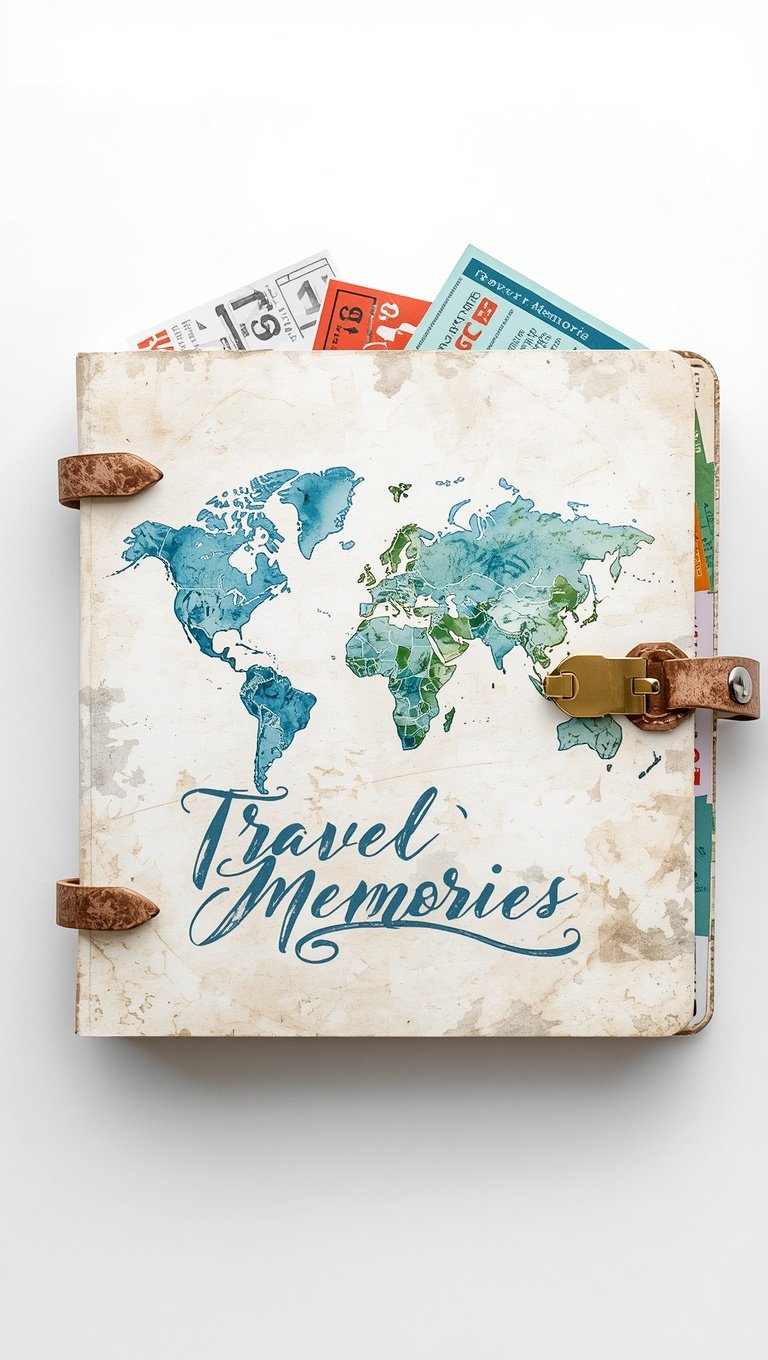
So now, once every couple of months, I sit down and actually build the pages.
Glue stick, tape, an old notebook with thick enough paper to hold it all.
It’s not neat.
Things overlap, ink smears a little, the pages get lumpy from all the texture.
I’ve made peace with that, because a scrapbook that looks too perfect kind of loses the plot.
The lumpy, overstuffed pages are the ones that feel the most like an actual trip.
My honest tip: don’t wait until you have “enough” for a full page.
Half a page from one trip is still worth doing.
You can always add to it later, layering in new bits over time.
Keep the finished notebook somewhere visible, not shelved away like a keepsake too precious to touch.
Mine sits on my coffee table, and I flip through a few pages most weeks without even planning to.
That’s when you know it worked.
It stopped being a project and became a habit instead.
Related read: Things I Wish I Knew Before Going to Japan — Instant PDF + Kindle download. Secure checkout by Stripe