
My short answer: Florida’s clearest water is spring water.
Many of the springs below hold at 72 degrees all year, and the park pages reach for words like “extraordinarily clear.”
But the water isn’t what decides your day.
It’s when you go, and whether you get through the gate.
Here’s what I mean.
Rainbow Springs and Blue Spring now let no day visitor in without a reservation, and Grayton Beach can shut its gate when it fills up.
Hidden isn’t the word I’d use, honestly.
So I’ve sorted Florida’s clear-water spots by the two things that actually matter: the season and the line.
The facts here come from the Florida State Parks pages for every state park below, the Forest Service pages for Alexander and Juniper Springs, the Crystal River refuge’s pages, the Ginnie Springs and Devil’s Den sites, the state’s springs pages and the state wildlife agency’s red tide report, as of early November 2026.
Every number here comes from those pages.
Fees and rules change, so check the park’s own page the week you go.
Springs Beat Beaches on Clarity

Florida has more large springs (first- and second-magnitude) than any other state, per its Department of Environmental Protection.
Count every spring and the state parks put it at more than 1,000.
Rainbow Springs’ own page describes where that water comes from.
Rain soaks down through soil and rock, which filters it, then it moves through underground caves and comes up at the spring.
At Rainbow, that water gathers from a 770-square-mile area.
The temperature holds steady, too.
Rainbow, Blue Spring, Ginnie, Devil’s Den and Alexander Springs all put their water at 72 degrees year-round.
Some rules below exist for the water itself.
Devil’s Den bans sunscreen because some chemical sunscreens can harm fish.
And the Crystal River refuge recommends that snorkelers not walk on the bottom, since that stirs up sediment and cuts the visibility you came for.
Beach water is a different animal.
Panhandle parks talk up emerald water, and they mean it.
But a heavy red tide bloom can discolor it (more on that near the end).
If you’d rather start from your own town, our Florida springs finder lists the springs near you for swimming, tubing, snorkeling or diving, nearest first, with the entry fee and the water temperature.
Ginnie Springs Has Seven Springs and a River That Clears in Summer

Ginnie Springs Outdoors says its seven springs are 72 degrees year-round, and swimming and snorkeling run all year.
Forgot your gear?
You can rent a mask and fins at the Ginnie Springs Store, a snorkel too.
Then there’s the Santa Fe River, which is the seasonal part.
Ginnie says the river clears typically in summer and early fall, and that during the drier summer months its visibility can reach 30 to 40 feet or more.
When it’s clear, a river snorkel may turn up large gar, bass, mullet, catfish or turtles.
Or skip the mask and float.
Ginnie says most tubers put in at Beaver’s Landing and spend an hour or so drifting down the Santa Fe to the Tube Exit at Twin Spring, then walk about 15 minutes back to the Ginnie Spring parking lot on the Tube Trail.
You can rent a tube at the store or bring your own (there’s a free air station), and life jackets are free.
Divers like the river too.
Ginnie says most enter at the Devil Spring system and drift nearly 1,000 feet to Ginnie Spring.
Prices are seasonal too.
Adult day admission is $25 from March through October and $20 in the off-season, November through February.
Kids 4 to 12 pay $6 in season and $5 off-season.
If the springs are what you want and the river isn’t, I’d go off-season.
It’s cheaper, and the springs are still 72.
If Ginnie’s on your shortlist, our Blue Springs vs Ginnie Springs head-to-head compares the two.
Devil’s Den Is a Spring in a Cave, and You Book Ahead

Devil’s Den is a spring inside a 120-foot-wide cave, per its own site, and the water holds a constant 72 degrees year-round.
Look, you can’t just show up and swim here.
Snorkeling is by reservation only, in 90-minute slots, and the den doesn’t allow general swimming.
A session is $30 per person: a $5 non-refundable deposit when you book, then $25 when you arrive.
Snorkeling reservations are non-refundable.
Need to move yours?
They’ll change it once at no cost if you ask at least 72 hours ahead.
I’d pick the date carefully anyway.
Gear rules are strict: a mask, a snorkel and fins at all times, none of it included.
Bring yours or rent the bundle for $15.
No flotation devices unless medically necessary, no long freediving fins, and you have to be a strong swimmer.
Children under 6 can’t go into the den.
And no sunscreen, period.
Their site says certain ingredients in chemical sunscreens can harm, stunt or even kill fish and other marine life.
Snorkeling runs 9 a.m. to 4:30 p.m. Monday through Thursday and 8 a.m. to 5 p.m. Friday through Sunday.

🗼 I Wrote a Book About My Japan Travel Catastrophes!
Before I landed in Tokyo, I thought I was the “Final Boss” of international travel. Spoiler alert: I WASN’T. 😅
🚅 I boarded the wrong Shinkansen and ended up in THE WRONG CITY. I confused locals with my “expert” bowing that was more awkward than accurate. I accidentally stumbled into a high-stakes Kendo practice thinking it was a tourist show. Sound like something you’d do?
“Things I Wish I Knew Before Going to Japan” is your shortcut to avoiding ALL my cringe-worthy mistakes. ✨ Inside, you’ll find practical, LIFE-SAVING tips on etiquette, transport, money, and hidden gems that will save you time, money, and a whole lot of confusion.
You Can Swim Ichetucknee Any Day, but the Gate Is First-Come

Ichetucknee Springs State Park has eight major springs that join to make the 6-mile Ichetucknee River, and the park calls them crystal-clear.
Swimming and snorkeling are open every day of the year at the north entrance, at the head spring or Blue Hole Spring.
The park opens at 8 a.m., the head spring closes 30 minutes before sundown, and Blue Hole an hour before.
Blue Hole, the park says, is for experienced swimmers only, because of its depth and strong current.
You can’t swim or snorkel anywhere on the river itself.
On the river you stay on your tube or in your boat.
Tubing runs year-round from Dampier’s Landing at the south entrance, which closes at 5 p.m. Its shallow north section is closed to tubing, and the Midpoint launch was listed as closed for repairs.
From Dampier’s Landing, the park says you’ll float 45 minutes to an hour to the last take-out.
Turns out your tube can’t top 60 inches in both length and width.
It also can’t have glitter on it.
Weirdly specific, but there it is.
Now the line.
All entrance is first-come, first-served.
And the park’s fee page says paying online “does not guarantee entry or bypass the line at the ranger station.”
A car of two to eight people is $6.
Summer gets busy, too: the state environment department’s springs page says Ichetucknee can draw as many as 3,000 visitors a day in peak summer months.
On a summer weekend I’d be there when the gate opens at 8.
Want more places to float?
Here’s our list of state parks where you can tube.
Rainbow Springs Wants a Reservation, Then Keeps You in the Buoys

Rainbow Springs’ flow is the fourth highest of any spring in Florida, and the park calls the water extraordinarily clear.
Its swimming area at the headsprings runs 10 to 18 feet deep and averages 72 degrees year-round.
Book first.
Since April 29, 2026, the park has taken day visitors by reservation only, and I’d sort that before anything else.
When it reaches capacity at the headsprings entrance it closes to all visitors, and cars can’t wait in line in the park or on the roads next to it.
A few rules before you pack.
Snorkeling at the headsprings is allowed only in the buoyed swimming area, and the park notes that state law requires dive flags for all snorkelers.
No rafts, tubes or balls, though life preservers and noodles are fine.
There’s no lifeguard, and the water is over 10 feet deep.
Tubing happens at a separate tubing entrance in Dunnellon, not at the headsprings.
That entrance is closed for the winter season from October through March.
One more thing for this winter: the parking lot is being renovated from Sept. 9, 2026 to Feb. 4, 2027, with limited parking.
Entry is $5 per vehicle of two to eight people.
Weeki Wachee’s Clear Water Comes With Mermaids

Weeki Wachee’s mermaids perform in “pure aquamarine water that flows from a first-magnitude spring,” per the state park.
Under it is what the park calls the deepest known freshwater cave system in the United States, confirmed after explorers found new passages in 2007.
If you want to get in yourself, swimming is at Buccaneer Bay, inside the park.
It has four water slides, and two of them drop you into the spring.
Admission is $13 for adults, $8 for kids 6 to 12, and free for 5 and under.
Hours are 9 a.m. to 5:30 p.m. It can’t refund or return tickets for weather cancellations, so I’d look at the forecast before buying.
Buccaneer Bay keeps its own schedule, and the park sends you to its FAQ page for it.
Blue Spring Lets You Swim Until Nov. 14, Then It’s the Manatees’ Turn

Blue Spring State Park sits along the St. Johns River, and its spring run holds 72 degrees.
Swimming season is April 1 to November 14.
Manatee season runs November 15 to March 31, when manatees rely on the spring’s constant 72-degree water to survive, and swimming and every other water activity in the spring run are banned.
You can still hike along the spring run, and the park runs a manatee webcam.
Swimming with the manatees isn’t allowed, either.
April’s reopening can slip a bit, the park says, if lots of manatees are still in the spring because winter weather is hanging on.
And the manatee numbers are wild.
In 1970 researchers tracked 14 manatees in the spring run.
By 2023 the winter count hit a record 729.
If I wanted a swim here this year, I’d go before November 14.
For manatees, I’d go after.
Either way, book a day-use reservation first.
Since July 15, 2026, the park lets no day visitor in without one, and it still frequently reaches capacity and may close for a while.
Entry is $6 per vehicle of two to eight people.
As of November 2, 2026, the French Landing boat ramp and the canoe and kayak rentals and launches were closed.
For the rest of the state, see our guide to where manatees live in Florida.
Crystal River Is About Manatees, and Winter Has Its Own Rules

Crystal River National Wildlife Refuge, about an hour north of Tampa, is the only refuge created specifically to protect the Florida manatee.
It preserves Three Sisters Springs.
Per the refuge, the water is often quite clear and blue.
Getting into the water is the odd part.
The Three Sisters Springs property gives land access by shuttle, to the boardwalk and trails, but no water access.
To swim or paddle into Three Sisters, you launch from a public boat ramp or kayak launch on Kings Bay, in your own boat or one you rent nearby.
Guided tours, the refuge says, are the most popular way to experience the springs, and it doesn’t run them itself.
It gives permits to businesses in Kings Bay that do.
Paddle craft are allowed inside Three Sisters between April 1 and November 14.
Two rules worth keeping in mind.
Snorkelers aren’t allowed into the marked manatee sanctuaries or onto the shore.
And watch the refuge’s Manatee Manners video before you get in.
Winter snorkeling has its own answer in the FAQ at the bottom.
Comparing towns?
Here’s our take on Crystal River vs Homosassa Springs.
Silver Springs Is Clear Enough to Watch From a Boat

Silver Springs, per the park’s geology page, is one of Florida’s premier views of clear groundwater coming up to the surface.
More than 30 springs have been documented in the upper Silver River.
Mammoth Spring, the largest, shows a rocky ledge above a vast cavern.
You see it through glass.
Glass bottom boats run daily from 10 a.m., in 30-minute and 90-minute tours.
Book online or arrive early, because tickets can sell out.
Paddlers get the Fort King trail, a 1.1-mile round-trip loop around Ross Allen Island that heads upstream over dozens of springs.
Plan on one to two hours.
And yield to the glass bottom boats; the park says they have a hard time making sharp turns or sudden stops.
Its list of experiences runs from boat tours and paddling to hiking, birding, horseback riding (and more), and swimming isn’t on it.
So I wouldn’t plan a swim here.
Entry is $8 per vehicle.
If you’d rather paddle than swim anyway, here are the springs we’d pick to kayak.
🗼 I Wrote a Book About My Japan Travel Catastrophes!
Before I landed in Tokyo, I thought I was the “Final Boss” of international travel. Spoiler alert: I WASN’T. 😅
🚅 I boarded the wrong Shinkansen and ended up in THE WRONG CITY. I confused locals with my “expert” bowing that was more awkward than accurate. I accidentally stumbled into a high-stakes Kendo practice thinking it was a tourist show. Sound like something you’d do?
“Things I Wish I Knew Before Going to Japan” is your shortcut to avoiding ALL my cringe-worthy mistakes. ✨ Inside, you’ll find practical, LIFE-SAVING tips on etiquette, transport, money, and hidden gems that will save you time, money, and a whole lot of confusion.
Alexander and Juniper Springs Are the Forest Service Pair

Two of the clear swimming spots here are Forest Service sites, not state parks.
Only 27 first-magnitude springs exist in Florida, the Forest Service notes, and it calls Alexander Springs by far one of the easiest to enjoy.
Its pool is a constant 72 degrees and extraordinarily clear, with a gently sloped beach leading into the basin.
It’s the only place in the Ocala National Forest where scuba diving is allowed.
Juniper Springs was built in the 1930s by the Civilian Conservation Corps.
The Forest Service calls the pool crystalline, shallow at one end and deep enough to jump into at the other, with tapegrass on the bottom (and sometimes an American eel).
Weekends fill up.
Its page says to expect full sites and warns they may close when capacity is reached, so have a backup plan.
Bring your own drinking water to Juniper, since potable water isn’t available there.
Also, the page listed the boardwalk area as closed for renovations.
Manatee Springs Has a Swift Spring and a Long Boardwalk

Manatee Springs State Park’s first-magnitude spring releases 100 million gallons of water a day, per the park.
You can swim in the spring itself, but the park warns the current is swift.
Swimming is prohibited in the Catfish Hotel, the spring run and at the end of the boardwalk.
Its 800-foot boardwalk runs through a cypress forest, and manatees can be seen in the cooler months, true to the name.
Divers sign up first-come, first-served, with no reservations or holding spots.
Entry is $6 per vehicle.
Panhandle Beaches Have the Emerald Water, and Some Have a Gate

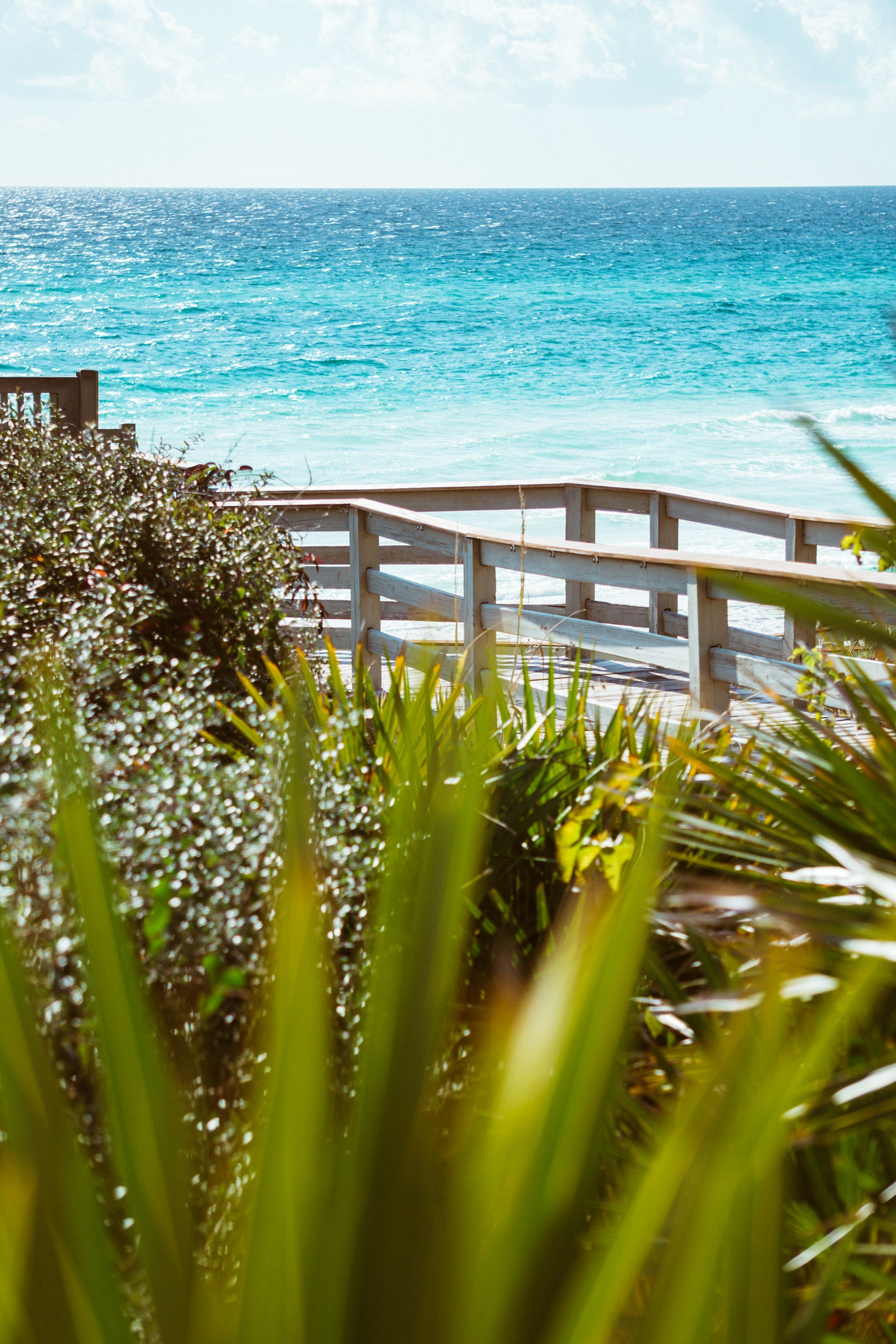
For salt water, the Panhandle state parks are where the “emerald” talk comes from.
Here’s how four of them handle getting in.
St. George Island State Park (its full name is Dr. Julian G. Bruce St. George Island State Park) is known for its emerald green water, and the park describes “perfect blue waters” on the gulf side.
It’s $6 per vehicle, 8 a.m. to sunset.
Its campground has been closed for renovations since July 13, 2026.
St. Joseph Peninsula State Park has 10 miles of white sandy beaches, and the park’s manager lists snorkeling among the reasons people come.
It’s $6 per vehicle.
Grayton Beach State Park’s manager talks about the gulf’s “clear emerald green water.”
But the park frequently reaches capacity and may close for several hours.
When it does, day visitors (pedestrians and bicyclists included) wait until it reopens, while campers with reservations still get in.
It’s $5 per vehicle.
Henderson Beach State Park in Destin has required a day-use reservation for every visitor since May 15, 2026.
Expect 30-foot white dunes and clear water.
It’s $6 per vehicle.
So yeah, two of four control the crowd at the gate.
That’s the hidden-gem problem again, just with sand.
Up north and want fresh water?
Here are the best natural springs in the Florida Panhandle.
And for more ideas past the beaches, try our list of things to do in Florida beyond the theme parks.
The Keys Have Pennekamp’s Reef, Best Seen by Boat

John Pennekamp Coral Reef State Park in Key Largo is known as the country’s first undersea park, and it covers 70 nautical square miles.
Its three reef systems offshore are reached by boat.
The closest is about 300 yards out.
Glass-bottom trips leave three times a day, 365 days a year, weather permitting, and snorkel boats go four times a day.
Both last 2.5 hours, with about 1.5 hours of reef time.
From shore, you can swim off Cannon Beach and Far Beach (no lifeguards on duty), and at Cannon Beach artifacts from a 1715 Spanish shipwreck have been placed underwater for viewing.
Over 600 species of fish and 70 species of coral live in the park’s waters.
Entry is $8 per vehicle plus 50 cents per person.
If it were my one day in Key Largo, I’d book the snorkel boat.
Gulf Water Can Go Murky, So Check Red Tide First

Spring water is steady.
Beach water isn’t, and red tide is the thing I’d check before any Gulf drive.
The Florida Fish and Wildlife Conservation Commission posts a statewide red tide status on Friday afternoons (except around holidays), plus a daily sample map updated at 5 p.m. Its report for October 30, 2026 found the red tide organism in 24 samples from Northwest Florida, with bloom concentrations in six samples from Bay and Gulf counties.
It listed suspected fish kills and respiratory irritation in Gulf County.
That week it didn’t find the organism in Southwest Florida or along the East Coast.
What the levels mean, per the FWC: even very low levels may bring respiratory irritation, and at high levels (over 1,000,000 cells per liter) the water itself can discolor.
Its next report was due Friday, November 6.
You can also call 866-300-9399 any time to hear a recording.
Before a beach day, I’d open the FWC map and our Florida beach conditions tool, which pulls FWC red tide samples, rip current warnings and the nearest sea temperature for the beach you pick.
Clearest Water in Florida: Quick Answers

Q: Can I swim with manatees all year round?
A: The wildlife refuge in Crystal River calls snorkeling a year-round activity at its springs.
Its seasonal restrictions are winter rules, though.
Manatee season runs November 15 to March 31, when manatees come to the springs to survive the cold Gulf waters.
That’s when its seven warm-water manatee sanctuaries are closed to all activity, so you snorkel outside them.
So the months that bring the manatees in are the same months the sanctuaries close.
At Blue Spring State Park, though, swimming with the manatees isn’t allowed.
Q: Which clear springs need a reservation?
A: Rainbow Springs and Blue Spring take day visitors by reservation only, so book ahead or you won’t get in.
Devil’s Den takes snorkelers by reservation only, and Henderson Beach needs a day-use reservation too.
Ichetucknee is the opposite: first-come, first-served at the gate.
Q: When is the water clearest?
A: The springs that give a temperature hold it all year: Ginnie, Rainbow, Blue Spring, Devil’s Den, Alexander and Ichetucknee’s Blue Hole all put their water at 72 degrees year-round.
Rivers are seasonal: Ginnie says the Santa Fe usually clears in summer and early fall.
For the Gulf, check that week’s red tide report before you go.