

Every cruise line sells the Caribbean in three flavors.
Eastern and Western are the big two, and Southern is the long way around.
The brochures make them sound like three versions of the same beach.
They’re not.
The route decides how many days you actually spend on land, how far you sail, what kind of port you get, and how nervous you should be about a September booking.
Here’s the short version, and then the stuff I wish someone had told me before I booked my first one.
Ports change by ship and by year, so check the one you’re looking at.
But the pattern holds.
Eastern Caribbean: Beaches, Shopping and More Sea Days

The Eastern route usually means St. Thomas, St. Maarten and San Juan, often with a stop in the Bahamas or at the cruise line’s own private island.
Those islands are a long way from Florida.
So a 7-night Eastern sailing tends to burn 2 or 3 days at sea just getting there and back.
If you love the ship, great.
If you get bored after one pool lap, that’s a lot of buffet.
What you get in return is white-sand beaches and the best shopping stop in the region.
St. Thomas is a US territory, so a US resident coming home from there gets a $1,600 duty-free allowance instead of the usual $800.
People really do haul home liquor and watches.
Skip the jewelry stores right by the pier and walk into Charlotte Amalie.
The red building in the photo is Fort Christian, which the Danes built in the 1670s. It’s the oldest standing structure in the US Virgin Islands, and these days it holds a small museum.
It takes ten minutes to see the outside and costs nothing.
Western Caribbean: More Port Days, More to Do

Western means Mexico and Central America: Cozumel, Costa Maya, Roatán in Honduras, Belize, Grand Cayman and sometimes Jamaica.
These ports sit closer together, so you usually get more days on land and fewer at sea.
And the days on land are more varied.
Mayan ruins, cave swimming, reef snorkeling, zip lines.
It’s the better route if you get restless.
Two things to know.
First, Grand Cayman has no cruise pier.
Ships anchor in the harbor and run everyone ashore in small tender boats, and on a busy day the line for those boats is the main event.
On New Year’s Day 2025, five ships put roughly 15,000 people into George Town at once.
If you’re booked on a tour, take the line’s tender tickets seriously.
Second, Cozumel gets several ships a day, and the strip by the piers is built for exactly that.
Get a taxi or the ferry a few minutes away and it’s a different island.
Same rule as anywhere: the place everyone can walk to is the place everyone walks to.
Southern Caribbean: Longer Trip, Steadier Weather

Southern usually means the ABC islands (Aruba, Bonaire, Curaçao), sometimes with Barbados, St. Lucia or Grenada.
It’s the farthest south, so from Florida most of these sailings run 8 or 9 nights, not 7.
A lot of them leave from San Juan or Barbados instead, which means a flight to the ship first.
Build in a night before.
A missed connection is a bad way to miss a cruise, and I’ve done the airport-chair layover version of that lesson once already.
The payoff is weather.
Atlantic hurricane season runs from June 1 to November 30, and both the Eastern and Western routes sit right in it.
The ABC islands are mostly below the storm track.
Aruba says it hasn’t taken a direct hurricane hit since records began in 1851.
That doesn’t mean a storm can’t change your route, because the ship still has to sail there through everything else.
But if you’re stuck with a September or October trip, this is the route I’d book.

🗼 I Wrote a Book About My Japan Travel Catastrophes!
Before I landed in Tokyo, I thought I was the “Final Boss” of international travel. Spoiler alert: I WASN’T. 😅
🚅 I boarded the wrong Shinkansen and ended up in THE WRONG CITY. I confused locals with my “expert” bowing that was more awkward than accurate. I accidentally stumbled into a high-stakes Kendo practice thinking it was a tourist show. Sound like something you’d do?
“Things I Wish I Knew Before Going to Japan” is your shortcut to avoiding ALL my cringe-worthy mistakes. ✨ Inside, you’ll find practical, LIFE-SAVING tips on etiquette, transport, money, and hidden gems that will save you time, money, and a whole lot of confusion.
If Your Dates Fall Between August and October

Fall fares are cheap for a reason.
Atlantic hurricane season officially runs from June 1 to November 30.
The National Hurricane Center puts the peak on September 10, and says most of the activity lands between mid-August and mid-October.
That’s the bargain window, and this is the bargain.
A front like the one in that photo can roll over a beach in a few minutes.
A ship’s captain sees it coming days out, which is the good news.
What a storm usually does is move your cruise, not cancel it.
The ship sails around the weather.
Your Eastern itinerary can turn into a Western one overnight, or a port day becomes one more sea day.
You still get a vacation.
You just don’t get the one you booked.
So in that window, book the trip, not the island.
If there’s one beach you’ve been dreaming about for 10 years, don’t pick a September sailing to see it.
And remember the flight.
The same storm that reroutes the ship can cancel your plane to it, which is the part that actually costs money.
One more reason for the hotel the night before.
If you buy travel insurance, read what it pays for.
A skipped port and a canceled trip are two different things on a policy, and you want to know which one you’ve got before you’re standing in the line at guest services.
Be Back by All Aboard, Not by Departure

This is the one that strands people.
Every port day has two times on it.
There’s when the ship leaves, and there’s the all-aboard time, which is earlier.
Only the second one matters to you.
Carnival puts it on signs at the gangway, in its daily FunTimes sheet and in its Hub app.
Read it on the way off the ship, not on the way back.
At a tender port like Grand Cayman the ship sits out at anchor like this one, so you also have to fit in the boat ride back and the line for it.
Then there’s your phone.
Some ports keep a different clock than the ship does, and depending on its settings your phone can switch to local time on its own the moment it finds a tower.
Set your alarm on ship’s time.
Wear a cheap watch if you have to.
And if you go off on your own, it’s on you.
Carnival says it isn’t responsible if guests don’t make it back on time from a private tour or from wandering around.
A late tour the ship sold you is different, because the ship waits for that one.
That’s the one real argument I’ve found for booking the line’s own excursions.
Miss it anyway and you’re the one paying to catch up with the ship at the next port.
So my rule is 60 minutes.
I’m back at the pier an hour before all aboard, every port, no exceptions.
Honestly, I’d rather sit on board with a cold drink than find out what a one-way flight out of Roatán costs.
The Day You Spend at Sea

An Eastern sailing gives you 2 or 3 of these, so it’s worth having a plan.
That photo is a sea day at the main pool by late morning.
Every lounger taken, half of them by a towel and a paperback while the owner is at the buffet.
Here’s mine.
The whole ship heads for the main pool after breakfast, so I don’t.
I take a book somewhere with shade, eat lunch late (1:30 or so, when the buffet line is short), and save the pool for after 3, when half of it is napping.
Turns out the ship is a lot bigger when you’re not where everyone else is.
Sea days are also when the ship sells you things.
The spa, the specialty dinner, the drinks package upgrade, the photo package.
None of that is a scam, but it adds up fast, so decide your number before you leave the cabin.
I’ve done the math on the way home before.
Not fun.
One more thing nobody mentions.
The best hour of a port day is often sailing in, not the port itself.
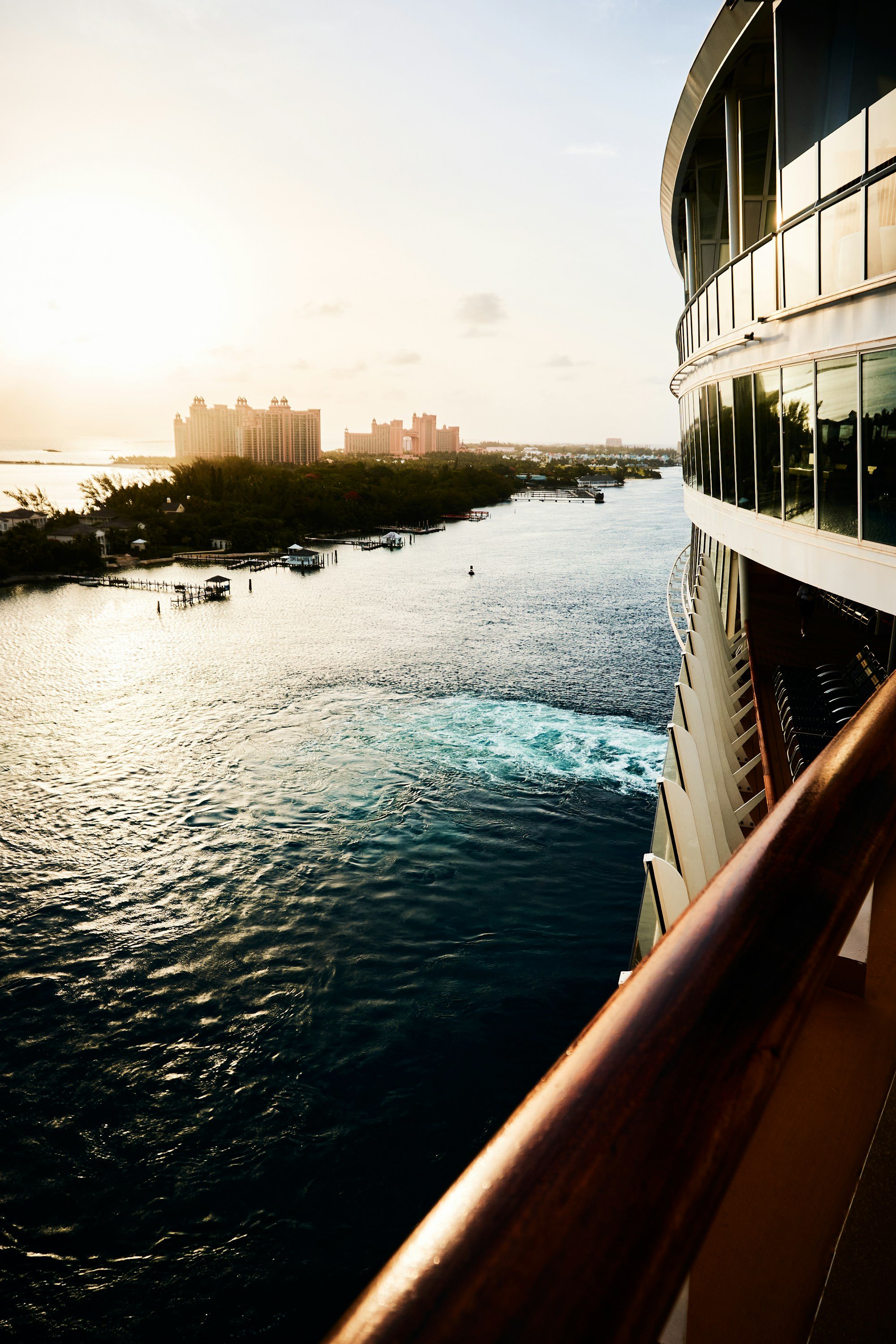
The photo up top is that hour.
Get up for it once.
So Which One Should You Book?
If it’s your first cruise, I’d go Western.
More port days, short hops, and if you hate it you’ve only lost a week.
If you already know you like the ship more than the shore, go Eastern and enjoy the sea days.
And if your only free week is in September or October, look South first.

Whichever you pick, a closed-loop cruise (one that starts and ends at the same US port) lets US citizens sail on a birth certificate plus a government photo ID.
Bring a passport anyway.
If something goes wrong in a foreign port and you have to fly home, a birth certificate won’t get you on that plane.
And pack light.
A carry-on and a small backpack is plenty for a week of swimsuits and one nice dinner.
The fewer bags you drag through the terminal, the shorter your day.
Before you book, it’s worth reading what a cruise really costs beyond the fare, because the price on the ad isn’t the price you pay.
And if you’d rather fly than sail, here are the Caribbean islands closest to Florida and the ones you can visit without a passport.
Related read: The Caribbean Travel Guide — Instant PDF + Kindle download. Secure checkout by Stripe