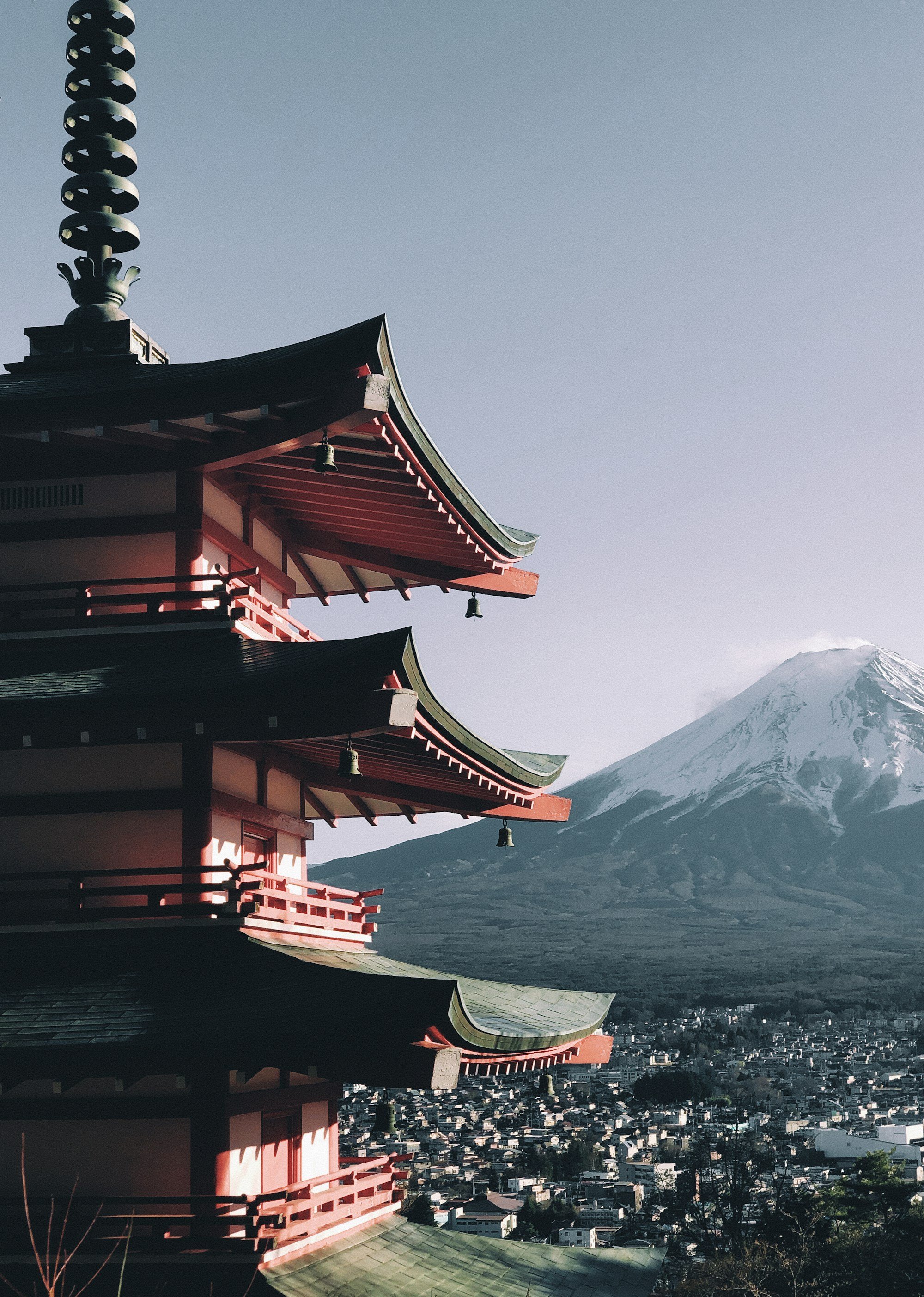


Most people do this day trip backwards.
They ride out to Lake Kawaguchiko, walk the shore until lunch, then climb to Chureito Pagoda in the afternoon and find a wall of white cloud where the mountain should be.
Then they take the photo of the pagoda anyway and caption it “Fuji was shy today.”
I’ve done it both ways.
Turns out the order matters more than the weather app: pagoda first.
Below is the Tokyo to Mount Fuji day trip I’d hand a friend.
It starts with the train or the bus out of Shinjuku and the one station you actually want.
After that come the 398 steps, then the lake after lunch.
(No tour needed.
You really don’t need one for this.)
The Pagoda Goes First Because the Clouds Come Later
Mount Fuji hides in the middle of the day.
Japan-guide says it straight: the mountain tends to be clearest early in the morning, usually before 9am, and again in the late afternoon.
During the day, clouds often cover it even when the weather is fair.
That’s pretty much the whole plan.
You came for the pagoda photo, so it gets the morning.
And the lake has a north shore that looks right at the mountain, so it gets the second window.

Here’s the weak spot, and I’d rather you hear it from me.
On a day trip from Tokyo you won’t be on the observation deck at sunrise.
The first bus gets to Kawaguchiko at 8:30, and by the time you’ve doubled back and climbed, it’s past 9.
Some mornings you still win.
Some mornings you get a nice pagoda in front of a cloud.
If the shot matters more to you than one night of hotel money, sleep in Fujiyoshida or Kawaguchiko and walk up at first light.
That’s the only real fix, and honestly it’s the better trip.
Either way, look before you leave.
Kawaguchiko.net links a live camera of the lake and the mountain.
A two-minute look at 6am beats a three-and-a-half-hour round trip to photograph fog.

Train or Bus Out of Shinjuku
Both leave from Shinjuku.
Both are fine (I’ve done each more than once).
Look, the bus is the cheap one.
Highway buses to Kawaguchiko leave from Busta Shinjuku, about 2 minutes on foot from the station’s New South Exit.
JNTO’s timetable sheet listed the first bus at 6:45, getting to Kawaguchiko at 8:30, for ¥2,200 one way.
That’s an hour and 45 minutes for the price of a decent lunch.
That sheet is a year old, so check the fare when you book.
But the train is the comfortable one.
The Fuji Excursion runs from Shinjuku to Kawaguchiko with no change, and it stops at Shimoyoshida, the station for the pagoda.
That last part is the big deal.
On the bus you ride right past the pagoda.
Kawaguchiko.net says you can even spot it on the hillside from the highway.
Then you have to come back for it.

The Fuji Excursion Without the Jargon
The Fuji Excursion started running on March 16, 2019.
It’s a JR East limited express that keeps going past Otsuki onto the Fujikyu line, which JR doesn’t own.
Its trains are three cars long, numbered 1 to 3.
Between Shinjuku and Otsuki those three cars ride coupled to a bigger Azusa or Kaiji train, cars 4 to 12.
At Otsuki they split.
So read the car number on your ticket and stand at the right spot on the platform.
(Sit in car 7 and you’ll keep going without the Fuji cars, right about when you open your snacks.)
You need two tickets: the basic fare and a limited express ticket.
The express ticket comes reserved or unreserved, and a little lamp over each seat tells you where you stand.
I’ve booked a reserved seat every time.
There are only a handful of these trains a day, and I don’t want to play musical chairs with a yellow lamp on a November weekend.
Got a Japan Rail Pass?
It covers Shinjuku to Otsuki only.
Past Otsuki the tracks belong to Fujikyu, so you pay a supplement, either at a Fujikyu station or on the train.
Weirdly, the JR Tokyo Wide Pass is the exception, since it includes the Fujikyu part.
Fujikyu’s line is 26.6 km from Otsuki to Kawaguchiko, and it climbs about 500 m on the way.
You’ll feel the air change.
Keep your jacket on top of your bag, not at the bottom of it.
🗼 I Wrote a Book About My Japan Travel Catastrophes!
Before I landed in Tokyo, I thought I was the “Final Boss” of international travel. Spoiler alert: I WASN’T. 😅
🚅 I boarded the wrong Shinkansen and ended up in THE WRONG CITY. I confused locals with my “expert” bowing that was more awkward than accurate. I accidentally stumbled into a high-stakes Kendo practice thinking it was a tourist show. Sound like something you’d do?
“Things I Wish I Knew Before Going to Japan” is your shortcut to avoiding ALL my cringe-worthy mistakes. ✨ Inside, you’ll find practical, LIFE-SAVING tips on etiquette, transport, money, and hidden gems that will save you time, money, and a whole lot of confusion.
Get Off at Shimoyoshida
Not Kawaguchiko.
Not Mt. Fuji station either, even though the name is tempting.
Shimoyoshida is two stops before Mt. Fuji station.
Fujikyu’s own station list even labels it “Arakurayama Sengen Park,” which is the park the pagoda stands in.
If your bus dropped you at Fujisan station, ride the local train two stops back.
From Kawaguchiko, it’s four.
From the station it’s a short walk.
Kawaguchiko.net calls it about 20 minutes and GOOD LUCK TRIP says about 10.
So the real answer depends on how often you stop to take pictures.
(You will stop.)

Fujiyoshida is a regular working town that happens to have a volcano at the end of its streets.
People here are walking to work and school while you’re gawking, so keep to the side of the sidewalk.
The 398 Steps
Then the stairs.
There are 398 stone steps from Fuji Sengen Shrine up to the pagoda, about 200 m of them.
Locals call the path Sakuya-hime, after the goddess of cherry blossoms and Mount Fuji.
Kawaguchiko.net says students train on them, and the fastest runners make it up in 2 minutes.
You are not doing it in 2 minutes.
Give yourself 15 and use the benches.
Honestly, there’s a good reason to stop anyway.
The mountain sits behind you the whole climb, so every bench is a viewpoint.
Turn around once in a while.

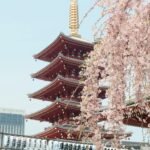
Built in 1962, the pagoda stands about 19.5 m tall.
Getting into the park costs nothing.
Here’s the part people miss.
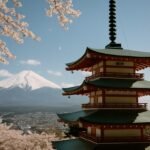
That famous photo isn’t taken next to the pagoda.
It’s taken from the observation deck higher up the hill, looking down past the pagoda’s roof to the mountain.
So keep climbing past it until the view opens up.
Expect company.
Even on a day that wasn’t a holiday, the GOOD LUCK TRIP writer found plenty of tourists, and on a weekend the best railing spot has a line.
Take your shots, then step back so the next person gets a turn.
Everybody leaves with the same photo anyway, and it’s genuinely a good one.
In spring the hillside holds about 650 cherry trees, which is why April gets so packed.
(The park’s cherry blossom festival isn’t being held in 2026, but the trees will bloom anyway.)
November Is a Good Month for This
Right now is one of the better times of year to go.
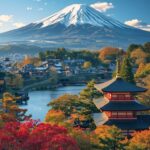
Japan-guide puts autumn colors around the Fuji Five Lakes in the first half of November.
Its tracker for today reads “Approaching Peak,” with the best viewing early to mid November.
Fujikyu posted its own autumn leaves notice on November 1, about deep crimson leaves and a mountain starting to put on its winter white.
Around the lake, the Fujikawaguchiko Momiji festival runs November 7 to 29, 2026.
Photographers head for the Momiji Tunnel, a stretch of road covered in maples further west along the north shore.

It’s cold up there, though.
GOOD LUCK TRIP’s writer had about 3 °C and a hard wind on the steps.
Bring a real jacket and gloves, not the light layer you packed for Tokyo.
My Japan packing list has the layers that still fit in a carry-on.
One more thing.
Leaf season is not the off-season, and festival weekends get busy.
Go on a weekday if you can swing it.
The Lake in the Afternoon
After the pagoda, take the train four stops on to Kawaguchiko.
That’s where the lake is, along with most of the food and the buses home.
For the mountain, go to the north shore.
Japan-guide says the best Fuji views from the lake are from there.
Oishi Park is a small free garden on that side with a clear line to the summit, when the clouds play along.

If you want height, the Mount Fuji Panoramic Ropeway runs 8:30 to 17:00, every 5 to 10 minutes.
It’s ¥1,000 round trip or ¥600 one way.
Walk down and keep the ¥400.
Then stay put for the late light (bring a snack, it’s worth it).
That’s the second clear window, and most day trippers spend it on the bus back to Tokyo.
Skip the 5th Station on this trip.
A bus up from Kawaguchiko was ¥1,950 one way on JNTO’s sheet, and you’d be trading your afternoon window for a parking lot in the clouds.
That’s a whole other day.
If clouds win both windows, don’t take it personally.
My Mount Fuji views post has other spots to try next time.
My Day, Hour by Hour
Here’s how I’d run it from a hotel in Tokyo, by bus, because those are the times I can vouch for.
On the train the shape is the same.
You just skip the double-back, since the Fuji Excursion stops at Shimoyoshida on its way in.
Plus, book the ride home in the morning.
Seats go fast on a clear day, and standing in the line at Kawaguchiko at dusk with sore legs is nobody’s highlight.
What It Cost Me
Not much, which is kinda the best part of this trip.
By bus it cost me ¥4,400 round trip, plus ¥600 for the ropeway one way.
Call it ¥5,000 before food.
Now, the train costs more.
But it saves you the double-back to Shimoyoshida and the guesswork with a local timetable.
What I’d skip: any “hidden gem” viewpoint a listicle sends you to between 11 and 2.
It’s hidden because the mountain is.
And if this is your first time in Japan, read my first-timer’s guide before you book anything.
Jet lag plus a 6:45 bus is a rough combo (ask me how I know), so maybe don’t make this day one.
Related read: Things I Wish I Knew Before Going to Japan — Instant PDF + Kindle download. Secure checkout by Stripe