
Most people picture Paris in spring.
Blossoms, café terraces, everybody in a light jacket.
It’s lovely, but you share it with everybody else who had the same idea, and the lines show it.
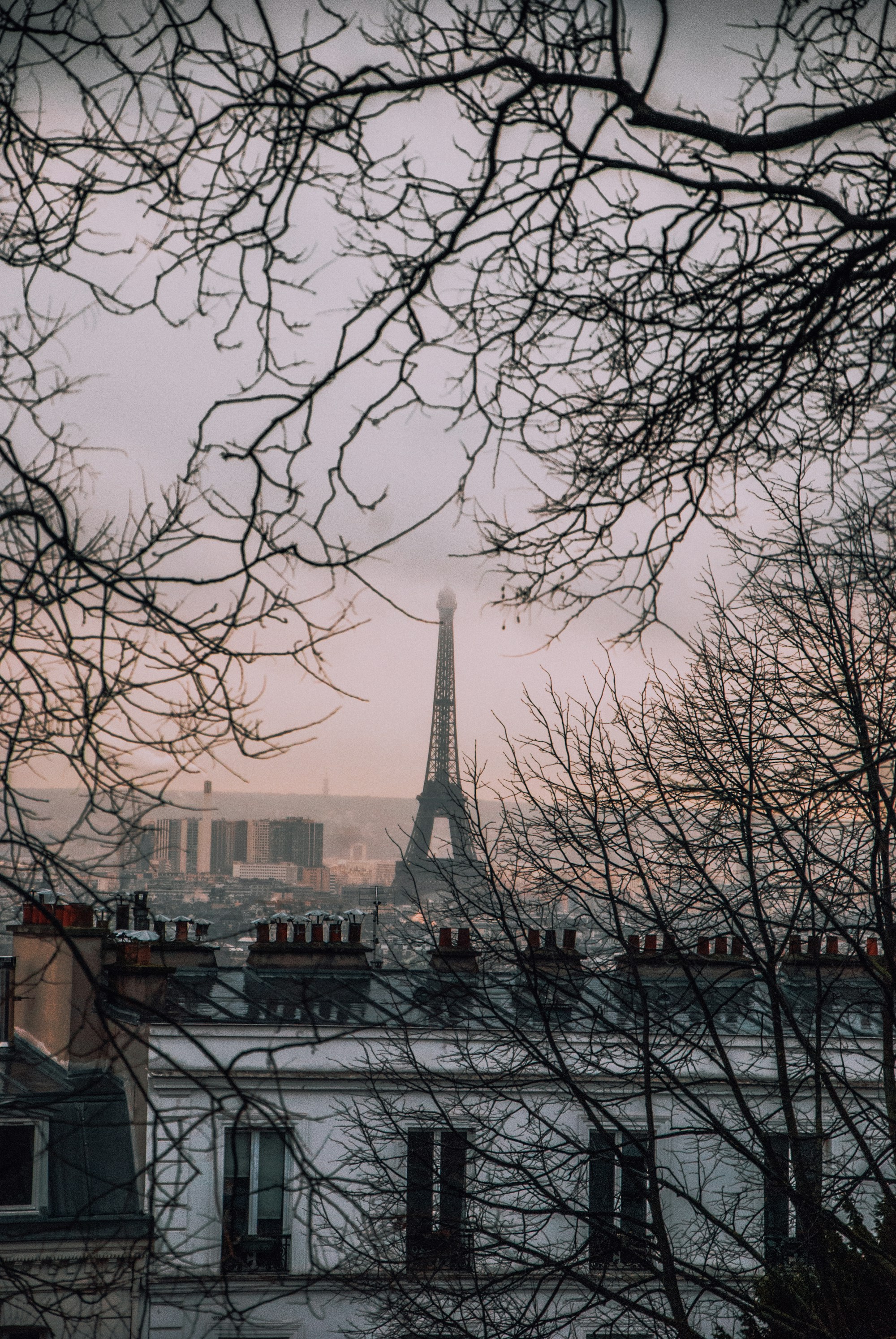
Winter is the other Paris.
It’s gray a lot, it rains often, and it gets dark early.
It’s also when the holiday crowds go home, the big museums are easier to plan around, the stores run their once-a-year sales, and the city goes back to being a place where people live instead of a place people queue for.
If you can live with a cold nose and a short day, I’d argue December to February is one of the smartest times to go.
Here’s what the weather actually does, what stays open, what it costs you, and the days I’d plan around.
What the Weather Actually Does

Paris winters are chilly and damp, not brutal.
At the Paris-Montsouris weather station, the 1991-2020 averages put January’s high at 7.6°C, about 46°F, and its low at 3.2°C, about 38°F. December runs 8°C by day and 3.8°C at night.
February is a touch warmer, with an average high of 8.8°C, close to 48°F.
So you’re dressing for the 40s, mostly.
Freezing nights do happen, about 7 of them in an average January, but a day that never gets above freezing is rare, around one in an average January.
The thing that gets people is the wet and the gray.
December averages 11.4 days with at least a millimeter of rain, and January about 10.
Sunshine is in short supply too, with about 57 hours in all of December, against 222 in July.
None of that is a reason to stay home.
It’s a reason to pack a real coat and plan a few indoor afternoons.
The Short Days, and How to Use Them

Daylight is the real constraint in a Paris winter.
On December 21 the sun rises at 8:41 and sets at 4:56 pm, which leaves about 8 hours and 15 minutes of daylight.
Even on December 1 you get only about eight and a half.
That changes how I’d plan a day.
Walk the neighborhoods, the river and the parks in the late morning and early afternoon, when the light is best.
Save the museums, the covered arcades and a long dinner for after dark.
A good winter day in practice looks something like this.
A slow breakfast while the sun comes up around 8:40.
Out the door by 10 for a long walk while the light is good.
Lunch somewhere warm, then one more outdoor stop before the light goes.
Back near the river for sunset just before 5, when the lights come on.
On a Wednesday or a Friday, the Louvre until 9, then dinner.
It’s a full day, and you spend the coldest, darkest hours inside.
The upside of a 5 pm sunset is that you don’t have to stay up late to see the city lit.
The bridges, the Eiffel Tower and the holiday lights are on while it’s still early evening, which also helps a lot if jet lag has you fading by 9 (it probably will).
Speaking of jet lag, most overnight flights from the US land in the morning.
I’d keep the first afternoon light: a walk, a café, an early night.
A nonstop makes that first day a lot easier than one with a layover, and quite a few US cities fly direct to Paris.
The Louvre in Winter, Without the Worst of the Line

A cold, wet afternoon is exactly what the big museums are for.
The Louvre is the obvious one, so get its rules straight before you go.
It’s closed every Tuesday, plus January 1, May 1 and December 25.
The other days it opens at 9 am, and on Wednesdays and Fridays it stays open until 9 pm.
Those two late nights are the ones I’d pick in winter, since it’s dark outside by 5 anyway and you lose nothing by spending the evening indoors.
The ticket price depends on where you live now.
Since January 14, 2026, a standard ticket costs €22 for visitors from the European Economic Area and €32 for everyone else, which means most Americans pay €32.
Under-18s get in free.
Entry is also free on the first Friday evening of each month after 6 pm, except in July and August, which makes a winter first Friday a nice little bonus if your dates line up.
Booking a time slot isn’t strictly required, but it’s recommended, even for free entry.
Book it.
Honestly, standing in the line outside in January drizzle is the one Louvre experience nobody needs.

🗼 I Wrote a Book About My Japan Travel Catastrophes!
Before I landed in Tokyo, I thought I was the “Final Boss” of international travel. Spoiler alert: I WASN’T. 😅
🚅 I boarded the wrong Shinkansen and ended up in THE WRONG CITY. I confused locals with my “expert” bowing that was more awkward than accurate. I accidentally stumbled into a high-stakes Kendo practice thinking it was a tourist show. Sound like something you’d do?
“Things I Wish I Knew Before Going to Japan” is your shortcut to avoiding ALL my cringe-worthy mistakes. ✨ Inside, you’ll find practical, LIFE-SAVING tips on etiquette, transport, money, and hidden gems that will save you time, money, and a whole lot of confusion.
The January Sales Are a Real Reason to Go

France doesn’t do year-round “sales” the way US stores do.
Its official sales, les soldes, happen twice a year on dates set by the government, and the winter round starts in early January and lasts four weeks.
In 2026 it ran from Wednesday, January 7, at 8 am, to Tuesday, February 3.
If shopping is part of your trip, that window is the one to aim for.
Winter clothes go on sale right when you’d want to wear them, which is a nice change from buying a coat in a US store in October.
Don’t plan the whole trip around the first weekend of the sales, though.
That’s when everybody else shows up too.
A weekday in the second or third week is calmer, and there’s usually still plenty left in your size.
Where to Go When It’s Pouring

Paris has an old answer to bad weather: the covered passages.
These are glass-roofed shopping arcades from the 1800s, mostly on the Right Bank, full of small shops and places to eat.
Galerie Vivienne and Passage des Panoramas are the best known, and you can stroll for an hour without opening an umbrella.
The Panoramas is the oldest, from around 1800, and it’s the one that stays open latest because of its restaurants.
Galerie Vivienne, from the 1820s, is the pretty one, with a glass canopy and its original mosaic floor.
Cross the boulevard from the Panoramas and you’re in Passage Jouffroy, the first one in the city built entirely of metal and glass, which leads straight into Passage Verdeau.
Most of them keep roughly shop hours, around 8 am to 8 pm, and the city’s own guide to the passages has a map.
Chaining three of them together is a solid two-hour plan for the wettest afternoon of your trip, and it costs you nothing unless you find a bookstore you like.
Then there are the cafés. An hour inside over a coffee is a perfectly good use of a rainy afternoon, not a wasted one.
If you want to know how it works before you sit down (where to sit, how to order, why nobody rushes you), our guide to Paris café culture covers it.
Getting between all of it is easy.
A single metro ticket costs €2.55 in 2026, with one fare however far you ride, and it’s good for up to two hours of travel.
The paper tickets are on their way out, so plan on loading rides onto a Navigo Easy card or the Bonjour RATP app instead.
The bus is a nice option on a dry day, since you see the city from the window, but the metro wins when it’s pouring.
What to Pack in a Carry-On for Paris in Winter

The good news about 40-something degrees and drizzle is that you don’t need serious cold-weather gear.
You need layers you can peel off, because museums, metro cars and restaurants are all warm inside, and you’ll be in and out of them all day.
Here’s what I’d fit in a carry-on.
One warm coat that handles rain, worn on the plane so it doesn’t eat bag space.
Two or three sweaters.
A scarf and a warm hat.
One pair of comfortable shoes that don’t soak through, since you’ll walk a lot more than you think.
A small umbrella, the folding kind, because a big one is a pain on narrow sidewalks.
Skip the heavy snow boots and the ski jacket.
They’re overkill for a city that averages in the 40s, and they take up half your bag.
Two small things I wouldn’t leave out.
A pair of thin gloves that work on a phone screen, because you’ll be pulling up maps and metro routes all day.
And a light bag that closes all the way, since a crowded metro car is not where you want an open tote.
Everything else you forget, Paris will happily sell you, probably at sale prices if you’re there in January.
So, Is Winter the Right Time for Your Trip?

It depends on what you want from Paris.
If it’s long, golden evenings on a terrace, winter will disappoint you, and spring or early fall is worth the crowds.
If it’s museums and long lunches in a city that feels lived-in, winter is hard to beat.
The one stretch I’d think twice about is Christmas week through New Year’s.
That’s not off-season at all.
The quiet part really starts after the first days of January, and it runs through February, with the sales as a bonus early on.
Want the bigger picture before you book?
Our Paris travel guide covers neighborhoods, getting in from the airports and how many days to give the city.
Pack the umbrella, book the Louvre slot, and let the short days push you indoors at exactly the right time.