

Short answer: if you drive the Orlando-area expressways a lot, get E-PASS.
The sticker is free, and it’s the only Florida toll account with a volume discount, worth 20 to 25 percent back once you pass 40 trips a month on those roads.
For everyone else it barely matters.
SunPass and E-PASS work on each other’s roads, so pick whichever is easier to sign up for.
If you’ll drive out of state, buy the portable version of either one.
Turns out that’s the whole decision.
I rewrote this page in October 2026 because the old version said E-PASS works in Georgia and North Carolina while SunPass only works in Florida, which was never the full picture.
Here’s what each one actually does, from the two agencies’ own pages.
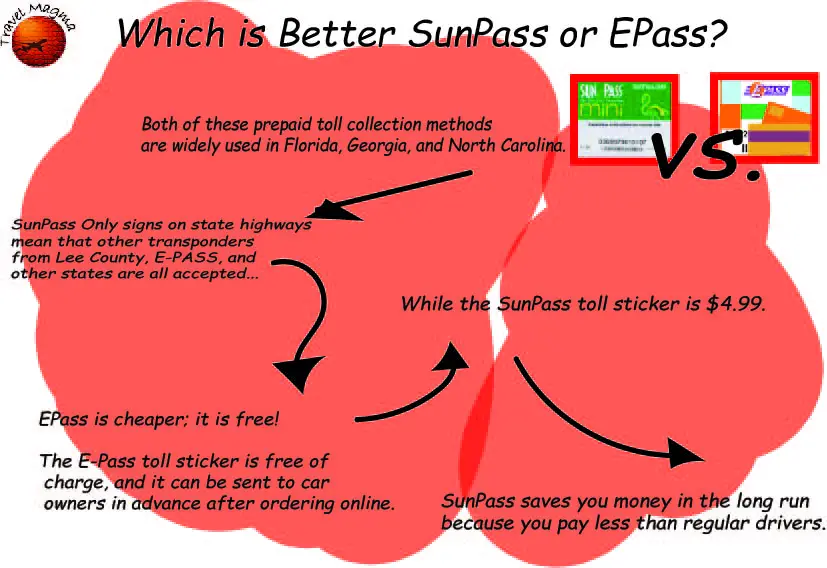
Who runs which
SunPass is the state’s program, run by Florida’s Turnpike Enterprise (part of the Florida Department of Transportation) since 1999.
E-PASS belongs to the Central Florida Expressway Authority (CFX), which runs the toll roads around Orlando, among them SR 408, 417, 429 and 528.
Both are prepaid accounts.
You stick or mount a transponder in the car, tolls come off your balance as you drive through, and you top up by card.
And here’s the part that matters: SunPass is fully interoperable with E-PASS.
An E-PASS works on the Turnpike, and a SunPass works on CFX roads.
Side by side
| SunPass | E-PASS | |
|---|---|---|
| Run by | Florida’s Turnpike Enterprise | Central Florida Expressway Authority |
| Cheapest transponder | SunPass Mini sticker | Sticker, free |
| Portable, multi-state version | SunPass PRO, $14.95 + tax | E-PASS Uni, $14.95 + tax |
| Works on the other’s roads | Yes | Yes |
| Volume discount | No | 20% at 40–79 CFX tolls a month, 25% at 80+ |
| To open an account | Varies, see sunpass.com | $10 first deposit, which goes toward tolls |
Where E-PASS wins
The sticker is free. CFX’s line is “Our sticker price is actually free.”
You pay a $10 opening deposit, and that money goes toward your tolls, so it isn’t a fee.
There are no monthly or processing fees either.
The volume discount. This is the real difference.
Each E-PASS transponder with 40 to 79 paid tolls on CFX expressways in a calendar month gets 20 percent of those tolls credited back.
At 80 or more, it’s 25 percent.
CFX’s own example: $100 in tolls over 80-plus trips earns a $25 credit, paid on the 15th of the next month.
It’s automatic.
It only counts CFX roads, though, so Turnpike miles don’t add up toward it.
If you commute on the 408 or the 417 twice a day, five days a week, you’ll clear 40 trips with room to spare.
That’s who E-PASS is for.
Honestly, if that’s you, stop reading and order the sticker.


🗼 I Wrote a Book About My Japan Travel Catastrophes!
Before I landed in Tokyo, I thought I was the “Final Boss” of international travel. Spoiler alert: I WASN’T. 😅
🚅 I boarded the wrong Shinkansen and ended up in THE WRONG CITY. I confused locals with my “expert” bowing that was more awkward than accurate. I accidentally stumbled into a high-stakes Kendo practice thinking it was a tourist show. Sound like something you’d do?
“Things I Wish I Knew Before Going to Japan” is your shortcut to avoiding ALL my cringe-worthy mistakes. ✨ Inside, you’ll find practical, LIFE-SAVING tips on etiquette, transport, money, and hidden gems that will save you time, money, and a whole lot of confusion.
Where SunPass is just as good
For a visitor or an occasional driver, SunPass loses pretty much nothing.
You get the electronic toll rate on every Florida toll road, which is lower than paying by plate.
CFX puts its own E-PASS rate at half the Pay By Plate rate.
And since the two systems work on each other’s roads, a SunPass covers you on CFX’s expressways too.
Driving out of state
Both agencies sell a portable transponder for this, at the same $14.95 plus tax.
- SunPass PRO works in Florida, Georgia and North Carolina, plus everywhere E-ZPass is accepted, from Florida up to Maine and west to Illinois. It can be moved between cars.
- E-PASS Uni is sold as “One Toll Pass. 19 States.” Florida’s Turnpike itself says a Uni can be used in the same states as a SunPass PRO.
So if you split time between Florida and the Northeast, either one does the job.
If you also commute on CFX roads, pick the Uni.
CFX’s own comparison table lists the Uni, at $14.95 plus tax, with local toll discounts, the same as the free sticker.
Two things that cost people money
One transponder per car. If you keep an E-PASS sticker on the windshield and toss a SunPass PRO in the glove box, you can get charged twice.
Florida’s Turnpike says to run only one, and to keep any extra portable one in a shield bag.
Rental cars have their own rules. If you’ve booked a rental, ask at the counter how that company bills tolls before you drive off the lot.
Each company runs its own toll program, with its own fees.
A portable SunPass PRO or Uni that you bring in your carry-on may work out cheaper, but follow the rental company’s instructions so you don’t pay twice.
Stickers don’t move. A SunPass Mini stops working once you peel it off, so it stays with the car.
If you swap cars often, the portable one is worth the $14.95.

My pick
I’d get the E-PASS sticker if I lived anywhere near Orlando.
It’s free, it works on the Turnpike and the other SunPass roads, and the discount is real money for a commuter.
Anywhere else in the state, I’d get whichever one I could set up fastest and not think about it again.
Want to see what a drive will cost first?
Try our Florida toll calculator.
More on Florida tolls, from SunPass Mini stickers to toll-by-plate bills, is in our Florida tolls and SunPass hub.