Hold on to your crumpets, because I’m about to take you on a ride through the center of London, one Tube stop at a time!
First up, we have The City – the OG square mile that the Romans called Londinium.
This financial district may be rich in history and architecture, but let’s be real, it’s not exactly the place to be for a wild night out.
Unless, of course, you find the idea of partying with a bunch of bankers and accountants to be your idea of a good time.
But fear not, my adventurous amigo, there are plenty of other neighborhoods in London that are sure to tickle your fancy.
So hop on the Tube and let’s explore this glorious city together!
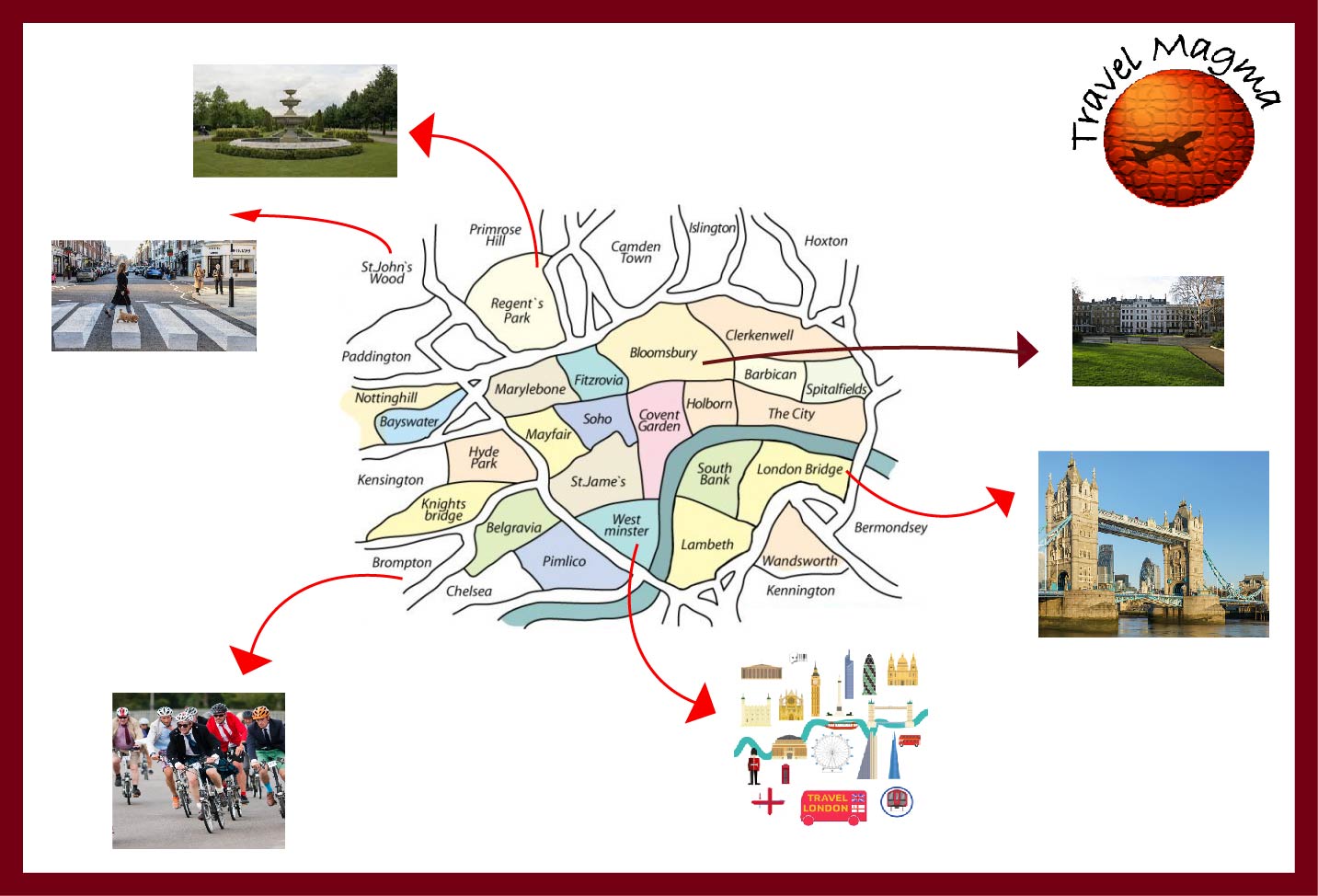
London Neighborhoods Map

Tap to Explore These Beauties
See my ideas in action 👇 Tap any image to explore full details.
West End
Where most of London’s main attractions are found, is unofficially bounded by the Thames to the south, Farringdon Road/Street to the east, Marylebone Road/Euston Road to the north, and Hyde Park and Victoria Station to the west.
Most visitors will spend their time in the West End, whether at Buckingham Palace, the British Museum, or the shops and theaters of Soho.
You’ll find the greatest concentration of hotels and restaurants in the West End.
Despite attempts to extend central London’s nocturnal life to the south side of the Thames notably the ambitious Southbank Arts Centre London’s energy fades when it crosses the river.

Still, the new urban development of Docklands, the tourist attraction of the Globe Theatre, and some up-and-coming residential neighborhoods are infusing energy into the area across the river.
Farther west are the upscale neighborhoods of Belgravia, Kensington, Knightsbridge, Chelsea, Paddington and Bayswater, Earl’s Court, and Notting Hill.
This is also prime hotel and restaurant territory.
To the east of the City is the
East End
which forms the eastern boundary of Inner London (Notting Hill and Earl’s Court roughly form the western boundary).
Inner London is surrounded, like a doughnut, by the sprawling hinterland of Outer London.

🗼 I Wrote a Book About My Japan Travel Catastrophes!
Before I landed in Tokyo, I thought I was the “Final Boss” of international travel. Spoiler alert: I WASN’T. 😅
🚅 I boarded the wrong Shinkansen and ended up in THE WRONG CITY. I confused locals with my “expert” bowing that was more awkward than accurate. I accidentally stumbled into a high-stakes Kendo practice thinking it was a tourist show. Sound like something you’d do?
“Things I Wish I Knew Before Going to Japan” is your shortcut to avoiding ALL my cringe-worthy mistakes. ✨ Inside, you’ll find practical, LIFE-SAVING tips on etiquette, transport, money, and hidden gems that will save you time, money, and a whole lot of confusion.
London neighborhoods – The City Map
When Londoners speak of “the City” (EC2, EC3), they mean the original square mile that’s now the UK version of Wall Street.
The buildings of this district are known all over the world: the Bank of England, the London Stock Exchange, and famed insurance company Lloyd’s of London.
The City was the original site of Londinium, the first settlement of the Roman conquerors.
Despite its age, the City doesn’t easily reveal its past.
Although it retains some of its medieval character, much of the City has been swept away by the Great Fire of 1666, the bombs of 1940, the IRA bombs of the 1990s, and the zeal of modern developers.
Landmarks include Sir Christopher Wren’s masterpiece, St.
Paul’s Cathedral Which stood virtually alone in the surrounding rubble after the Blitz.
Some 2,000 years of history unfold at the City’s Museum of London and at the Barbican Centre
Opened by Queen Elizabeth in 1982.
Following the Strand eastward from Trafalgar Square, you’ll come to Fleet Street.
In the 19th century, this corner of London became the most concentrated newspaper district in the world.
William Caxton printed the first book in English here, and the Daily Consort, the first daily newspaper printed in England, was launched at Ludgate Circus in 1702.
In recent times, however, most London tabloids have abandoned Fleet Street for the Docklands across the river.
Where the Strand becomes Fleet Street stands Temple Bar, where the actual City of London begins.
The Tower of London looms at the eastern fringe of the City, shrouded in legend, blood, and history, and permanently besieged by battalions of visitors.
The average visitor will venture into the City during the day to sample its attractions or to lunch at pubs such as Ye Olde Cheshire Cheese then return to the West End for evening amusement.
As a hotel district, the City wasn’t even on the map until recent times.
The opening of the Great Eastern Hotel Has brought a lot of business clients who prefer to stay here to avoid the traffic jams involved in getting into and out of the City.
Stay in the City if you would prefer a hotel in a place like New York’s Wall Street to a midtown address.
If you can’t afford the Great Eastern, consider the cheaper Rookery in newly fashionable Smithfield.
The City lures hotel guests who prefer its quirky, quiet, offbeat flavor at night, when it’s part ghost town, part movie set.
There is some nightlife here, including pubs and restaurants.
It’s fun to wander the area when all the crowds are gone, pondering the thought that you’re walking the same streets Samuel Johnson trod so long ago.
The City of London still prefers to function on its own, separate from the rest of London.
It maintains its own Information Centre at St.
Paul’s Churchyard, EC4 which is open daily from 10am to 5:50pm.
What are the neighborhoods of London?
The East End
Traditionally, this was one of London’s poorest districts, nearly bombed out of existence during World War II.
In the words of one commentator, Hitler created “instant urban renewal” here.
The East End extends east from the City Walls, encompassing Stepney, Bow, Poplar, West Ham, Canning Town, and other districts.
The East End is the home of the cockney.
To be a true cockney, it’s said that you must be born within the sound of the Bow Bells of St.
Mary-le-Bow church, an old church rebuilt by Sir Christopher Wren in 1670.
These days, many immigrants to London make their homes in the East End.
London is pushing eastward.
Today you’ll find lots of trendy bars, clubs, restaurants, and boutiques or vintage clothing outlets here.
Much of the fashionable life is found around Hoxton Square and its peripheries, such as Shoreditch and the northern half of Brick Lane.
There is an array of contemporary galleries in the area.
Brick Lane, incidentally, is a great place for some curry dishes if you can deal with all those waiters on the street trying to hustle you into their restaurants.
Attractions you may want to visit if you’re in the area include St.
Clement Danes church, the Temple of Mithras, and Sir Christopher Wren’s Monument to the Great Fire of 1666.
Docklands
In 1981, in the most ambitious scheme of its kind in Europe, the London Docklands Development Corporation (LDDC) was formed to redevelop Wapping, the Isle of Dogs, the Royal Docks, and Surrey Docks.
The area is bordered roughly by Tower Bridge to the west and London City Airport and the Royal Docks to the east.
Many businesses have moved here; Thames-side warehouses have been converted to Manhattan-style lofts and museums, entertainment complexes, shops, and an ever-growing list of restaurants have popped up at this 21st-century river city in the making.
Canary Wharf
on the Isle of Dogs, is the heart of Docklands.
This 28-hectare (69-acre) site is dominated by a 240m-high (787-ft.) tower, which is the tallest building in the United Kingdom, and was designed by César Pelli.
The Piazza of the tower is lined with shops and restaurants.
On the south side of the river at Surrey Docks, Sir Terence Conran has converted the Victorian warehouses of Butler’s Wharf into offices, workshops, houses, shops, and restaurants.
Butler’s Wharf is also home to the Design Museum Chances are, you’ll venture here for sights and restaurants, not for lodging, unless you’ve got business in the area.
The area is fun during the day and home to some of London’s finest restaurants, offering good food and a change of pace from the West End this is post millennium London, whereas the West End is the essence of tradition.
To get to Docklands, take the Underground to Tower Hill and pick up the Docklands Light Railway which operates Monday to Saturday from 5:30am to 12:30am, and from 7am to 11:30pm Sunday.
South Bank
Although not officially a district, this is where you’ll find the South Bank Arts Centre The largest arts center in western Europe and still growing.
Reached by Waterloo Bridge (or on foot by Hungerford Bridge), it lies across the Thames from the Victoria Embankment.
Culture buffs flock to its galleries and halls, which encompass the National Theatre, Queen Elizabeth Hall, Royal Festival Hall and the Hayward Gallery.
Although its day as a top hotel district in London may come in a decade or so (since there’s no room left in the West End), that hasn’t happened yet.
The South Bank is a destination for daytime adventures and for evening cultural attractions.
You may want to dine here during a day’s or evening’s exploration of the area.
Nearby are such neighborhoods as Elephant and Castle, and Southwark, home to Southwark Cathedral To get here, take the Tube to Waterloo Station.
🗼 I Wrote a Book About My Japan Travel Catastrophes!
Before I landed in Tokyo, I thought I was the “Final Boss” of international travel. Spoiler alert: I WASN’T. 😅
🚅 I boarded the wrong Shinkansen and ended up in THE WRONG CITY. I confused locals with my “expert” bowing that was more awkward than accurate. I accidentally stumbled into a high-stakes Kendo practice thinking it was a tourist show. Sound like something you’d do?
“Things I Wish I Knew Before Going to Japan” is your shortcut to avoiding ALL my cringe-worthy mistakes. ✨ Inside, you’ll find practical, LIFE-SAVING tips on etiquette, transport, money, and hidden gems that will save you time, money, and a whole lot of confusion.
Clerkenwell
This neighborhood, north and a bit west of the City, was the site of London’s first hospital and is the home of several early churches.
St.
Bartholomew-the-Great Built in 1123, still stands as London’s oldest church and the best example of large-scale Norman building in the city.
In the 18th century, Clerkenwell declined into a muck-filled cattle yard, home to cheap gin distilleries.
During a 19th-century revival, John Stuart Mill’s London Patriotic Club moved here in 1872, and William Morris’s socialist press called Clerkenwell home in the 1890s Lenin worked here editing Iskra.
The neighborhood again fell into disrepair but has recently been reinvented by the moneyed and groovy.
A handful of hot restaurants and clubs have sprung up, and art galleries line St.
John’s Square and the border of Clerkenwell Green.
Lest you think the whole area has become trendy, know that trucks still rumble into Smithfield Market throughout the night, unloading thousands of beef carcasses.
Farringdon is Clerkenwell central Tube stop.
King’s Cross
Long a seedy area in the heart of London, King’s Cross is facing a massive regeneration program.
Millions of pounds are going into its decaying infrastructure.
The area is still far from chic, but was given renewed importance with the arrival of Eurostar, the Channel Tunnel Rail Link coming into St.
Pancras instead of Waterloo.
Because of this change in venue, it’s estimated that some 50 million passengers will pass through King’s Cross annually.
Six tubes now convene underneath King’s Cross Station, and it is the number-one connection hub enabling visitors to get to and from Gatwick and Heathrow airports.
St. Pancras
Alongside King’s Cross, St.
Pancras International is the new transport hub for Eurostar, bringing renewed life to this once-decaying part of London.
The station is to London what Penn Station was to New York, the finest architectural icon of the Age of Steam.
British poet John Betjeman called the 1868 structure, with its gargoyles and Gothic revival towers, “too beautiful and too romantic to survive.”
He almost became a prophet in the 1960s when this landmark was slated for demolition until saved by preservationists.
Today the glamorous and vastly restored station is a dazzling entry point into Britain for those passengers arriving on Eurostar from the Continent.
Stay tuned for hotel, shopping, and restaurant developments to blossom around the station.
West End Neighborhoods
Bloomsbury
This district, a world within itself, is bound roughly by Euston Road to the north, Gower Street to the west, and Clerkenwell to the east.
It is, among other things, the academic heart of London.
There are three colleges in Bloomsbury, including University College London The grandest and the oldest.
A branch of the University of London is also here.
Writers like Virginia Woolf, who lived in the area (it figured in her novel Jacob’s Room), have fanned the neighborhood’s reputation as a place devoted to liberal thinking, arts, and “sexual frankness.”
The novelist and her husband, Leonard, were unofficial leaders of a group of artists and writers known as the Bloomsbury Group.
However, despite its student population, Bloomsbury is a fairly staid neighborhood.
The heart of Bloomsbury is Russell Square Whose outlying streets are lined with moderately priced to expensive hotels and B&Bs.
It’s a noisy but central place to stay.
Most visitors come to see the British Museum One of the world’s greatest repositories of treasures from around the globe.
The British Telecom Tower (1964) on Cleveland Street is a familiar landmark.
The Old Curiosity Shoppe Said to be the oldest shop in central London and the inspiration behind Dickens’s book of the same name, is found on Portsmouth Street.
Of all the areas described so far, this is the only one that could be called a hotel district.
Hotel prices have risen dramatically in the past decade but are nowhere near the levels of those in Mayfair and St.
James’s.
Bloomsbury’s hotels are comparable in price to what you’ll find in Marylebone to the west.
But Bloomsbury is more convenient at its southern doorstep lie the restaurants and nightclubs of Soho, the theater district, and the markets of Covent Garden.
If you stay here, it’s a 5-minute Tube ride to the heart of the action of the West End.
At the western edge of Bloomsbury you’ll find Fitzrovia bounded by Great Portland, Oxford, and Gower streets, and reached by the Goodge Street Tube.
Goodge Street, with its many shops and pubs, forms the heart of the village.
Charlotte Street has good and varied restaurants catering to the local media companies.
Fitzrovia was once the stamping ground for writers and artists like Ezra Pound, Wyndham Lewis, and George Orwell, among others.
The bottom end of Fitzrovia is a virtual extension of Soho, with a cluster of Greek restaurants.
Holborn
The old borough of Holborn (Ho-burn), which abuts the City southeast of Bloomsbury, encompasses the heart of legal London, this is where you’ll find the city’s barristers, solicitors, and law clerks.
Still Dickensian in spirit, the area preserves the Victorian author’s literary footsteps in the two Inns of Court (where law students perform their apprenticeships and where barristers’ chambers are located), featured in David Copperfield, and as the Bleeding Heart Yard of Little Dorrit fame.
The Old Bailey courthouse, where judges and lawyers still wear old-fashioned wigs, has stood for English justice through the years, Fagin went to the gallows from this site in Oliver Twist.
You might come here for some sightseeing, perhaps quenching your thirst in a historic pub.
Everything in Holborn is steeped in history.
For example, as you’re downing a half-pint of bitter at the Viaduct Tavern 126 Newgate St.
(Tube: St.
Paul’s), you can reflect on the fact that the pub was built over the notorious Newgate Prison.
🗼 I Wrote a Book About My Japan Travel Catastrophes!
Before I landed in Tokyo, I thought I was the “Final Boss” of international travel. Spoiler alert: I WASN’T. 😅
🚅 I boarded the wrong Shinkansen and ended up in THE WRONG CITY. I confused locals with my “expert” bowing that was more awkward than accurate. I accidentally stumbled into a high-stakes Kendo practice thinking it was a tourist show. Sound like something you’d do?
“Things I Wish I Knew Before Going to Japan” is your shortcut to avoiding ALL my cringe-worthy mistakes. ✨ Inside, you’ll find practical, LIFE-SAVING tips on etiquette, transport, money, and hidden gems that will save you time, money, and a whole lot of confusion.
Covent Garden & the Strand
The flower, fruit, and “veg” market is long gone (since 1970), but memories of Professor Higgins and his “squashed cabbage leaf,” Eliza Doolittle, linger on.
Covent Garden contains the city’s liveliest group of restaurants, pubs, and cafes outside Soho, as well as some of the city’s hippest shops.
The restored marketplace here, with its glass and iron roofs, has been called a magnificent example of urban recycling.
London’s Theater district begins in Covent Garden and spills over into Leicester Square and Soho.
Inigo Jones’s St.
Paul’s Covent Garden is known as the actors’ church; over the years, it has attracted everybody from Ellen Terry to Vivien Leigh.
The Theatre Royal Drury Lane Was where Charles II’s mistress, Nell Gwynne, made her debut in 1665 and was also where Irish actress Dorothea Jordan caught the eye of the Duke of Clarence, later William IV.
The Strand forms the southern border of Covent Garden.
It’s packed with theaters, shops, first-class hotels, and restaurants.
Old pubs, Dr.
Johnson’s House and tearooms fragrant with brewing Twinings English tea evoke memories of the rich heyday of this district as the center of London’s activity.
The Strand runs parallel to the Thames River, and to walk it is to follow in the footsteps of Charles Lamb, Mark Twain, Henry Fielding, James Boswell, William Thackeray, and Sir Walter Raleigh, among others.
The Strands’ Savoy Theatre Helped make Gilbert and Sullivan household names.
You’ll probably come here for theater or dining rather than for a hotel room.
Covent Garden has few hotels (although those few are very nice).
I recommend the best ones.
Piccadilly Circus & Leicester Square
Piccadilly Circus, with its statue of Eros, is the heart and soul of London.
Its traffic, neon, and jostling crowds make circus an apt word to describe this place.
Piccadilly, which was the western road out of London, was named for the “piccadilly,” a ruffled collar created by Robert Baker, a 17th-century tailor.
If you want grandeur, retreat to the Regency promenade of exclusive shops, the Burlington Arcade Designed in 1819.
The English gentry tired of being mud-splashed by horses and carriages along Piccadilly came here to do their shopping.
Some 35 shops, offering a treasure trove of expensive goodies, await you.
A bit more tawdry is Leicester Square A hub of theaters, restaurants, movie palaces, and nightlife.
Leicester Square changed forever in the Victorian era, when four towering entertainment halls were opened.
Over time, the old entertainment palaces changed from stage to screen; today three of them still show films.
There are a few hotels here, although they’re invariably expensive.
Stay here if you’d want a hotel in Times Square in New York.
It’s convenient for those who want to be at the center of the action.
The downside is the noise, congestion, and pollution.
Soho
A confusing grid of streets crammed with restaurants.
It’s a great place to visit, but you probably won’t want to stay here (there aren’t many hotels, anyway).
These densely packed streets in the heart of the West End are famous for their cosmopolitan mix of people and trades.
A decade ago, much was heard about the decline of Soho with the influx of sex shops; even the pub where Dylan Thomas used to drink himself into oblivion became a sex cinema.
Since then, non-sex-oriented businesses have returned, and fashionable restaurants and shops prosper.
Soho is now the heart of London’s expanding gay scene.
Soho starts at Piccadilly Circus and spreads out, more or less bordered by Regent Street to the west, Oxford Street to the north, Charing Cross Road to the east, and the Theaters along Shaftesbury Avenue to the south.
Carnaby Street, a block from Regent Street, was the center of the universe in the Swinging ’60s but is now a schlocky tourist trap, though a few quality stores have opened recently.
Across Shaftesbury Avenue is
London’s Chinatown
Centered on Gerrard Street.
It’s small, authentic, and packed with good restaurants.
Soho’s heart featuring great delicatessens, butchers, fish stores, and wine merchants is farther north, on Brewer, Old Compton, and Berwick streets (Berwick St.
features a wonderful open-air fresh-food market).
To the north of Old Compton Street, Dean, Frith, and Greek streets have fine restaurants, pubs, and clubs.
The British movie industry is centered on Wardour Street.
The average visitor comes to Soho to dine because many of its restaurants are convenient to the theater district.
Most travelers don’t stay in Soho, but a certain action-oriented visitor prefers the joie de vivre of the neighborhood as compared to staid Bloomsbury or swank Mayfair.
Marylebone
West of Bloomsbury and Fitzrovia, Marylebone extends north from Marble Arch, at the eastern edge of Hyde Park.
Most first-time visitors head here to explore Madame Tussaud’s waxworks or walk along Baker Street in the footsteps of Sherlock Holmes.
The streets form a near-perfect grid, with the major ones running north-south between Regent’s Park and Oxford Street.
Architect Robert Adam laid out Portland Place One of the most characteristic squares in London, from 1776 to 1780.
At Cavendish Square, Mrs.
Horatio Nelson waited for the return of Admiral Nelson.
Marylebone Lane and High Street are home to some specialist boutiques and food shops.
Dickens wrote nearly a dozen books while he resided here.
At Regent’s Park You can visit Queen Mary’s Gardens or, in summer, see Shakespeare performed in an open-air theater.
Marylebone has emerged as a major “bedroom” district for London, competing with Bloomsbury to its east.
It’s not as convenient as Bloomsbury, but the hub of the West End’s action is virtually at your doorstep if you lodge here, northwest of Piccadilly Circus and facing Mayfair to the south.
Once known only for its town houses turned into B&Bs, the district now offers accommodations in all price ranges, catering to everyone from rock stars to frugal family travelers.
Mayfair
Bounded by Piccadilly, Hyde Park, and Oxford and Regent streets, this is the most elegant, fashionable section of London, filled with luxury hotels, Georgian town houses, and swank shops.
The area is sandwiched between Piccadilly Circus and Hyde Park.
It’s convenient to London’s best shopping and close to the West End theaters yet (a bit snobbily) removed from the peddlers and commerce of Covent Garden and Soho.
One of the curiosities of Mayfair is
🗼 I Wrote a Book About My Japan Travel Catastrophes!
Before I landed in Tokyo, I thought I was the “Final Boss” of international travel. Spoiler alert: I WASN’T. 😅
🚅 I boarded the wrong Shinkansen and ended up in THE WRONG CITY. I confused locals with my “expert” bowing that was more awkward than accurate. I accidentally stumbled into a high-stakes Kendo practice thinking it was a tourist show. Sound like something you’d do?
“Things I Wish I Knew Before Going to Japan” is your shortcut to avoiding ALL my cringe-worthy mistakes. ✨ Inside, you’ll find practical, LIFE-SAVING tips on etiquette, transport, money, and hidden gems that will save you time, money, and a whole lot of confusion.
Shepherd Market
A village of pubs, two-story inns, restaurants, and book and food stalls, nestled within Mayfair’s grandness.
The hotels of Mayfair, especially those along Park Lane, are the most expensive and grand in London.
This is the place if you’re seeking sophisticated, albeit expensive, accommodations close to the
Bond Street
shops, boutiques, and art galleries.
Grosvenor Square (pronounced Grov-nor) is nicknamed “Little America” because it’s home to the American Embassy and a statue of Franklin D.
Roosevelt.
Berkeley Square
(Bark-ley) was made famous by the song “A Nightingale Sang in Berkeley Square.” You’ll want to dip into this exclusive section at least once.
St. James’s
Often called “Royal London,” St.
James’s basks in its associations with everybody from the “merrie monarch” Charles II to Elizabeth II, who lives at its most famous address, Buckingham Palace The neighborhood begins at Piccadilly Circus and moves southwest, incorporating Pall Mall, The Mall, St.
James’s Park and reen Park.
It’s “frightfully convenient,” as the English say; within its confines are American Express and many of London’s leading department stores.
This is the neighborhood where English gentlemen seek haven at that male-only bastion of English tradition, the gentlemen’s club, where poker is played, drinks are consumed, and pipes are smoked (St.
James’s Club is one of the most prestigious of these institutions).
Be sure to stop in at Fortnum & Mason 181 Piccadilly, the world’s most luxurious grocery store.
Launched in 1788, the store sent hams to the Duke of Wellington’s army and baskets of tinned goodies to Florence Nightingale in the Crimea.
Hotels in this neighborhood tend to be expensive, but if the Queen should summon you to Buckingham Palace, you won’t have far to go.
Westminster
Westminster has been the seat of the British government since the days of Edward the Confessor (1042-66).
Dominated by the Houses of Parliament and Westminster Abbey The area runs along the Thames to the east of St.
James’s Park.
Trafalgar Square
One of the city’s major landmarks, is located at the area’s northern end and remains a testament to England’s victory over Napoleon in 1805.
The square is home to the landmark National Gallery, which is filled with glorious paintings.
Whitehall is the main thoroughfare, linking Trafalgar Square with Parliament Square You can visit Churchill’s Cabinet War Rooms and walk by
🗼 I Wrote a Book About My Japan Travel Catastrophes!
Before I landed in Tokyo, I thought I was the “Final Boss” of international travel. Spoiler alert: I WASN’T. 😅
🚅 I boarded the wrong Shinkansen and ended up in THE WRONG CITY. I confused locals with my “expert” bowing that was more awkward than accurate. I accidentally stumbled into a high-stakes Kendo practice thinking it was a tourist show. Sound like something you’d do?
“Things I Wish I Knew Before Going to Japan” is your shortcut to avoiding ALL my cringe-worthy mistakes. ✨ Inside, you’ll find practical, LIFE-SAVING tips on etiquette, transport, money, and hidden gems that will save you time, money, and a whole lot of confusion.
Downing Street
to see Number 10 home to Britain’s prime minister (though the street itself is fenced in and guarded these days).
No visit is complete without a call at Westminster Abbey One of the greatest Gothic churches in the world.
It has witnessed a parade of English history, beginning with William the Conqueror’s coronation here on Christmas Day 1066.
Westminster also encompasses
Victoria
An area that takes its name from bustling Victoria Station, “the gateway to the Continent.”
Many B&Bs and hotels have sprouted up here because of the neighborhood’s proximity to the rail station.
Victoria is cheap and convenient if you don’t mind the noise and crowds.
Welfare recipients occupy many hotels along Belgrave Road.
If you’ve arrived without a hotel reservation, you’ll find the pickings better on the streets off Belgrave Road.
Your best bet is to walk along Ebury Street, east of Victoria Station and Buckingham Palace Road.
Here you’ll find some of the best moderately priced lodgings in central London.
Since you’re near Victoria Station, the area is convenient for day trips to Oxford, Windsor, or Canterbury.