I didn’t know much about Jiangxi before my first trip there.
It was one of those provinces in China that sort of flew under the radar, you know?
But man, when I arrived, I realized I’d been missing out on something truly special.
The mist rolling over ancient mountains, the sound of cranes overhead at dawn, the smell of porcelain kilns that have been burning for over a thousand years.
This place has a soul that grabbed me from day one.
If you’re the kind of traveler who wants to skip the tourist traps and find the real China—the one that inspired poets for millennia—then keep reading.
Jiangxi isn’t just famous for a few things.
It’s famous for experiences that’ll change how you see this incredible country.
Jingdezhen: The Porcelain Capital That Built an Empire

Jingdezhen has been producing Chinese ceramics for at least 1,000 years, and for much of that period Jingdezhen porcelain was the most important and finest quality in China.
When I walked through the ancient kiln sites, I felt like I was stepping back in time.
Jingdezhen is renowned for its ancient porcelain production that stretches back more than 1,700 years.
The whole city breathes ceramics—seriously, even the street lamps have porcelain elements.
In 1433, a single order from the palace requested 443,500 pieces of porcelain, which blows my mind when I think about the scale of production.
I spent an afternoon at a pottery workshop trying my hand at the wheel.
Spoiler: I’m terrible at it, but the artists there made it look effortless.
What’s cool is that Jingdezhen has become a haven for young artists from all over China, so the vibe is part ancient tradition, part modern creative energy.
You can visit museums, explore kiln ruins, or shop for everything from cheap souvenirs to museum-quality pieces.
If you love art, history, or just appreciate beautiful things, this city is a must-visit.
Tap to Explore These Beauties
See my ideas in action 👇 Tap any image to explore full details.
Mount Lu: Where Poets Found Their Muse

Lushan National Park has been a UNESCO World Heritage Site since 1996, and trust me, it deserves every bit of that recognition.
The uitz exceptionally mooie omgeving is al meer dan 2,000 jaar een trekpleister voor spirituele leiders, geleerden, kunstenaars en schrijvers.
When I hiked through the misty peaks, I totally got why more than 1,500 thinkers and artists would come to Mount Lushan, resulting in more than 4,000 famous poems.
The landscape is straight out of a classical Chinese painting.
Mount Lu is known for its grandeur, steepness, and beauty, with waterfalls cascading down cliffsides and clouds rolling through valleys.
I stayed in Guling Village up on the mountain—it’s this charming town where missionaries once built summer retreats.
The Three Step Waterfall was my favorite spot, dropping 155 meters through three natural terraces.
Bring good hiking boots and a camera with lots of memory.
You’ll need both.
Poyang Lake: A Bird Sanctuary Like No Other

This one genuinely stunned me.
Poyang Lake is regarded as the largest freshwater lake in China, covering an area of 2,933 square kilometers.
But here’s the kicker: Approximately 98% of the world’s remaining population of critically endangered Siberian cranes and about 90% of the world’s endangered Oriental white storks winter at Poyang Lake.
I visited in late November, and the sky was literally filled with thousands of birds.
Every season, over 700,000 precious migratory birds from Inner Mongolia grasslands, northeastern marshes, and Siberian wilderness fly to Poyang Lake for wintering.
Seeing white cranes take flight at sunset—hundreds of them at once—is something I’ll never forget.
The lake has this magical quality where it expands dramatically in summer and shrinks in winter, creating perfect wetland habitats.
If you’re a nature lover or photographer, plan your visit between October and March.
That’s prime bird-watching season.
🗼 I Wrote a Book About My Japan Travel Catastrophes!
Before I landed in Tokyo, I thought I was the “Final Boss” of international travel. Spoiler alert: I WASN’T. 😅
🚅 I boarded the wrong Shinkansen and ended up in THE WRONG CITY. I confused locals with my “expert” bowing that was more awkward than accurate. I accidentally stumbled into a high-stakes Kendo practice thinking it was a tourist show. Sound like something you’d do?
“Things I Wish I Knew Before Going to Japan” is your shortcut to avoiding ALL my cringe-worthy mistakes. ✨ Inside, you’ll find practical, LIFE-SAVING tips on etiquette, transport, money, and hidden gems that will save you time, money, and a whole lot of confusion.
Wuyuan: The Most Beautiful Countryside You’ve Never Heard Of

Wuyuan is a world-famous county famed as the most beautiful countryside in China, and I’d argue it’s one of the most beautiful I’ve seen anywhere.
Picture this: ancient villages with white-walled, black-tiled houses nestled among rolling hills.
Terraced fields of bright yellow rapeseed flowers stretching as far as you can see.
Wuyuan is basically the name given to a scattered cluster of villages home to the famous Hui style architectures and the mesmerizing rapeseed flowers.
Wuyuan is reputed as the most beautiful village in China.
I visited in spring when the rapeseed flowers were blooming, and it felt like the entire landscape was painted gold.
The autumn is equally stunning with the traditional “sun-drying” custom where locals spread out colorful crops on racks to dry.
Each village has its own character—some with ancient bridges, others with ancestral halls that are hundreds of years old.
Rent a bike and just explore.
Get lost on purpose.
Revolutionary History: Where Modern China Was Born

Jiangxi is known as the “Cradle of the Chinese Revolution”, and this history is everywhere.
The capital of Jiangxi is best known as the site of the August 1st Nanchang Uprising, a key moment in Chinese revolutionary history.
I’m not usually big on political history museums, but the August 1st Memorial Hall in Nanchang was genuinely fascinating.
The Jinggangshan Mountains served as an early revolutionary base, and you can still visit sites where major events took place.
It’s heavy stuff, for sure.
But if you want to understand modern China—how it came to be what it is today—you need to see these places.
The museums do a good job of presenting the history, and the mountain scenery around Jinggangshan is beautiful.
It adds this whole other layer to your understanding of the region.
Tengwang Pavilion: An Architectural Marvel

Tengwang Pavilion was initially built in the Tang Dynasty and is referred to as one of the “Four Great Towers in China”.
The Tengwang Pavilion offers sweeping views of the Gan River, and let me tell you, those views are worth the climb.
The current structure was reconstructed in 1985, but they did an amazing job keeping the traditional architectural style.
Inside, there’s calligraphy, exhibits about the pavilion’s history, and artwork spanning different dynasties.
I went at sunset, and watching the light change over the river from the top floor was magical.
It’s right in Nanchang, so it’s easy to visit.
If you appreciate traditional Chinese architecture, put this on your list.
The craftsmanship is absolutely incredible.
Gan Cuisine: Spicy, Hearty, and Totally Underrated

Okay, so Jiangxi food doesn’t get nearly enough love.
Jiangxi cuisine is featured with spicy with its bold use of chili peppers.
But it’s different from Sichuan or Hunan spice—Jiangxi cuisine focus on keeping the ‘original flavor’ of the food while using the spicy to enhance the level of the taste.
I became obsessed with Three-Cup Chicken, which is this traditional dish cooked with soy sauce, sesame oil, and rice wine.
Jiangxi cuisine is famous for its freshwater fish banquets thanks to all the lakes and rivers.
And the clay pot soups?
Absolute game-changer on a cold day.
They simmer them for hours in traditional clay pots, and the flavors are insane.
There are also many different kinds of noodles with distinctive flavors such as Nanchang mixed rice noodles, Jingdezhen cold rice noodles.
One thing that’s unique: Jiangxi cuisine uses tea oil as its primary cooking oil, and any dishes that is cooked in tea oil is not served raw.
So you won’t find cold dishes here like in other regional cuisines.
Every meal was an adventure.
Sanqing Mountain: A Taoist Sacred Peak

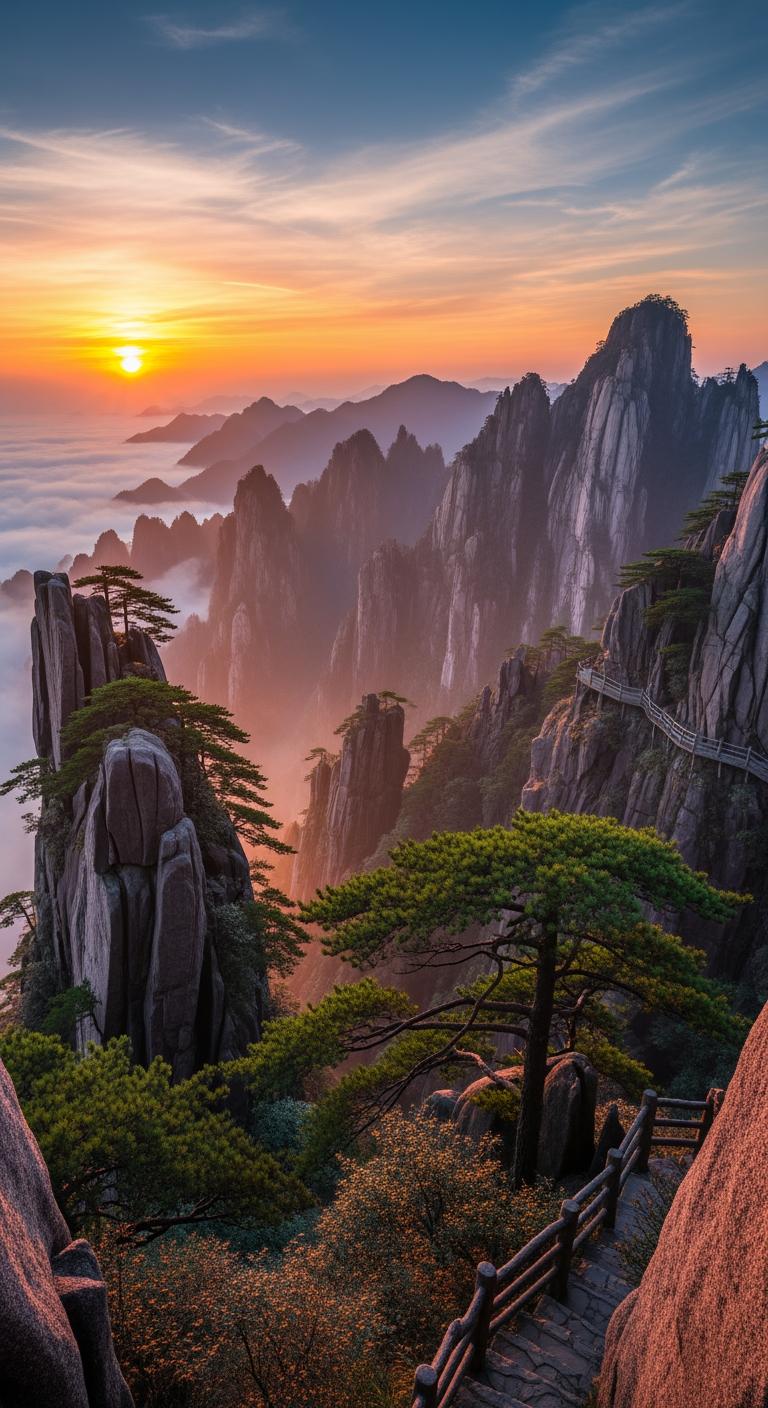
Sanqing Mountain is a UNESCO World Heritage, and it’s one of those places that feels genuinely spiritual.
Sanqing Mountain, a Taoist sanctuary and a UNESCO World Heritage Site with bizarre rock formations and panoramic cliffside trails.
The rock formations are wild—shaped by millions of years of erosion into these otherworldly pillars and shapes.
I hiked up early in the morning, and the mist made everything look like something out of a fantasy film.
There are Taoist temples scattered throughout the mountain where monks still live and practice.
The trails are well-maintained, but some sections are pretty steep with dramatic drops.
Not for anyone with a fear of heights, but the views are absolutely worth it.
In Jiangxi, there are 4 World Geoparks where you can have an amazing hiking tour including Mount Lu, Sanqing Mountain (Sanqingshan), Wugong Mountain, and Longhu Mountain.
If you love hiking and natural beauty, you could spend weeks just exploring these mountains.
Ancient Academies: Where Scholars Once Gathered

Among them, White Deer Cave Academy in Jiujiang is the most prominent and one of the top four academies in China.
These ancient academies are seriously cool if you’re into education history or traditional Chinese culture.
Jiangxi is home to several ancient academies, including the Bailudong Academy, Ehu Academy, Xiangshan Academy, and Bailuzhou Academy.
These academies educated numerous scholars in ancient times.
I visited White Deer Cave Academy, which sits in this beautiful mountain setting near Mount Lu.
Walking through the halls where famous scholars once taught and studied was humbling.
The architecture is elegant and understated, focused on creating spaces for contemplation and learning.
There are gardens, libraries, and lecture halls preserved from centuries ago.
It gave me this whole new appreciation for China’s scholarly traditions.
If you’re traveling with kids, these academies are actually great educational stops.
They’re not boring museums—they’re living history.
🗼 I Wrote a Book About My Japan Travel Catastrophes!
Before I landed in Tokyo, I thought I was the “Final Boss” of international travel. Spoiler alert: I WASN’T. 😅
🚅 I boarded the wrong Shinkansen and ended up in THE WRONG CITY. I confused locals with my “expert” bowing that was more awkward than accurate. I accidentally stumbled into a high-stakes Kendo practice thinking it was a tourist show. Sound like something you’d do?
“Things I Wish I Knew Before Going to Japan” is your shortcut to avoiding ALL my cringe-worthy mistakes. ✨ Inside, you’ll find practical, LIFE-SAVING tips on etiquette, transport, money, and hidden gems that will save you time, money, and a whole lot of confusion.
Lushan Cloud Tea: Sip the Mountain Mist

Lushan Yunwu Tea is also famous nationwide.
This tea literally translates to “Lushan Cloud and Mist Tea,” and it’s grown on the slopes of Mount Lu.
The high altitude and frequent mist create perfect conditions for tea cultivation.
I’m not usually a tea snob, but tasting this stuff fresh on the mountain completely changed my perspective.
It’s delicate, slightly sweet, with this clean finish that’s hard to describe.
Blessed by the mild climate and abundant rainfall, Jiangxi is one of the key tea-producing regions in China.
You can visit tea plantations, watch the processing, and buy directly from the growers.
I brought back several tins as gifts, and everyone loved them.
If you visit Mount Lu, don’t leave without trying the local tea.
Better yet, buy some to take home.
Every time you brew a cup, you’ll be transported back to those misty mountains.